Trematosaurus
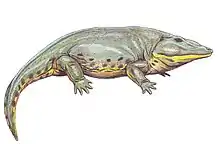
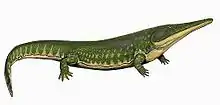
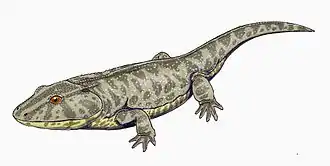
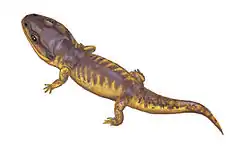
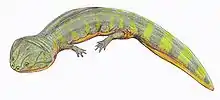
Trematosaurus is an extinct genus of temnospondyl amphibian found in Germany and Russia.[1] It was first named by Hermann Burmeister in 1849 and the type species is Trematosaurus brauni.[1]
| Trematosaurus Temporal range: Early Triassic | |
|---|---|
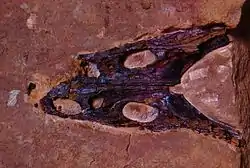 | |
| T. brauni skull | |
| Scientific classification | |
| Kingdom: | |
| Phylum: | |
| Class: | |
| Order: | |
| Superfamily: | |
| Family: | |
| Genus: | †Trematosaurus Burmeister, 1849 |
| Species | |
| |
Classification
Below is a cladogram from Steyer (2002) showing the phylogenetic relationships of trematosaurids:[2]
| Trematosauridae |
| |||||||||||||||||||||||||||||||||||||||||||||||||||||||||
Species
Valid species
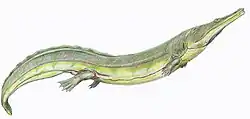
T. brauni
- The type species, Trematosaurus brauni (Burmeister, 1849) is known from the middle member of variegated sandstone in the vicinity of Bernburg, Germany.
- T. galae (Novikov, 2010) is known from fragmentary specimens found in Lower Triassic Donskaya Luka locality (Volgograd Region), Russia.
Reclassified species
- T. fuchsi (Seidlitz, 1920) is known from the same stratigraphic level of German Basin, Thuringia. It is a junior synonym of T. brauni.
- T. thuringiensis (Werneburg, 1993) is also known from Thuringia.
- T. madagascariensis (Lehman, 1966) referred by Schoch & Milner, 2000, to Tertremoides (Lehman, 1979).
- South African T. kannemeyeri (Broom, 1909), described based on a skull fragment, most likely belongs to the genus Aphaneramma or a closely related lonchorhynchine.
- Another South African species, T. sobeyi (Haughton, 1915), was assigned to its own genus Trematosuchus (Watson, 1919).
- East European trematosaurid remains referred to Trematosaurus in fact belong to the genus Inflectosaurus Shishkin, 1960 (Novikov, 2007).
References
- I. V. Novikov (2010). "New data on trematosauroid labyrinthodonts of Eastern Europe: 2. Trematosaurus galae sp. nov.: Cranial morphology". Paleontological Journal. 44 (4): 457–467. doi:10.1134/S003103011004012X.CS1 maint: uses authors parameter (link)
- Steyer, J. S. (2002). "The first articulated trematosaur 'amphibian' from the Lower Triassic of Madagascar: implications for the phylogeny of the group". Palaeontology. 45: 771–793. doi:10.1111/1475-4983.00260.
This article is issued from Wikipedia. The text is licensed under Creative Commons - Attribution - Sharealike. Additional terms may apply for the media files.