Broiliellus
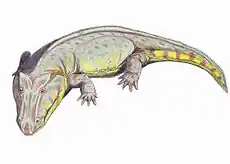
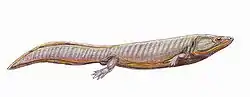
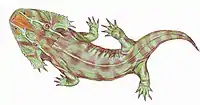
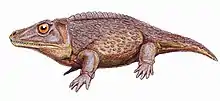
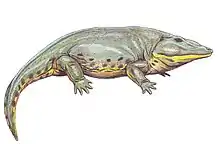
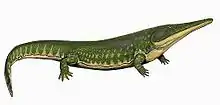
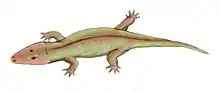
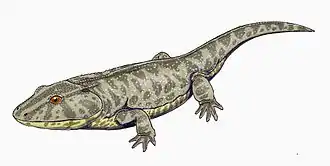
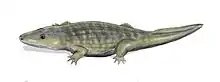
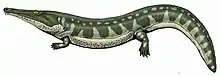
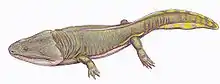
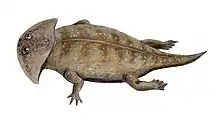
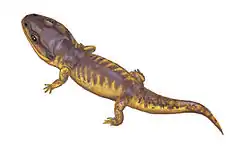
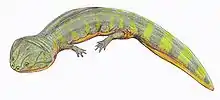
Broiliellus is an extinct genus of dissorophoid temnospondyl within the family Dissorophidae. Broiliellus is most closely related to the genus Dissorophus, and both have been placed in the subfamily Dissorophinae. Broiliellus is known from five species from the Early Permian: the type species is Broiliellus texensis, and the other species are Broiliellus brevis, Broiliellus olsoni, Broiliellus arroyoensis, and Broiliellus reiszi. An additional species, Broiliellus novomexicanus, which was originally named Aspidosaurus novomexicanus, is now thought to fall outside the genus as a member of the subfamily Eucacopinae.[1]
| Broiliellus Temporal range: Early Permian | |
|---|---|
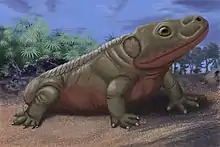 | |
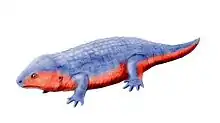
| Restoration of Broiliellus olsoni | |
Scientific classification  | |
| Kingdom: | Animalia |
| Phylum: | Chordata |
| Order: | †Temnospondyli |
| Family: | †Dissorophidae |
| Subfamily: | †Dissorophinae |
| Genus: | †Broiliellus Williston, 1914 |
| Type species | |
| †Broiliellus texensis Williston, 1914 | |
| Species | |
| |
History of study
Broiliellus was first named by American paleontologist S.W. Williston in 1914 based on two nearly complete skulls in articulation with postcranial material from the early Permian of Texas; this species was given the name Broiliellus texensis, the genus name being for the German paleontologist Ferdinand Broili, and the species name being for the geographic provenance.[2] The holotype is currently reposited in the Field Museum. A second species, Broiliellus brevis, from the Archer City bonebed in Texas was named in 1964 by Canadian paleontologist Robert Carroll; the holotype of this species is currently reposited in the Museum of Comparative Zoology.[3] Two more species were named in 1967 by American paleontologist Robert DeMar, Broiliellus olsoni and Broiliellus arroyoensis, both from Texas.[4] The most recent species to be described was Broiliellus reiszi in 2013 by Canadian paleontologist Robert Holmes and colleagues.[5]
Phylogeny
The phylogenetic analysis of Schoch (2012) found that Broiliellus was most closely related to Dissorophus. However, the three species of Broiliellus did not form their own clade, but rather a polytomy (unresolved evolutionary relationship) with Dissorophus.[1]
Holmes et al. (2013) named a new species of Broiliellus, Broiliellus reiszi.[5] They performed two phylogenetic analyses using the data matrix of Schoch (2012). This analysis yielded more resolved topology and a monophyletic Broiliellus. Below is the cladogram from that analysis:
| Dissorophoidea |
| ||||||||||||||||||||||||||||||||||||||||||||||||||||||||||||||||||||||||||||||||||||||||||||||||||||||||||||||||||||||||||||||||||||
References
- Schoch, R. R. (2012). "Character distribution and phylogeny of the dissorophid temnospondyls". Fossil Record. 15 (2): 121–137. doi:10.1002/mmng.201200010.
- Williston, S. W. (1914). "Broiliellus, a New Genus of Amphibians from the Permian of Texas". The Journal of Geology. 22 (1): 49–56. Bibcode:1914JG.....22...49W. doi:10.1086/622132. ISSN 0022-1376. JSTOR 30058879.
- Carroll, Robert L. (1964). "Early evolution of the dissorophid amphibians". Bulletin of the Museum of Comparative Zoology. 131: 163–250 – via Biodiversity Heritage Library.
- DeMar, Robert E. (1967). "Two new species of Broiliellus (Amphibians) from the Permian of Texas". Fieldiana: Geology. 16: 117–129 – via Biodiversity Heritage Library.
- Holmes, R.; Berman, D. S.; Anderson, J. S. (2013). "A new dissorophid (Temnospondyli, Dissorophoidea) from the Early Permian of New Mexico (United States)". Comptes Rendus Palevol. 12 (7–8): 419–435. doi:10.1016/j.crpv.2013.07.002.