Lydekkerinidae
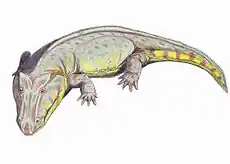
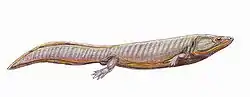
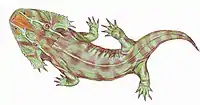
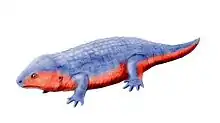
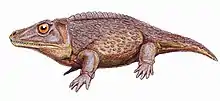
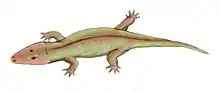
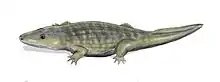
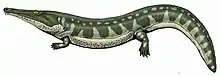
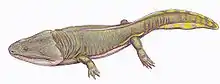
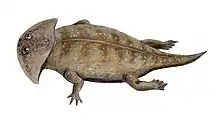
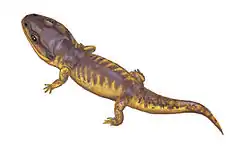
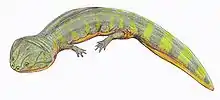
Lydekkerinidae is a family of stereospondyl temnospondyls that lived in the Triassic period. During the Triassic, lydekkerinids had a global distribution. They were small-bodied with wedge-shaped, roughly triangular heads. Fossils have been found in Russia, Greenland, India, South Africa, Madagascar, and Australia. The type genus is Lydekkerina, the namesake of the family and the most well-known lydekkerinid.
| Lydekkerinidae | |
|---|---|
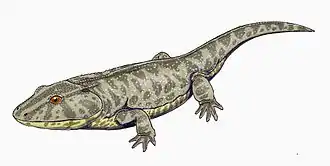 | |
| Life restoration of Lyddekerina huxleyi | |
Scientific classification  | |
| Kingdom: | Animalia |
| Phylum: | Chordata |
| Order: | †Temnospondyli |
| Suborder: | †Stereospondyli |
| Family: | †Lydekkerinidae Watson, 1919 |
| Synonyms | |
| |
Description
Lydekkerinids have a distinguishing combination of characteristics. Synapomorphies, or unique characteristics, include a step-shaped contact between the nasal and prefrontal bones, indented lateral margins of the interpterygoid vacuities (two large holes in the palate), and straight cheek margins when the skull is viewed from behind. Other characteristics include frontal bones that do not touch the rims of the eye sockets and ridges on the pterygoid bones. Sensory sulci (canals running along the surface of the skull) are present in many temnospondyls but are hardly visible on lydekkerinid skulls. The infraorbital sulcus, a canal that runs below the eyes and nostrils, has a distinctive bend along its length. Small bumps called denticles cover much of the palate.[1]
Classification
Lydekkerinids are usually classified as basal stereospondyls. Schoch and Milner (2000) placed them in the clade Rhytidostea along with brachyopoids and rhytidosteids.[2] Some phylogenetic studies of lydekkerinids have found them to be polyphyletic. These studies include the traditionally lydekkerinid taxa Lydekkerina and Luzocephalus, and sometimes Deltacephalus. Luzocephalus has been found to be more closely related to a family called Trematosauridae, while Lydekkerina remains in a basal position among stereospondyls. Yates and Warren (2000) found Lydekkerina to be a basal member of the stereospondyl clade Capitosauria, while Luzocephalus fell within a second stereospondyl clade called Trematosauria. Below is a cladogram from Yates and Warren (2000) showing the polyphyly:[3]
| Stereospondyli |
| ||||||||||||||||||||||||||||||||||||||||||||||||||||||||||||||||||||||||||||||||||||||||||||||||||||||||||||||||||
The phylogenetic analysis of Damiani (2001) resulted in a monophyletic Lydekkerinidae, although it was only weakly supported. Below is a cladogram from that analysis:[4]
| Stereospondyli |
| |||||||||||||||||||||||||||||||||||||||||||||
References
- Jeannot, A.M.; Damiani, R.; Rubidge, B.S. (2006). "Cranial anatomy of the Early Triassic stereospondyl Lydekkerina huxleyi (Tetrapoda: Temnospondyli) and the taxonomy of South African lydekkerinids". Journal of Vertebrate Paleontology. 26 (4): 822–838. doi:10.1671/0272-4634(2006)26[822:CAOTET]2.0.CO;2. ISSN 0272-4634.
- Schoch, R. R.; Milner, A. R. (2000). "Stereospondyli". In P. Wellnhofer (ed.). Handbuch der Paläoherpetologie. 3B. Munich: Verlag Dr. Friedrich Pfeil. p. 203.
- Yates, A. M.; Warren, A. A. (2000). "The phylogeny of the 'higher' temnospondyls (Vertebrata: Choanata) and its implications for the monophyly and origins of the Stereospondyli". Zoological Journal of the Linnean Society. 128: 77. doi:10.1111/j.1096-3642.2000.tb00650.x.
- Damiani, R. J. (2001). "A systematic revision and phylogenetic analysis of Triassic mastodonsauroids (Temnospondyli: Stereospondyli)". Zoological Journal of the Linnean Society. 133 (4): 379–482. doi:10.1111/j.1096-3642.2001.tb00635.x.