Rubeostratilia
Rubeostratilia is an extinct genus of amphibamiform temnospondyl from the early Permian of Texas. It is known from a single skull. This genus was named by Hélène Bourget and Jason S. Anderson in 2011, and the type species is Rubeostratilia texensis.[1] The genus name comes from the Latin translation of 'redbeds' in reference to the Texas redbeds that produced both the holotype and many other early Permian fossils. The species name is for the state of Texas. The holotype and only known specimen was collected in 1941 from the Nocona Formation exposures in Clay County by a Works Projects Administration project that was transferred to the Field Museum of Natural History through an interinstitutional exchange with the Texas Memorial Museum.
| Rubeostratilia Temporal range: Early Permian | |
|---|---|
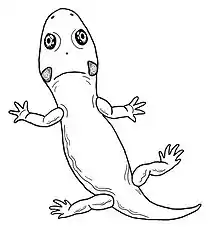 | |
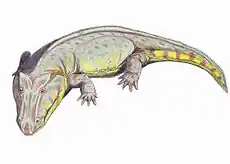
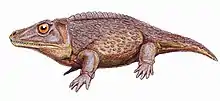
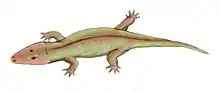
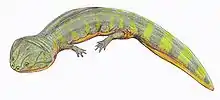
| Restoration of Rubeostratilia texensis | |
Scientific classification  | |
| Kingdom: | Animalia |
| Phylum: | Chordata |
| Order: | †Temnospondyli |
| Clade: | †Amphibamiformes |
| Genus: | †Rubeostratilia Bourget and Anderson, 2011 |
| Type species | |
| †Rubeostratilia texensis Bourget and Anderson, 2011 | |
Anatomy
Rubeostratilia is differentiated from other amphibamiforms by: (1) a pterygoid sutured only to the ectopterygoid anteriorly; and (2) the presence of four, equally sized foramina along the surface of the lacrimal that forms the anterior orbital margin. It shares a number of features with Pasawioops mayi, which at the time was known only from the Richards Spur locality in Oklahoma but which was subsequently reported from the Archer City Formation in Texas.[2]
Relationships
The relationships of Rubeostratilia are unstable, which Bourget & Anderson (2011) ascribed to the influence of both missing data and changes to a small number of character codings that produced drastically different results of amphibamiform phylogeny.
Below is the result of the parsimony analysis from Bourget & Anderson (2011) when coding for Plemmyradytes shintoni was left unchanged:
| Amphibamiformes |
| ||||||||||||||||||||||||||||||||||||||||||||||||||||||||||||
Below is the result of the analysis from Bourget & Anderson (2011) with a number of proposed coding changes:
| Amphibamiformes |
| ||||||||||||||||||||||||||||||||||||||||||||||||||||||||||||
Below is the result of the analysis from Maddin et al. (2013), derived from the matrix of Fröbisch & Reisz (2008):[3]
| Amphibamiformes |
| ||||||||||||||||||||||||||||||||||||||||||||||||||||||||||||||||||||||||
References
- Bourget, Hélène; Anderson, Jason S. (2011). "A new amphibamid (Temnospondyli: Dissorophoidea) from the Early Permian of Texas". Journal of Vertebrate Paleontology. 31 (1): 32–49. doi:10.1080/02724634.2011.539652.
- Maddin, Hillary C.; Fröbisch, Nadia B.; Evans, David C.; Milner, Andrew R. (2013). "Reappraisal of the Early Permian amphibamid Tersomius texensis and some referred material". Comptes Rendus Palevol. 12 (7–8): 447–461. doi:10.1016/j.crpv.2013.06.007.
- Fröbisch, Nadia B.; Reisz, Robert R. (2008-12-12). "A new Lower Permian amphibamid (Dissorophoidea, Temnospondyli) from the fissure fill deposits near Richards Spur, Oklahoma". Journal of Vertebrate Paleontology. 28 (4): 1015–1030. doi:10.1671/0272-4634-28.4.1015. ISSN 0272-4634.