Capitosauria
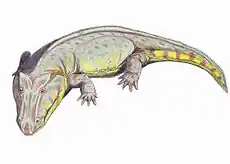
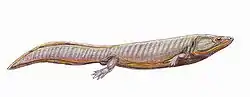
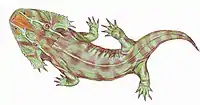
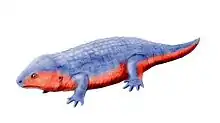
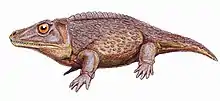
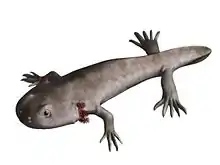
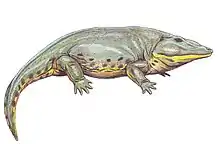
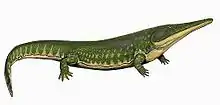
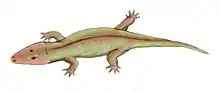
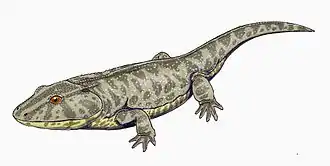
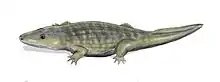
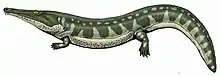
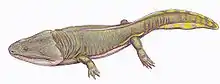
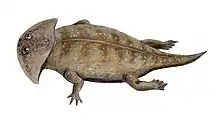
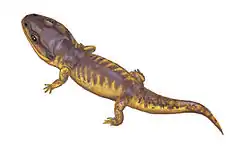
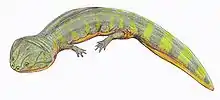
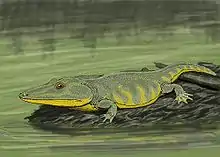
Capitosauria is an extinct group of large temnospondyl amphibians with simplified stereospondyl vertebrae. Mainly living as piscivores in lakes and rivers, the Capitosauria and its sister taxon Trematosauria were the only major labyrinthodonts that existed during the Mesozoic in ecological niches broadly similar to those of modern crocodiles, and some grew to very large sizes. At 6 meter in length, the Mid-Triassic Mastodonsaurus giganteus is not only thought to have been the largest capitosaur, but possibly also the largest amphibian to have lived.[1] The latest known remains are from the Rhaetian of Germany and are referred to Cyclotosaurus.[2]
| Capitosauria | |
|---|---|
 | |
| Mastodonsaurus | |
Scientific classification  | |
| Kingdom: | Animalia |
| Phylum: | Chordata |
| Order: | †Temnospondyli |
| Suborder: | †Stereospondyli |
| Clade: | †Capitosauria Schoch and Milner, 2000 |
| Subgroups | |
| |
Capitosauria was first named by Schoch and Milner (2000) and further described by Yates and Warren (2000), who assigned Lydekkerina and Mastodonsauroidea to it.[3][4] It was described by Damiani (2001) under the name Mastodonsauroidea.[5] In their phylogenetic analysis of temnospondyls, Ruta et al. (2007) placed Lydekkerina and its relatives within the clade Rhytidostea, while placing only mastodonsauroid taxa within Capitosauria.[6]
Phylogeny
Below is a cladogram from Fortuny et al. (2011) showing the phylogenetic relationships of capitosaurs:[7]
| Stereospondyli |
| |||||||||||||||||||||||||||||||||||||||||||||||||||||||||||||||||||||||||||||||||||||||||||||||||||||||||||||||||||||||||||||||||||||||||||||||||||
References
- "Capitosauria". Palaeos. Retrieved 18 June 2014.
- Konietzko-Meier, Dorota; Werner, Jennifer D.; Wintrich, Tanja; Martin Sander, P. (31 October 2018). "A large temnospondyl humerus from the Rhaetian (Late Triassic) of Bonenburg (Westphalia, Germany) and its implications for temnospondyl extinction". Journal of Iberian Geology. 45 (2): 287–300. doi:10.1007/s41513-018-0092-0. ISSN 1698-6180.
- Schoch, R. R.; Milner, A. R. (2000). "Stereospondyli". In P. Wellnhofer (ed.). Handbuch der Paläoherpetologie. 3B. Munich: Verlag Dr. Friedrich Pfeil. p. 203.
- Yates, A. M.; Warren, A. A. (2000). "The phylogeny of the "higher" temnospondyls (Vertebrata: Choanata) and its implications for the monophyly and origins of Stereospondyli". Zoological Journal of the Linnean Society. 128: 77–121. doi:10.1111/j.1096-3642.2000.tb00650.x.
- Damiani, R. J. (2001). "A systematic revision and phylogenetic analysis of Triassic mastodonsauroids (Temnospondyli: Stereospondyli)". Zoological Journal of the Linnean Society. 133 (4): 379–482. doi:10.1111/j.1096-3642.2001.tb00635.x.
- Ruta, M.; Pisani, D.; Lloyd, G. T.; Benton, M. J. (2007). "A supertree of Temnospondyli: cladogenetic patterns in the most species-rich group of early tetrapods". Proceedings of the Royal Society B. 274 (1629): 3087–3095. doi:10.1098/rspb.2007.1250. PMC 2293949. PMID 17925278.
- Fortuny, J.; Galobart, À.; Santisteban, C. D. (2011). "A New Capitosaur from the Middle Triassic of Spain and the Relationships within the Capitosauria". Acta Palaeontologica Polonica. 56 (3): 553. doi:10.4202/app.2010.0025.
External links