Tupuxuara
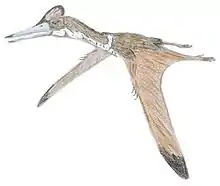
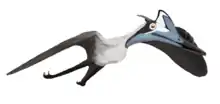
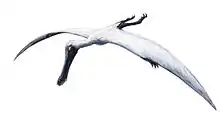
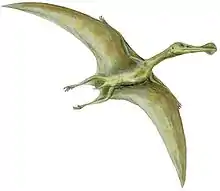
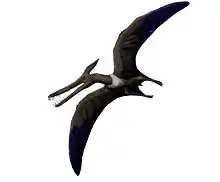
Tupuxuara is a genus of large, crested, and toothless pterodactyloid pterosaur from the Early Cretaceous period (Albian stage) of what is now the Romualdo Formation of the Santana Group, Brazil, about 112 million years ago. Tupuxuara is a close relative of Thalassodromeus, and both formed a group that is either called Thalassodromidae (if placed within the Neoazhdarchia) or Thalassodrominae (if placed within the Tapejaridae).
| Tupuxuara | |
|---|---|
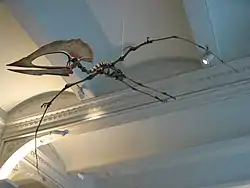 | |
| Reconstructed skeleton of T. leonardii, American Museum of Natural History | |
Scientific classification  | |
| Kingdom: | Animalia |
| Phylum: | Chordata |
| Order: | †Pterosauria |
| Suborder: | †Pterodactyloidea |
| Clade: | †Azhdarchoidea |
| Genus: | †Tupuxuara Kellner & Campos, 1988 |
| Type species | |
| †Tupuxuara longicristatus Kellner & Campos, 1988 | |
| Other species | |
| |
Discovery
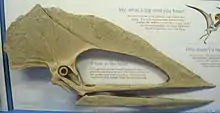
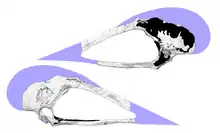
The genus was named and described by Alexander Kellner and Diógenes de Almeida Campos in 1988.[1] The type species is Tupuxuara longicristatus. The generic name refers to a familiar spirit from the mythology of the Tupi. The specific name means "long-crested" in Latin.
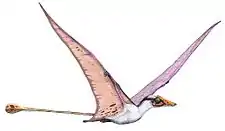
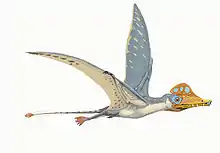
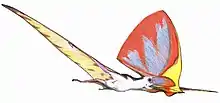
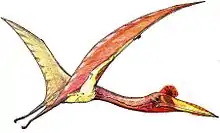
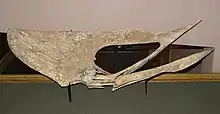
The holotype, MN 6591-V, was found in the Early Cretaceous (Albian) Santana Formation (now known as the Romualdo Formation) of Brazil. It consists of a snout and some partial wing bones. Mature individuals of T. longicristatus had a back-swept crest arising from the snout. Much more fossil material has later been found, showing considerable variation in morphology. Some researchers explain this as intra-specific variability, being caused by a difference in age or sex. Others, however, assume there are different species present.
In 1994 a second species was named by Kellner: Tupuxuara leonardii. The specific name honors Giuseppe Leonardi.[2] The holotype is MN 6592-V, a fragmentary skull with a more rounded crest. Other such material has been referred to T. leonardii. The largest skulls have a length of 130 centimeters (4.3 ft) indicating a wingspan of 5.5 meters (18 ft).
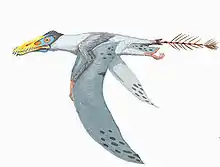
In 2009 a third species was named, by Mark Witton: Tupuxuara deliradamus. The holotype is SMNK PAL 6410, a skull. Another skull is the paratype: KPMNH DL 84. The specific name is derived from Latin delirus, "insane" or "crazy", and adamas, "invincible", but also the word from which "diamond" is derived. The species has a distinctive diamond-shaped skull opening and low eye sockets. The name is a tribute to the song "Shine On You Crazy Diamond" by Pink Floyd, one of Witton's favorite bands.[3]
Classification
Tupuxuara is a member of the group Azhdarchoidea. Kellner assigned it to the Tapejaridae within Azhdarchoidea. According to some analyses however, Tupuxuara is closer to the Azhdarchidae (the group that includes the giant Texan form Quetzalcoatlus) than to Tapejara and its relatives.

The cladogram below follows the 2011 analysis of Felipe Pinheiro and colleagues.[4]
| Azhdarchoidea |
| |||||||||||||||||||||||||||||||||||||||||||||||||||||||||||||||||||||||||||
Below is a cladogram showing the phylogenetic placement of Tupuxuara within Neoazhdarchia from Andres and Myers (2013).[5]
| Neoazhdarchia |
| |||||||||||||||||||||||||||||||||||||||||||||||||||||||||||||||||||||||||||||||||||||||||||||||||||
Paleobiology
It was once been suggested that Tupuxuara was a fish eater at the coasts of South America, while some deviant hypotheses include the possibility it was a fruit eater. However, based on its azhdarchoid affinities, it was most likely a terrestrial omnivore or carnivore. The closely related Thalassodromeus was specialized for larger prey, while both Tupuxuara species lacked such specializations.[6]
A subadult described by David Martill and Darren Naish from the University of Portsmouth in 2006 had not yet fully developed its crest, which supports the suggestion that the crest was a marker for sexual maturity.
Comparisons between the scleral rings of Tupuxuara and modern birds and reptiles suggest that it may have been diurnal.[7]
References
- Kellner, A.W.A., and Campos, D.A. (1988). "Sobre un novo pterossauro com crista sagital da Bacia do Araripe, Cretaceo Inferior do Nordeste do Brasil. (Pterosauria, Tupuxuara, Cretaceo, Brasil)." Anais da Academia Brasileira de Ciências, 60: 459–469. [in Portuguese]
- Kellner, A. W. A.; Campos, D. A. (1994). "A new species of Tupuxuara (Pterosauria, Tapejaridae) from the Early Cretaceous of Brazil". An. Acad. Bras. Ciênc. 66: 467–473.
- Witton, Mark P. (October 2009). "A new species of Tupuxuara (Thalassodromidae, Azhdarchoidea) from the Lower Cretaceous Santana Formation of Brazil, with a note on the nomenclature of Thalassodromidae". Cretaceous Research. 30 (5): 1293–1300. doi:10.1016/j.cretres.2009.07.006.
- Pinheiro, Felipe L.; Fortier, Daniel C.; Schultz, Cesar L.; De Andrade, José Artur F.G.; Bantim, Renan A.M. (September 2011). "New Information on the Pterosaur, with Comments on the Relationships of Tapejaridae". Acta Palaeontologica Polonica. 56 (3): 567–580. doi:10.4202/app.2010.0057.
- Andres, B.; Myers, T. S. (2013). "Lone Star Pterosaurs". Earth and Environmental Science Transactions of the Royal Society of Edinburgh. 103 (3–4): 383–398. doi:10.1017/S1755691013000303.
- Witton, Mark P. Pterosaurs: Natural History, Evolution, Anatomy. ISBN 9780691150611.
- Schmitz, L.; Motani, R. (2011). "Nocturnality in Dinosaurs Inferred from Scleral Ring and Orbit Morphology". Science. 332 (6030): 705–8. Bibcode:2011Sci...332..705S. doi:10.1126/science.1200043. PMID 21493820. S2CID 33253407.
External links
- BBC News, "Flying reptile mystery 'solved'", July 27, 2006