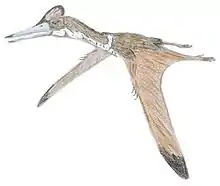
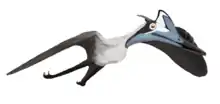
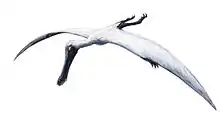
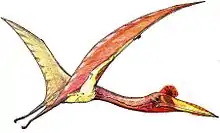
Tapejara wellnhoferi
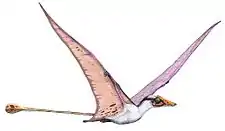
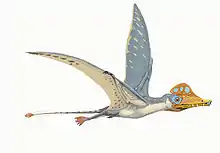
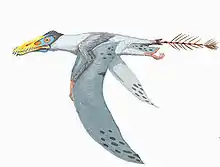
Tapejara (from a Tupi word meaning "the old being") is a genus of Brazilian pterosaur from the Cretaceous Period (Santana Formation, dating to about 112 million years ago). Tapejara crests consisted of a semicircular crest over the snout, and a bony prong which extended back behind the head.
| Tapejara | |
|---|---|
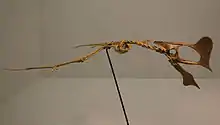 | |
| Reconstructed skeleton | |
Scientific classification  | |
| Kingdom: | Animalia |
| Phylum: | Chordata |
| Order: | †Pterosauria |
| Suborder: | †Pterodactyloidea |
| Family: | †Tapejaridae |
| Subfamily: | †Tapejarinae |
| Tribe: | †Tapejarini |
| Genus: | †Tapejara Kellner, 1989 |
| Species: | †T. wellnhoferi |
| Binomial name | |
| †Tapejara wellnhoferi Kellner, 1989 | |
Species and classification
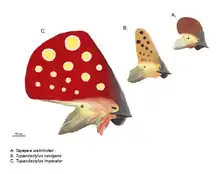
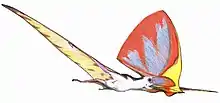
The type species and only one currently recognized as valid by most researchers, is T. wellnhoferi. The specific name honors German paleontologist Peter Wellnhofer. Two larger species, originally named Tapejara imperator and Tapejara navigans, were later classified in the genus Tapejara. However, several studies have shown that T. imperator and T. navigans are significantly different from T. wellnhoferi and therefore were reclassified into new genera. The species T. imperator was given its own genus, Tupandactylus, by Kellner and Campos.[1] Unwin and Martill found that T. imperator and T. navigans belong in the same genus, and named them Ingridia imperator and I. navigans, respectively. This genus name honored Wellnhofer's late wife Ingrid.[2]
Because Tupandactylus was named first, it retained priority over the name Ingridia. To complicate matters, both the name Tupandactylus and Ingridia used the former Tapejara imperator as their type species.[3] The scientists who described Tupandactylus did not name a Tupandactylus navigans (but instead suggested it was synonymous to Tupandactylus imperator), and Tapejara navigans was not formally reclassified as a distinct species of Tupandactylus until 2011.[4]
The cladogram below follows the 2014 analysis by Brian Andres and colleagues.[5]
| Azhdarchoidea |
| ||||||||||||||||||||||||||||||||||||||||||||||||||||||||||||||||||||||||||||||
Paleobiology
Comparisons between the scleral rings of Tapejara and modern birds and reptiles suggest that it may have been cathemeral, active throughout the day at short intervals.[6]
References
- Kellner, A.W.A.; Campos, D.A. (2007). "Short note on the ingroup relationships of the Tapejaridae (Pterosauria, Pterodactyloidea". Boletim do Museu Nacional. 75: 1–14.
- Unwin, D. M. and Martill, D. M. (2007). "Pterosaurs of the Crato Formation." In Martill, D. M., Bechly, G. and Loveridge, R. F. (eds), The Crato Fossil Beds of Brazil: Window into an Ancient World. Cambridge University Press (Cambridge), pp. 475–524.
- Naish, D. (2008). "Crato Formation fossils and the new tapejarids." Weblog entry. Tetrapod Zoology. January 18, 2008. Accessed January 31, 2008 ("Archived copy". Archived from the original on July 6, 2008. Retrieved November 15, 2008.CS1 maint: archived copy as title (link)).
- Pinheiro, Felipe L.; Fortier, Daniel C.; Schultz, Cesar L.; De Andrade, José Artur F.G.; Bantim, Renan A.M. (2011). "New information on Tupandactylus imperator, with comments on the relationships of Tapejaridae (Pterosauria)". Acta Palaeontologica Polonica. 56 (3): 567–580. doi:10.4202/app.2010.0057.
- Andres, B.; Clark, J.; Xu, X. (2014). "The earliest pterodactyloid and the origin of the group". Current Biology. 24 (9): 1011–6. doi:10.1016/j.cub.2014.03.030. PMID 24768054.
- Schmitz, L.; Motani, R. (2011). "Nocturnality in dinosaurs inferred from scleral ring and orbit morphology". Science. 332 (6030): 705–8. Bibcode:2011Sci...332..705S. doi:10.1126/science.1200043. PMID 21493820. S2CID 33253407.