Elanodactylus
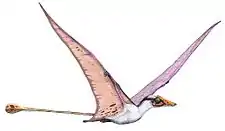
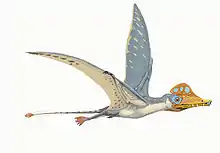
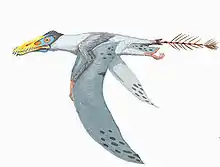
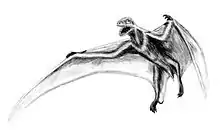
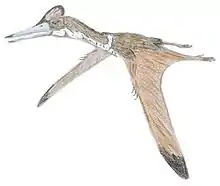
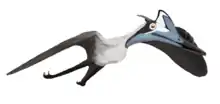
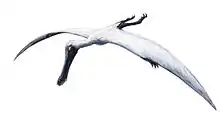
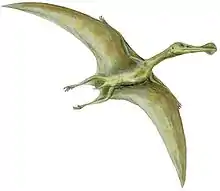
Elanodactylus (meaning "Kite finger") is a genus of ctenochasmatid pterodactyloid pterosaur from the Early Cretaceous period (early Aptian stage) of what is now the Yixian Formation of Liaoning, China.
| Elanodactylus | |
|---|---|
Scientific classification  | |
| Kingdom: | Animalia |
| Phylum: | Chordata |
| Order: | †Pterosauria |
| Suborder: | †Pterodactyloidea |
| Family: | †Ctenochasmatidae |
| Genus: | †Elanodactylus Andres & Ji, 2008 |
| Species: | †E. prolatus |
| Binomial name | |
| †Elanodactylus prolatus Andres & Ji, 2008 | |
The genus was named in 2008 by Brian Andres and Ji Qiang. The type species is Elanodactylus prolatus. The generic name is derived from the Kite genus Elanus, in reference to the long wings, and Greek daktylos, "finger", referring to the wing finger of pterosaurs. The specific name means "elongated" in Latin, in reference to the elongated middle cervical vertebrae.
It is known from a partial postcranial skeleton, holotype NGMC 99-07-1, preserving the wings, sternum, shoulder girdle, ribs, cervical and dorsal vertebrae. It represents an adult individual. In 2010, a second adult was described, specimen LPM-R00078, also a skeleton lacking the skull.[1]
The wingspan of the holotype was about 2.5 metres. That of the referred specimen was estimated at 1.7 metres.
The first phalanx of the wing finger is shorter than both the second and third phalanges, an autapomorphy.
The neck vertebrae possess exapophyses, a similarity with those of azhdarchids, long-necked giant pterosaurs most common in the Late Cretaceous. However, other skeletal material from Elanodactylus is otherwise distinct from the skeletons of azhdarchids. Andres and Ji performed a phylogenetic analysis and found that Elanodactylus was a ctenochasmatid. They postulated that ctenochasmatids and azhdarchids convergently evolved similar neck vertebrae.[2]
Classification
Below is a cladogram following a phylogenetic analysis published by paleontologists Longrich, Martill, and Andres in 2018. They recovered Elanodactylus within the family Ctenochasmatidae.[3]
| Ctenochasmatidae |
| ||||||||||||||||||||||||||||||||||||||||||||||||||||||||||||||||||
References
- Chang-Fu Zhou, 2010, “New material of Elanodactylus prolatus Andres & Ji, 2008 (Pterosauria: Pterodactyloidea) from the Early Cretaceous Yixian Formation of western Liaoning, China”, Neues Jahrbuch für Geologie und Paläontologie, Abhandlungen, 255: 277-286
- Andres, B.; Ji Q. (2008). "A new pterosaur from the Liaoning Province of China, the phylogeny of the Pterodactyloidea, and convergence in their cervical vertebrae". Palaeontology. 51 (2): 453–469. doi:10.1111/j.1475-4983.2008.00761.x.
- Longrich, N.R.; Martill, D.M.; Andres, B. (2018). "Late Maastrichtian pterosaurs from North Africa and mass extinction of Pterosauria at the Cretaceous-Paleogene boundary". PLoS Biology. 16 (3): e2001663. doi:10.1371/journal.pbio.2001663. PMC 5849296. PMID 29534059.