Azhdarchoidea
Azhdarchoidea is a group of pterosaurs within the suborder Pterodactyloidea, more specifically within the group Ornithocheiroidea.
| Azhdarchoids | |
|---|---|
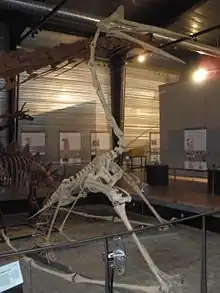 | |
| Reconstructed skeleton of Quetzalcoatlus northropi | |
Scientific classification  | |
| Kingdom: | Animalia |
| Phylum: | Chordata |
| Order: | †Pterosauria |
| Suborder: | †Pterodactyloidea |
| Clade: | †Ornithocheiroidea |
| Clade: | †Azhdarchoidea Nesov, 1984 |
| Subgroups | |
| |
| Synonyms | |
| |
Classification
Azhdarchoidea was given a phylogenetic definition by David Unwin in 2003. Unwin defined the group as the most recent common ancestor of Quetzalcoatlus and Tapejara, and all its descendants.[2]
There have been several competing views of azhdarchoid relationships. The first, presented by Felipe Pinheiro and colleagues in 2011, considered the tapejarids to be a monophyletic clade including the thalassodromines and chaoyangopterines.[3] The second, found by Naish & Martill (2006), as well as Lü et al. (2008), considered the traditional "tapejarids" to be a paraphyletic grade of primitive azhdarchoids. with true tapejarids most basal, and the thalassodromines (alternatively called thalassodromids) and chaoyangopterids being successively more closely related to azhdarchids.[4] All azhdarchoids which are part of the clade formed by Quetzalcoatlus and Tupuxuara are included in the group Neoazhdarchia ("new azhdarchids") as defined by Unwin in 2003.[2]
In 1996, Alexander Kellner created a different clade called Tapejaroidea, which he defined as the most recent common ancestor and all descendants of Tapejara, Quetzalcoatlus, and Dsungaripterus. Kellner created this clade to include both Azhdarchoidea and the family Dsungaripteridae but as separate groups.[5][6] A lot of recent studies have followed this concept.[7][8][9][10]
There are competing theories of azhdarchoid phylogeny. Below is a cladogram showing the results of a phylogenetic analysis presented by Andres and colleague in 2014. This study found the a grouping of tapejarids at the base of the clade, with thalassodromines more closely related to azhdarchids and chaoyangopterids, as well as dsungaripterids. Their cladogram is shown below.[11]
| Azhdarchoidea |
| ||||||||||||||||||||||||||||||||||||||||||||||||||||||||||||||||||||||||||||||||||||||||||||||||||||||||||||||||||||||||
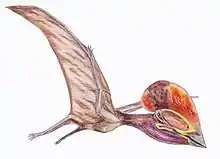
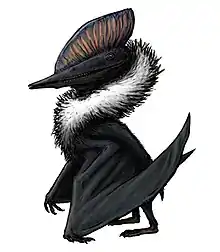
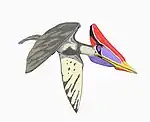
The result of a more recent phylogenetic analysis, by Kellner and colleagues in 2019, had recovered Azhdarchoidea within the larger group Tapejaroidea. Unlike the analysis by Andres and colleagues, Kellner and colleagues had found Azhdarchoidea to only consist of three groups: Azhdarchidae, Chaoyangopteridae, and Tapejaromorpha. Their cladogram is shown below.[10]
| Tapejaroidea |
| ||||||||||||||||||||||||||||||||||||||||||||||||||||||||||||||||||||||||||||||||||||||||||||||||||||||
References
- Unwin, David M.; Heinrich, Wolf-Dieter (1999). "On a pterosaur jaw from the Upper Jurassic of Tendaguru (Tanzania)". Mitteilungen aus dem Museum für Naturkunde in Berlin, Geowissenschaftliche Reihe. 2: 121–134.
- Unwin, D. M., (2003). "On the phylogeny and evolutionary history of pterosaurs." Pp. 139-190. in Buffetaut, E. & Mazin, J.-M., (eds.) (2003). Evolution and Palaeobiology of Pterosaurs. Geological Society of London, Special Publications 217, London, 1-347.
- Pinheiro, F.L., Fortier, D.C., Schultz, C.L., De Andrade, J.A.F.G. and Bantim, R.A.M. (in press). "New information on Tupandactylus imperator, with comments on the relationships of Tapejaridae (Pterosauria)." Acta Palaeontologica Polonica, in press, available online 03 Jan 2011. doi:10.4202/app.2010.0057
- Lü, J.; Unwin, D.M.; Xu, L.; Zhang, X. (2008). "A new azhdarchoid pterosaur from the Lower Cretaceous of China and its implications for pterosaur phylogeny and evolution". Naturwissenschaften. 95 (9): 891–897. doi:10.1007/s00114-008-0397-5. PMID 18509616.
- Kellner, A.W.A. (1996). "Description of new material of Tapejaridae and Anhangueridae (Pterosauria, Pterodactyloidea) and discussion of pterosaur phylogeny". Columbia University.
- Buffetaut, Eric; Mazin, Jean-Michel (2003). Evolution and Palaeobiology of pterosaurs. Geological Society of London. ISBN 9781862391437.
- Vidovic, S. U.; Martill, D. M. (2014). "Pterodactylus scolopaciceps Meyer, 1860 (Pterosauria, Pterodactyloidea) from the Upper Jurassic of Bavaria, Germany: The Problem of Cryptic Pterosaur Taxa in Early Ontogeny". PLoS ONE. 9 (10): e110646. doi:10.1371/journal.pone.0110646. PMC 4206445. PMID 25337830.
- Borja Holgado, Rodrigo V. Pêgas, José Ignacio Canudo, Josep Fortuny, Taissa Rodrigues, Julio Company & Alexander W.A. Kellner, 2019, "On a new crested pterodactyloid from the Early Cretaceous of the Iberian Peninsula and the radiation of the clade Anhangueria", Scientific Reports 9: 4940 doi:10.1038/s41598-019-41280-4
- Kellner, Alexander W. A.; Caldwell, Michael W.; Holgado, Borja; Vecchia, Fabio M. Dalla; Nohra, Roy; Sayão, Juliana M.; Currie, Philip J. (2019). "First complete pterosaur from the Afro-Arabian continent: insight into pterodactyloid diversity". Scientific Reports. 9 (1). doi:10.1038/s41598-019-54042-z.
- Kellner, Alexander W. A.; Weinschütz, Luiz C.; Holgado, Borja; Bantim, Renan A. M.; Sayão, Juliana M. (19 August 2019). "A new toothless pterosaur (Pterodactyloidea) from Southern Brazil with insights into the paleoecology of a Cretaceous desert". Anais da Academia Brasileira de Ciências. 91 (suppl 2): e20190768. doi:10.1590/0001-3765201920190768. ISSN 0001-3765. PMID 31432888.
- Andres, B.; Clark, J.; Xu, X. (2014). "The Earliest Pterodactyloid and the Origin of the Group". Current Biology. 24 (9): 1011–6. doi:10.1016/j.cub.2014.03.030. PMID 24768054.