Talenkauen
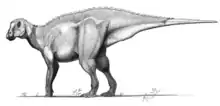
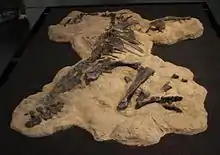
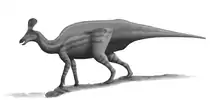
Talenkauen (meaning "small skull" in Aonikenk, referring to the proportionally small skull) is a genus of basal iguanodont dinosaur from the Campanian and Maastrichtian ages[1] of the Late Cretaceous Cerro Fortaleza Formation, formerly known as the Pari Aike Formation of Patagonian Lake Viedma, in the Austral Basin of Santa Cruz, Argentina. It is based on MPM-10001, a partial articulated skeleton missing the rear part of the skull, the tail, and the hands. Its most unusual feature is the presence of several thin mineralized plates along the sides of the ribs.[2]
| Talenkauen | |
|---|---|
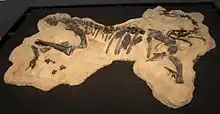 | |
| Holotype MPM-10001 | |
Scientific classification  | |
| Kingdom: | Animalia |
| Phylum: | Chordata |
| Clade: | Dinosauria |
| Order: | †Ornithischia |
| Clade: | †Neornithischia |
| Clade: | †Elasmaria |
| Genus: | †Talenkauen Novas et al. 2004 |
| Species: | †T. santacrucensis |
| Binomial name | |
| †Talenkauen santacrucensis Novas et al. 2004 | |
Description
Talenkauen was rather like Dryosaurus in shape and build, but with a proportionally longer neck. The full length of the body is estimated at no more than 4 meters (13 feet). Unlike more derived iguanodontians, it still had teeth in the tip of the beak (premaxillary teeth), and a first toe. More derived iguanodonts lose this toe, retaining only the three middle toes. The humerus has reduced areas for muscle attachment, a featured shared with other South American ornithopods like Notohypsilophodon and Anabisetia. This and other similarities to South American ornithopods suggests that there may have been a distinct Southern Hemisphere ornithopod group, but at the time the authors cautioned that such an interpretation was not entirely justified. In 2015, the describers of Morrosaurus found that such a clade did indeed exist.[3]
Mineralized plates
Talenkauen's most distinct feature is a set of smooth, ovoid plates found along the side of the rib cage. These plates can be long (180 millimeters, or 7.1 in), but are very thin (only 3 millimeters thick [0.1 in]). They were present with at least the first eight ribs, attaching along the middle portion of a rib and lying flat.[2] Several other dinosaurs are known to have had similar plates, including Hypsilophodon, Nanosaurus, Parksosaurus, Thescelosaurus,[4] and Macrogryphosaurus (also from Argentina, but from somewhat older rocks), which may have been related.[5] Because of the fragility of the plates, and the fact that they may not have always turned to bone in the living animal, they may have been more widespread than currently known. Novas and colleagues suggested that the plates may be homologous to uncinate processes, strip-like bony projections found on the ribs of a variety of animals including the tuatara, crocodiles, birds, and some maniraptoran theropod dinosaurs. In birds, uncinate processes help to ventilate the lungs, working with rib cage muscles, and Novas and colleagues proposed a similar function for the plates of Talenkauen.[2] This homology was rejected in a more recent study by Richard Butler and Peter Galton because of the plates' form.[4] The plates were too thin and limited in location to have been very useful as defensive devices.[2]
Classification
Through cladistic analysis, it was found to be more basal than Dryosaurus and Anabisetia, but more derived than Tenontosaurus and Gasparinisaura.[2] More recently, the describers of Macrogryphosaurus found their genus and Talenkauen to be related, and coined the clade Elasmaria for the two genera.[5] In 2015, several other Patagonian and Antarctic ornithopods were also found to be related.[3]
Cladogram based in the phylogenetic analysis of Rozadilla et al., 2015:
| |||||||||||||||||||||||||||||||||||||||||||||||||||||||||||||||||||
The cladogram below results from analysis by Herne et al., 2019, which placed Talenkauen as the most basal member of Elasmaria.[6]
| Ornithischia |
| ||||||||||||||||||||||||||||||||||||||||||||||||||||||||||||||||||||||||||||||||||||||||||||||||||||||||||||||||||||||||||||||||||||||||||||||||||||||||||||||||||||||||
Palaeoecology
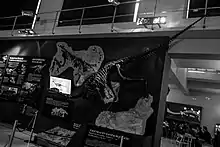
Talenkauen, as a basal iguanodont, would have been a small, bipedal herbivore.[7] Other dinosaurs from the Pari Aike Formation include the giant titanosaurid Puertasaurus[8] and the predatory neovenatorid Orkoraptor.[9]
References
- Sickmann, Zachary T.; Schwartz, Theresa M.; Graham, Stephan A. (2018). "Refining stratigraphy and tectonic history using detrital zircon maximum depositional age: an example from the Cerro Fortaleza Formation, Austral Basin, southern Patagonia". Basin Research. 30 (4): 708–729. doi:10.1111/bre.12272.
- Novas, Fernando E.; Cambiaso, Andrea V; Ambrioso, Alfredo (2004). "A new basal iguanodontian (Dinosauria, Ornithischia) from the Upper Cretaceous of Patagonia". Ameghiniana. 41 (1): 75–82.
- Rozadilla, Sebastián (2016). "A new ornithopod (Dinosauria, Ornithischia) from the Upper Cretaceous of Antarctica and its palaeobiogeographical implications". Cretaceous Research. 57: 311–324. doi:10.1016/j.cretres.2015.09.009.
- Butler, Richard J.; Galton, Peter M. (2008). "The 'dermal armour' of the ornithopod dinosaur Hypsilophodon from the Wealden (Early Cretaceous: Barremian) of the Isle of Wight: a reappraisal". Cretaceous Research. 29 (4): 636–642. doi:10.1016/j.cretres.2008.02.002.
- Calvo, J.O.; Porfiri, J.D.; Novas, F.E. (2007). "Discovery of a new ornithopod dinosaur from the Portezuelo Formation (Upper Cretaceous), Neuquén, Patagonia, Argentina". Arquivos do Museu Nacional. 65 (4): 471–483.
- Herne, Matthew C.; Nair, Jay P.; Evans, Alistair R.; Tait, Alan M. (2019). "New small-bodied ornithopods (Dinosauria, Neornithischia) from the Early Cretaceous Wonthaggi Formation (Strzelecki Group) of the Australian-Antarctic rift system, with revision of Qantassaurus intrepidus Rich and Vickers-Rich, 1999". Journal of Paleontology. doi:10.1017/jpa.2018.95.
- Norman, David B. (2004). "Basal Iguanodontia". In Weishampel, D.B.; Dodson, P.; Osmólska, H. (eds.). The Dinosauria (2nd ed.). Berkeley: University of California Press. pp. 413–437. ISBN 978-0-520-24209-8.
- Novas, Fernando E.; Salgado, Leonardo; Calvo, Jorge; Agnolin, Federico (2005). "Giant titanosaur (Dinosauria, Sauropoda)from the Late Cretaceous of Patagonia" (PDF). Revista del Museo Argentino de Ciencias Naturales. N.S. 7 (1): 37–41. doi:10.22179/REVMACN.7.344. Archived from the original (PDF) on 2006-08-22. Retrieved 2007-03-04.
- Novas, F.E.; Ezcurra, M.D.; Lecuona, A. (2008). "Orkoraptor burkei nov gen. et sp., a large theropod from the Maastrichtian Pari Aike Formation, Southern Patagonia, Argentina". Cretaceous Research. 29 (3): 468–480. doi:10.1016/j.cretres.2008.01.001.
External links
- National Geographic news release on Talenkauen; the National Geographic Society was one of the supporters of the research on this dinosaur.
| |||||||||||||||||||||||||||||||||||||||||||||||||
| |||||||||||||||||||||||||||||||||||||||||||||||||
| |||||||||||||||||||||||||||||||||||||||||||||||||
| |||||||||||||||||||||||||||||||||||||||||||||||||
.jpg.webp)