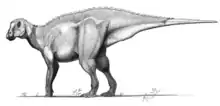
Galleonosaurus
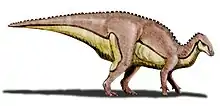
Galleonosaurus (meaning "galleon lizard" as the upper jaw bone resembles an upturned galleon) is a genus of basal ornithopod dinosaur from the Wonthaggi Formation of the Gippsland region of Victoria, Australia. The type and only species is Galleonosaurus dorisae.[1]
| Galleonosaurus | |
|---|---|
Scientific classification  | |
| Kingdom: | Animalia |
| Phylum: | Chordata |
| Clade: | Dinosauria |
| Order: | †Ornithischia |
| Suborder: | †Ornithopoda |
| Genus: | †Galleonosaurus Herne et al., 2019 |
| Type species | |
| †Galleonosaurus dorisae Herne et al., 2019 | |
Discovery and naming
Galleonosaurus dorisae was described by Matthew C. Herne, Jay P. Nair, Alistair R. Evans and Alan M. Tait in 2019.[1]
The holotype specimen is NMV P229196, a complete left maxilla with partial dentition. Other specimens referred to Galleonosaurus include NMV P212845, a partial left maxilla lacking erupted dentition; NMV P208178, a partial left maxilla with erupted dentition; NMV P208113, a worn right maxillary tooth; NMV P208523, worn left maxillary tooth; and NMV P209977, partial left maxilla, lacking erupted dentition and NMV P186440, a posterior portion of left maxilla, left palatine, and fragment of left lacrimal. All specimens were collected from the Flat Rocks locality.[1]
The generic name is derived from "galleon" (a type of large sailing ship) and "saurus" (New Latin from the Greek sauros for lizard), in reference to the appearance of the maxilla to the upturned hull of a galleon. The specific name dorisae was given in recognition of Doris Seegets-Villiers for her geological, palynological, and taphonomic work on the Flat Rocks fossil vertebrate locality.[1]
Description
Galleonosaurus was a small-bodied non-iguanodontian ornithopod. It is characterized by five potential autapomorphies: ascending ramus of maxilla has two slot-like foramina on the anterior margin that communicate with the neurovascular tract; neurovascular tract bifurcates internally to exit at two anteroventral maxillary foramina; lingual margin of maxillary tooth roots in midregion of tooth row form an S-bend at their bases; posterior third of maxilla on some, but not all, specimens deflects posterolaterally at an abrupt kink; and lateral end of palatine lateral ramus forms a hatchet-shaped flange.[1]
Phylogeny
The cladogram below results from analysis by Herne et al., 2019.[1]
| Ornithischia |
| ||||||||||||||||||||||||||||||||||||||||||||||||||||||||||||||||||||||||||||||||||||||||||||||||||||||||||||||||||||||||||||||||||||||||||||||||||||||||||||||||||||||||
References
- Herne, Matthew C.; Nair, Jay P.; Evans, Alistair R.; Tait, Alan M. (2019). "New small-bodied ornithopods (Dinosauria, Neornithischia) from the Early Cretaceous Wonthaggi Formation (Strzelecki Group) of the Australian-Antarctic rift system, with revision of Qantassaurus intrepidus Rich and Vickers-Rich, 1999". Journal of Paleontology. doi:10.1017/jpa.2018.95.
| |||||||||||||||||||||||||||||||||||||||||||||||||
| |||||||||||||||||||||||||||||||||||||||||||||||||
| |||||||||||||||||||||||||||||||||||||||||||||||||
| |||||||||||||||||||||||||||||||||||||||||||||||||
.jpg.webp)