Atlantogenata
Atlantogenata is a proposed clade of mammals containing the cohorts or superorders Xenarthra and Afrotheria. These groups originated and radiated in the South American and African continents, respectively, presumably in the Cretaceous. Together with Boreoeutheria, they make up Eutheria. The monophyly of this grouping was supported by some genetic evidence.[1][2]
| Atlantogenata Temporal range: Paleocene - Recent | |
|---|---|
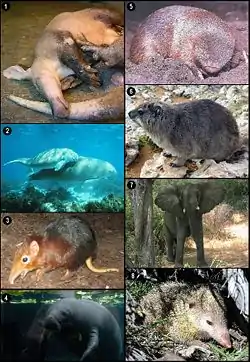 | |
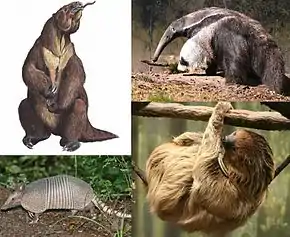 | |
Scientific classification  | |
| Kingdom: | Animalia |
| Phylum: | Chordata |
| Class: | Mammalia |
| Clade: | Eutheria |
| Clade: | Atlantogenata |
| Superorders and orders | |
|
| |
Alternative hypotheses are that Boreoeutheria and Afrotheria combine to form Epitheria (as generally supported by anatomical and other physiological evidence) or that Boreoeutheria and Xenarthra combine to form Exafroplacentalia or Notolegia.[3]
Updated analysis of transposable element insertions around the time of divergence strongly supports the fourth hypothesis of a near-concomitant origin (trifurcation) of the three superorders of mammals: Afrotheria, Boreoeutheria, and Xenarthra.[4][5]
| Eutheria |
| ||||||||||||||||||
Below shows the phylogeny of the extant atlantogenate families.
References
- Waddell, Peter J.; Okada, Norohiro; Hasegawa, Masami (1999). "Towards Resolving the Interordinal Relationships of Placental Mammals". Systematic Biology. 48 (1): 1–5. doi:10.1093/sysbio/48.1.1. PMID 12078634.
- Murphy, W.J.; Pringle, T.H.; Crider, T.A.; Springer, M.S.; Miller, W. (2007). "Using genomic data to unravel the root of the placental mammal phylogeny". Genome Research. 17 (4): 413–421. doi:10.1101/gr.5918807. PMC 1832088. PMID 17322288.
- Wildman, Derek E.; Chen, Caoyi; Erez, Offer; Grossman, Lawrence I.; Goodman, Morris; Romero, Roberto (2006). "Evolution of the mammalian placenta revealed by phylogenetic analysis". Proceedings of the National Academy of Sciences. 103 (9): 3203–3208. Bibcode:2006PNAS..103.3203W. doi:10.1073/pnas.0511344103. PMC 1413940. PMID 16492730.
- Nishihara, H.; Maruyama, S.; Okada, N. (2009). "Retroposon analysis and recent geological data suggest near-simultaneous divergence of the three superorders of mammals". Proceedings of the National Academy of Sciences. 106 (13): 5235–40. Bibcode:2009PNAS..106.5235N. doi:10.1073/pnas.0809297106. PMC 2655268. PMID 19286970.
- Churakov, G.; Kriegs, J. O.; Baertsch, R.; Zemann, A.; Brosius, J. R.; Schmitz, J. R. (2009). "Mosaic retroposon insertion patterns in placental mammals". Genome Research. 19 (5): 868–875. doi:10.1101/gr.090647.108. PMC 2675975. PMID 19261842.
Further reading
- Nikolaev, Sergey; Montoya-Burgos, Juan I.; Margulies, Elliott H.; NISC Comparative Sequencing Program; Rougemont, Jacques; Nyffeler, Bruno; Antonarakis, Stylianos E. (2007). "Early History of Mammals is Elucidated with the ENCODE Multiple Species Sequencing Data". PLoS Genetics. 3 (1): e2. doi:10.1371/journal.pgen.0030002. PMC 1761045. PMID 17206863.
- Springer, Mark S.; Murphy, William J.; Eizirik, Eduardo; O'Brien, Stephen J. (2003). "Placental mammal diversification and the Cretaceous–Tertiary boundary". Proceedings of the National Academy of Sciences. 100 (3): 1056–1061. Bibcode:2003PNAS..100.1056S. doi:10.1073/pnas.0334222100. PMC 298725. PMID 12552136.
- Waddell, Peter J.; Kishino, Hirohisa; Ota, Rissa (2001). "A phylogenetic foundation for comparative mammalian genomics". Genome Informatics. 12: 141–154. PMID 11791233.
- Wildman, Derek E.; Chen, Caoyi; Erez, Offer; Grossman, Lawrence I.; Goodman, Morris; Romero, Roberto (2006). "Evolution of the mammalian placenta revealed by phylogenetic analysis". Proceedings of the National Academy of Sciences. 103 (9): 3203–3208. Bibcode:2006PNAS..103.3203W. doi:10.1073/pnas.0511344103. PMC 1413940. PMID 16492730.