Australidelphia
Australidelphia is the superorder that contains roughly three-quarters of all marsupials, including all those native to Australasia and a single species[lower-roman 1] from South America. All other American marsupials are members of the Ameridelphia. Analysis of retrotransposon insertion sites in the nuclear DNA of a variety of marsupials has shown that the South American monito del monte's lineage is the most basal of the superorder.[1][2]
| Australidelphia Temporal range: Late Paleocene to present | |
|---|---|
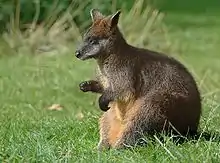 | |
| A swamp wallaby | |
Scientific classification  | |
| Kingdom: | Animalia |
| Phylum: | Chordata |
| Class: | Mammalia |
| Infraclass: | Marsupialia |
| Superorder: | Australidelphia |
| Orders | |
The Australian australidelphians form a clade, for which the name Euaustralidelphia ("true Australidelphia") has been proposed (the branching order within this group is yet to be determined).[2] The study also showed that the most basal of all marsupial orders are the other two South American groups (Didelphimorphia and Paucituberculata, with the former probably branching first). This indicates that Australidelphia arose in South America along with the other major divisions of extant marsupials, and likely reached Australia via Antarctica in a single dispersal event after Microbiotheria split off.[1][2]
Phylogeny
Phylogeny of living Australidelphia based on the work of May-Collado, Kilpatrick & Agnarsson 2015[3] with extinct clades from Black et al. 2012[4]
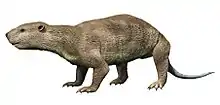
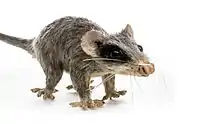
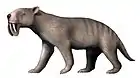
| Australidelphia |
| |||||||||||||||||||||||||||||||||||||||||||||||||||||||||||||||||||||||||||||||||||||||||||||||||||||||||||||||||||||||||||||||||||||||||||||||||||||||||||||||||||||||||||||||||||||||
Taxonomy
The orders within this group are listed below:
- Genera †Djarthia Godthelp, Wroe & Archer 1999
- Order †Yalkaparidontia Archer, Hand & Godthelp 1988
- Family †Yalkaparidontidae Archer, Hand & Godthelp 1988
- ?Order Microbiotheria (1 species)
- ?Family Microbiotheriidae: monito del monte
- Order Dasyuromorphia (71 species)
- Family †Thylacinidae: thylacine
- Family Dasyuridae: antechinuses, quolls, dunnarts, Tasmanian devil, and allies
- Family Myrmecobiidae: numbat
- Order Peramelemorphia (21 species)
- Family Thylacomyidae: bilbies
- Family †Chaeropodidae: pig-footed bandicoots
- Family Peramelidae: bandicoots and allies
- Order Notoryctemorphia (2 species)
- Family Notoryctidae: marsupial moles
- Order Diprotodontia (117 species)
- Family Phascolarctidae: koala
- Family Vombatidae: wombats
- Family Phalangeridae: brushtail possums and cuscuses
- Family Burramyidae: pygmy possums
- Family Tarsipedidae: honey possum
- Family Petauridae: striped possum, Leadbeater's possum, yellow-bellied glider, sugar glider, mahogany glider, squirrel glider
- Family Pseudocheiridae: ringtailed possums and allies
- Family Potoridae: potoroos, rat kangaroos, bettongs
- Family Acrobatidae: feathertail glider and feather-tailed possum
- Family Hypsiprymnodontidae: musky rat-kangaroo
- Family Macropodidae: kangaroos, wallabies, and allies
Footnotes
- The monito del monte or colocolo opossum, Dromiciops gliroides
References
- Schiewe, Jessie (2010-07-28). "Australia's marsupials originated in what is now South America, study says". LATimes.com. Los Angeles Times. Archived from the original on 1 August 2010. Retrieved 2010-08-01.
- Nilsson, M. A.; Churakov, G.; Sommer, M.; Van Tran, N.; Zemann, A.; Brosius, J.; Schmitz, J. (2010-07-27). Penny, David (ed.). "Tracking Marsupial Evolution Using Archaic Genomic Retroposon Insertions". PLOS Biology. 8 (7): e1000436. doi:10.1371/journal.pbio.1000436. PMC 2910653. PMID 20668664.
- May-Collado; et al. (2015). "Mammals from 'down under': a multi-gene species-level phylogeny of marsupial mammals (Mammalia, Metatheria)". PeerJ. 3 (e805): e805. doi:10.7717/peerj.805. PMC 4349131. PMID 25755933.
- Black; et al. (2012). "The Rise of Australian Marsupials: A Synopsis of Biostratigraphic, Phylogenetic, Palaeoecologic and Palaeobiogeographic Understanding". Earth and Life. Springer Netherlands. pp. 983–1078. doi:10.1007/978-90-481-3428-1_35. ISBN 9789048134274.
| |||||||||||||||||||||||||||||||||||||||||||||||||
| |||||||||||||||||||||||||||||||||||||||||||||||||
| |||||||||||||||||||||||||||||||||||||||||||||||||
| |||||||||||||||||||||||||||||||||||||||||||||||||