Alphadon
Alphadon (meaning "first tooth") was a genus of small, primitive mammal that was a member of the metatherians, a group of mammals that includes modern-day marsupials. Its fossils were first discovered in Henan, China,[2] and named by George Gaylord Simpson in 1929.[1]
| Alphadon | |
|---|---|
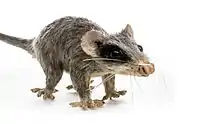 | |
| Reconstruction of Alphadon sp. | |
Scientific classification  | |
| Kingdom: | Animalia |
| Phylum: | Chordata |
| Class: | Mammalia |
| Family: | †Alphadontidae |
| Genus: | †Alphadon Simpson, 1927 |
| Species[1] | |
Description
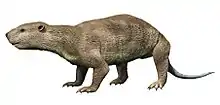
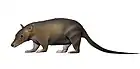
Not much is known about the appearance of Alphadon, as it is only known from teeth, a lower jaw and skull fragments. It probably grew to about 12 in (30 cm) and may have resembled a modern opossum.[3] Judging from its teeth, it was likely an omnivore, feeding on fruits, invertebrates and possibly small vertebrates. Alphadon had a very good sense of smell and sight to track down its food, both during the day and night. Its possible whiskers could have also aided in its forge for food.[4][3]
Taxonomy and classification
The Alphadon's classified type is the Alphadon marshi. Eight other species are known.[1]
The species Alphadon jasoni was originally described by Storer (1991);[5] it was subsequently transferred to the herpetotheriid genus Nortedelphys.[6]
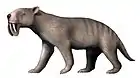
Recent phylogenetic studies group it with other northern non-marsupial metatherians such as Albertatherium and Turgidodon.[7][8] A 2016 phylogenetic analysis is shown below.[9]
| Marsupialiformes |
| ||||||||||||||||||||||||||||||||||||||||||||||||||||||||||||||||||||||||||||||||||||||||||||||||
References
- Haaramo, Mikko (August 2003). "Alphadontidae". Mikko's Phylogeny Archive.
- S. Bi, X. Jin, S. Li and T. Du. 2015. A new Cretaceous metatherian mammal from Henan, China. PeerJ 3:e896
- Jehle, Martin (August 2005). "Marsupials: A southern success story". Paleocene mammals of the world.
- Montellano, Marisol (1988). "Alphadon halleyi (Didelphidae, Marsupialia) from the Two Medicine Formation (Late Cretaceous, Judithian) of Montana". Journal of Vertebrate Paleontology. 8 (4): 378–382. doi:10.1080/02724634.1988.10011726.
- Storer, J.E. (1991). The mammals of the Gryde local fauna, Frenchman Formation (Maastrichtian: Lancian), Saskatchewan. Journal of Vertebrate Paleontology, vol. 11, no. 3, p. 350-396.
- Thomas E. Williamson; Stephen L. Brusatte; Thomas D. Carr; Anne Weil; Barbara R. Standhardt (2012). "The phylogeny and evolution of Cretaceous–Palaeogene metatherians: cladistic analysis and description of new early Palaeocene specimens from the Nacimiento Formation, New Mexico". Journal of Systematic Palaeontology. 10 (4): 625–651. doi:10.1080/14772019.2011.631592.
- Guillermo W. Rougier; Brian M. Davis; Michael J. Novacek (2015). "A deltatheroidan mammal from the Upper Cretaceous Baynshiree Formation, eastern Mongolia". Cretaceous Research. 52, Part A: 167–177. doi:10.1016/j.cretres.2014.09.009.
- S. Bi, X. Jin, S. Li and T. Du. 2015. A new Cretaceous metatherian mammal from Henan, China. PeerJ 3:e896
- Wilson, G.P.; Ekdale, E.G.; Hoganson, J.W.; Calede, J.J.; Linden, A.V. (2016). "A large carnivorous mammal from the Late Cretaceous and the North American origin of marsupials". Nature Communications. 7: 13734. doi:10.1038/ncomms13734. PMC 5155139. PMID 27929063.
| |||||||||||||||||||||||||||||||||||||||||||||||||
| |||||||||||||||||||||||||||||||||||||||||||||||||
| |||||||||||||||||||||||||||||||||||||||||||||||||
| |||||||||||||||||||||||||||||||||||||||||||||||||