Exafroplacentalia
Exafroplacentalia or Notolegia is a clade of placental mammals proposed in 2001 on the basis of molecular research.[1][2]
| Exafroplacentalia | |
|---|---|
 | |
 | |
Scientific classification  | |
| Kingdom: | Animalia |
| Phylum: | Chordata |
| Class: | Mammalia |
| Infraclass: | Placentalia |
| Clade: | Exafroplacentalia Waddell et al, 2001 |
| Orders and Clades | |
|
Magnorder Boreoeutheria:
| |
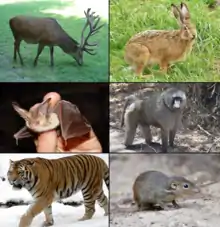
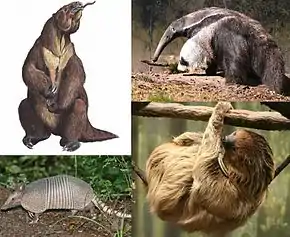
Exafroplacentalia places Xenarthra as a sister group to the Boreoeutheria (comprising Laurasiatheria and Euarchontoglires),[3] thus making Afrotheria a primitive group of placental mammals (the group name roughly means "those which are not African placentals").
Classification
| Eutheria |
| ||||||||||||||||||
However, this classification makes the autapomorphy (character shared only among Exafroplacentalia) dubious: it is hard to classify a group by the absence of a feature (in this case "not coming from Africa").[4] Hence, several alternative hypotheses can be considered.
Alternative hypotheses
One alternative hypothesis is the Epitheria hypothesis:
| Placentalia |
| ||||||||||||||||||
Another alternative hypothesis is the Atlantogenata hypothesis:
| Eutheria |
| ||||||||||||||||||
Updated analysis of transposable element insertions around the time of divergence strongly supports the fourth hypothesis of a near-concomitant origin of the three superorders of mammals:[4]
| Eutheria |
| |||||||||||||||
See also
References
- Murphy, W.J., Pringle, T.H., Crider, T.A., Springer, M.S. & Miller, W. 2007. Using genomic data to unravel the root of the placental mammal phylogeny. Genome Research 17, pp.413-421.
- Kriegs, J.O., Churakov, G., Kiefmann, M., Jordan, U., Brosius, J. & Schmitz, J. 2006. Retroposed elements as archives for the evolutionary history of placental mammals. Plos Biol 4, pp.e91.
- Goloboff, Pablo A.; Catalano, Santiago A.; Mirande, J. Marcos; Szumik, Claudia A.; Arias, J. Salvador; Källersjö, Mari; Farris, James S. (2009). "Phylogenetic analysis of 73 060 taxa corroborates major eukaryotic groups". Cladistics. 25 (3): 211–230. doi:10.1111/j.1096-0031.2009.00255.x.
- Nishihara, H., Maruyama, S. & Okada, N. 2009. Retroposon analysis and recent geological data suggest near-simultaneous divergence of the three superorders of placental mammals. PNAS 106: 5235-40.
Further reading
- Churakov, G.; Kriegs, J. O.; Baertsch, R.; Zemann, A.; Brosius, J. R.; Schmitz, J. R. (2009). "Mosaic retroposon insertion patterns in placental mammals". Genome Research. 19 (5): 868–875. doi:10.1101/gr.090647.108. PMC 2675975. PMID 19261842.
- Nikolaev, Sergey; Montoya-Burgos, Juan I.; Margulies, Elliott H.; NISC Comparative Sequencing Program; Rougemont, Jacques; Nyffeler, Bruno; Antonarakis, Stylianos E. (2007). "Early History of Mammals is Elucidated with the ENCODE Multiple Species Sequencing Data". PLoS Genetics. 3 (1): e2. doi:10.1371/journal.pgen.0030002. PMC 1761045. PMID 17206863.
- Springer, Mark S.; Murphy, William J.; Eizirik, Eduardo; O'Brien, Stephen J. (2003). "Placental mammal diversification and the Cretaceous–Tertiary boundary". Proceedings of the National Academy of Sciences. 100 (3): 1056–1061. doi:10.1073/pnas.0334222100. PMC 298725. PMID 12552136.
- Waddell, Peter J.; Kishino, Hirohisa; Ota, Rissa (2001). "A phylogenetic foundation for comparative mammalian genomics". Genome Informatics. 12: 141–154. PMID 11791233.
- Wildman, Derek E.; Chen, Caoyi; Erez, Offer; Grossman, Lawrence I.; Goodman, Morris; Romero, Roberto (2006). "Evolution of the mammalian placenta revealed by phylogenetic analysis". Proceedings of the National Academy of Sciences. 103 (9): 3203–3208. doi:10.1073/pnas.0511344103. PMC 1413940. PMID 16492730.