Procolophonidae
Procolophonidae is an extinct family of parareptiles from the Permian and Triassic periods.
| Procolophonidae Temporal range: Late Permian - Late Triassic | |
|---|---|
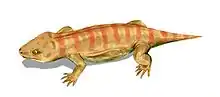 | |
| Life restoration of Procolophon pricei from the Early Triassic of South Africa | |
Scientific classification  | |
| Kingdom: | Animalia |
| Phylum: | Chordata |
| Class: | Reptilia |
| Clade: | †Parareptilia |
| Order: | †Procolophonomorpha |
| Superfamily: | †Procolophonoidea |
| Family: | †Procolophonidae Seeley, 1888 |
| Subgroups | |
| Synonyms | |
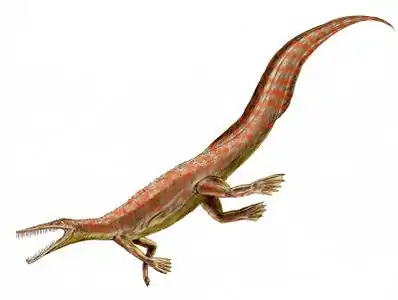
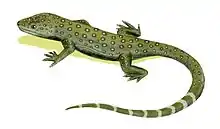
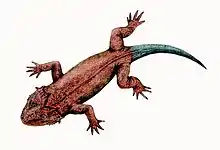
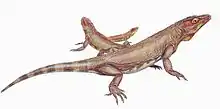
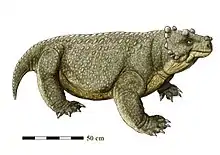
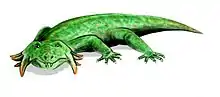
They were shaped like stocky lizards, with broad-cheeked skulls. Their cheeks sported a stout backward-pointing spike. Hypsognathus, from North America, had many cheek spikes. Procolophon, the genus after which the group was named, is unusual. Their skulls resemble the turtles', sharing a posttemporal fenestra. Accordingly, they have historically been classed alongside the turtles under the Anapsida.
Up to the early Triassic, their teeth were sharp, indicating an insectivorous diet. Later in the Triassic their teeth became broader, indicating a switch to a herbivorous diet. They became extinct at the end of the Triassic.
Discoveries announced in 2008 suggest that these animals may have lived in Antarctica in the Early Triassic, and were thus among the earliest tetrapods in the Antarctic.[3]
Phylogeny
Below is a cladogram from Ruta et al. (2011):[4]
| Procolophonidae |
| |||||||||||||||||||||||||||||||||||||||||||||||||||||||||||||||||||||||||||||||||||||||||||||||||||||||||||||||||||||||||||||||||||||||
References
- Cisneros, J. C. (2008). "Phylogenetic relationships of procolophonid parareptiles with remarks on their geological record". Journal of Systematic Palaeontology. 6 (3): 345–366. doi:10.1017/S1477201907002350. S2CID 84468714.
- Hans-Dieter Sues and Robert R. Reisz (2008). "Anatomy and Phylogenetic Relationships of Sclerosaurus armatus (Amniota: Parareptilia) from the Buntsandstein (Triassic) of Europe". Journal of Vertebrate Paleontology. 28 (4): 1031–1042. doi:10.1671/0272-4634-28.4.1031. S2CID 53967912.
- https://www.livescience.com/2580-fossils-suggest-ancient-cat-sized-reptiles-antarctica.html
- Ruta, M.; Cisneros, J. C.; Liebrecht, T.; Tsuji, L. A.; Müller, J. (2011). "Amniotes through major biological crises: Faunal turnover among Parareptiles and the end-Permian mass extinction". Palaeontology. 54 (5): 1117–1137. doi:10.1111/j.1475-4983.2011.01051.x.
Sources
- Lambert, David (2001). Dinosaur Encyclopedia. New York: Dorling Kindersley. p. 72.
External links