Delorhynchus
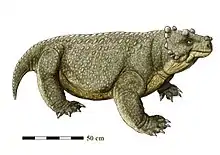
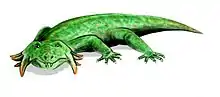
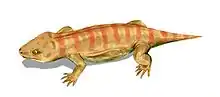
Delorhynchus is an extinct genus of lanthanosuchoid parareptile known from the late Early Permian (Artinskian age) Garber Formation of Comanche County, Oklahoma, south-central United States. It contains the type species D. priscus as well as a better preserved second species D. cifellii.[3][4]
| Delorhynchus | |
|---|---|
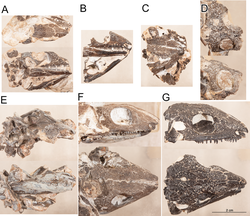 | |
| Different skulls of Delorhynchus cifellii in various growth stages | |
Scientific classification  | |
| Kingdom: | Animalia |
| Phylum: | Chordata |
| Class: | Reptilia |
| Clade: | †Parareptilia |
| Order: | †Procolophonomorpha |
| Superfamily: | †Lanthanosuchoidea |
| Genus: | †Delorhynchus Fox, 1962 |
| Type species | |
| †Delorhynchus priscus Fox, 1962 | |
| Species | |
| Synonyms | |
| |
Discovery
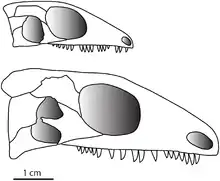
The type species D. priscus is known from the holotype KU 11117, a fragmentary left maxilla bearing 4 teeth, and from the fragmentary referred specimens KU 11118 and KU 11119, a right and a left maxillae respectively, each bearing 4 teeth. All known specimens of D. priscus are housed at the University of Kansas Natural History Museum in Lawrence, Kansas.[3] Unlike the type species, D. cifellii is known from a well-preserved partial subadult skeleton, an isolated adult skull, and other disarticulated elements, all housed at the Oklahoma Museum of Natural History. The subadult individual preserves both the partial skull and the postcranial remains in articulation, and thus was chosen as the holotype, represented by OMNH 73515. OMNH 73362 represents the complete skull of the large, adult, individual. Other remains referred to D. cifellii include OMNH 73363, a complete right mandibular ramus of an individual equal in size to OMNH 73362, as well as the right maxilla OMNH 73524.[4]
Both species of Delorhynchus are known only from the claystone and conglomerate Oklahoma Museum of Natural History (OMNH) Locality V51, at Dolese Brothers limestone quarry of Richards Spur, Fissure Fills, just west of U.S. Highways 62 & 281, 10.5 miles south of Apache and 6 miles north of Fort Sill, of Comanche County, Oklahoma. The remains of both species were collected from the Garber Formation (also known as the Willington Formation) of Summer Group, Arbuckle limestone, which is probably equivalent to the Arroyo Formation of Texas, dating to the middle Leonardian stage, of the upper Rotliegend epoch, Early Permian, about 275 million years ago.[4]
The Richards Spur locality presents a very rich Early Permian vertebrate paleofauna, including species of chondrichthyes, Lepospondyli, seymouriamorphs, basal synapsids, basal eureptiles and six species of parareptiles apart from the two Delorhynchus species, including the basal Microleter mckinzieorum, the bolosaurid Bolosaurus grandis, the nyctiphruretid Abyssomedon williamsi, and three other lanthanosuchoids including Colobomycter pholeter, Feeserpeton oklahomensis, and an unnamed new species of Acleistorhinidae.[5]
Etymology
Delorhynchus was first described and named by Richard C. Fox in 1962 and the type species is Delorhynchus priscus. The generic name is derived from Greek rhynchus/ρυγχος, meaning "beak" (a common suffix for extinct reptile genera names). The specific name of the type species priscus is derived from Greek πρίσκος, meaning "ancient" or "venerable" in reference to the fragmentary nature of the known remains.[3] The second better preserved species, D. cifellii, was first described and named by Robert R. Reisz, Mark J. Macdougall and Sean P. Modesto in 2014. Its specific name honors Dr. Richard L. Cifelli, a paleontologist at the Sam Noble Oklahoma Museum of Natural History, for his contributions to the paleontology of Oklahoma and support in studying D. cifellii.[4]
Phylogeny
Until recently, the phylogenetic position of Delorhynchus within Procolophonomorpha was uncertain, due to the fragmentary nature of the remains of D. priscus.[3][6] However, with the description of D. cifellii by Reisz et al. (2014), Delorhynchus could be added for the first time into a phylogenetic analysis to resolve its position. Reisz et al. (2014) recovered Delorhynchus in a sister taxon position to the clade formed by Acleistorhinus and Lanthanosuchus. Thus Delorhynchus was either considered to be the sister taxon of Lanthanosuchoidea, or a basal lanthanosuchoid, depending on the definition of Lanthanosuchoidea used.[4] The following cladogram is simplified after the phylogenetic analysis of MacDougall and Reisz (2014), an updated version of Reisz et al. (2014), and shows the placement of D. cifellii within Parareptilia. Relationships within bolded clades are not shown.[5]
| Parareptilia |
| ||||||||||||||||||||||||||||||||||||||||||||||||||||||||||||||||||||||||||||||||||||||||||||||||
References
- Anderson, J. S., & Reisz, R. R. (2003). A new microsaur (Tetrapoda: Lepospondyli) from the Lower Permian of Richards Spur (Fort Sill), Oklahoma. Canadian Journal of Earth Sciences, 40(4), 499-505.
- Yara Haridy; Mark J. Macdougall; Robert R. Reisz (2018). "The lower jaw of the Early Permian parareptile Delorhynchus, first evidence of multiple denticulate coronoids in a reptile". Zoological Journal of the Linnean Society. in press (3): 791–803. doi:10.1093/zoolinnean/zlx085.
- Richard C. Fox (1962). "Two New Pelycosaurs from the Lower Permian of Oklahoma". University of Kansas Publications, Museum of Natural History. 12 (6): 297–307.CS1 maint: uses authors parameter (link)
- Robert R. Reisz, Mark J. Macdougall and Sean P. Modesto (2014). "A new species of the parareptile genus Delorhynchus, based on articulated skeletal remains from Richards Spur, Lower Permian of Oklahoma". Journal of Vertebrate Paleontology. 34 (5): 1033–1043. doi:10.1080/02724634.2013.829844.
- Mark J. MacDougall and Robert R. Reisz (2014). "The first record of a nyctiphruretid parareptile from the Early Permian of North America, with a discussion of parareptilian temporal fenestration". Zoological Journal of the Linnean Society. 172 (3): 616–630. doi:10.1111/zoj.12180.
- Linda A. Tsuji; Johannes Muller; Robert R. Reisz (2010). "Microleter mckinzieorum gen. et sp. nov. from the Lower Permian of Oklahoma: the basalmost parareptile from Laurasia". Journal of Systematic Palaeontology. 8 (2): 245–255. doi:10.1080/14772010903461099.CS1 maint: uses authors parameter (link)