Nannaroter
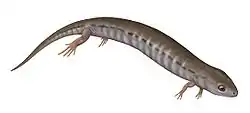
Nannaroter is an extinct genus of tuditanomorph microsaur within the family Ostodolepidae.
| Nannaroter Temporal range: Early Permian | |
|---|---|
| Scientific classification | |
| Kingdom: | |
| Phylum: | |
| Class: | |
| Subclass: | |
| Order: | |
| Suborder: | |
| Family: | |
| Genus: | Nannaroter Anderson et al., 2009 |
| Species | |
| |
History of study
Nannaroter was named in 2009 by Canadian paleontologists Jason Anderson, Diane Scott, and Robert Reisz. It is known from only the holotype specimen, which was found in the Dolese Brothers Limestone Quarry in Oklahoma. The holotype, a well preserved skull, was found in early Permian-aged fissure fill deposits in Ordovician limestone.[1] The species name is given for Mark McKinzie, who found and donated the specimen to the Sam Noble Oklahoma Museum of Natural History.
Anatomy
Nannaroter is the smallest known ostodolepid and is diagnosed by: (1) the high subtemporal recess that separates the postorbital from the squamosal; (2) four premaxillary tooth positions; (3) 12 maxillary tooth positions; circumorbital walls formed by medial laminae of the prefrontal, lacrimal, and jugal; (5) a ventral flange of the frontal meeting the sphenethmoid; (7) an anterolaterally bulbous sphenethmoid; and (8) a massive epipterygoid. Like other ostodolepids, it has a wedge-shaped skull, a pointed snout, and a temporal emargination. The skull is highly ossified in order to resist anteroposteriorly directed forces, as indicated by the markedly interdigitated sutures.
Ecology
The high degree of ossification in the skull of Nannaroter is seen as an adaptation to a fossorial, or burrowing, lifestyle.[1] More specifically, the animal would likely have used its recumbent snout to push forward into the substrate, facilitated by increased epaxial musculature that inserted into the broad, sloping occiput, as in amphisbaenians. As Nannaroter is known from only one specimen, it has been suggested that it was either a naturally rare component of the assemblage or that its inferred burrowing ecology did not lend itself well to preservation in the fissure fill system.
Relationships
Below is the placement of Nannaroter in the analysis of Huttenlocker et al. (2013):[2]
| ||||||||||||||||||||||||||||||||||||||||||||||||||||||||||||||||||||||||||||||||||||||||||||||||||||||||||||||||||||||||||||
References
- Anderson, J.S.; Scott, D.; Reisz, R.R. (2009). "Nannaroter mckinziei, a new ostodolepid 'microsaur' (Tetrapoda, Lepospondyli, Recumbirostra) from the Early Permian of Richards Spur (Ft. Sill), Oklahoma". Journal of Vertebrate Paleontology. 29 (2): 379–388. doi:10.1671/039.029.0222.
- Huttenlocker, Adam K.; Pardo, Jason D.; Small, Bryan J.; Anderson, Jason S. (2013). "Cranial morphology of recumbirostrans (Lepospondyli) from the Permian of Kansas and Nebraska, and early morphological evolution inferred by micro-computed tomography". Journal of Vertebrate Paleontology. 33 (3): 540–552. doi:10.1080/02724634.2013.728998. ISSN 0272-4634.
| |||||||||||||||||||||||||||||||||||||||||
| |||||||||||||||||||||||||||||||||||||||||
| |||||||||||||||||||||||||||||||||||||||||
| |||||||||||||||||||||||||||||||||||||||||