Microsauria
Microsauria ("small lizards") is an extinct, possibly polyphyletic[1] order of tetrapods from the late Carboniferous and early Permian periods. It is the most diverse and species-rich group of lepospondyls.[2][3] Recently, Microsauria has been considered paraphyletic, as several other non-microsaur lepospondyl groups such as Lysorophia seem to be nested in it.[2][4][5] Microsauria is now commonly used as a collective term for the grade of lepospondyls that were originally classified as members of Microsauria.[3]
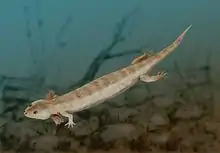
| Microsauria | |
|---|---|
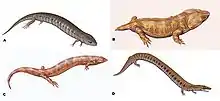 | |
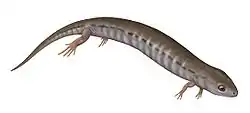
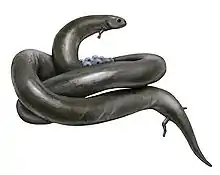
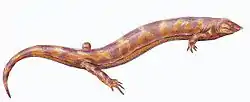
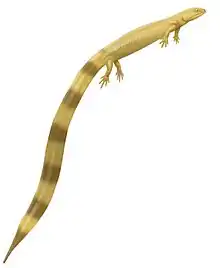
| Microsauria diversity. (Hyloplesion (A), Pantylus (B), Pelodosotis (C) & Rhynchonkos (D)) | |
Scientific classification  | |
| Kingdom: | Animalia |
| Phylum: | Chordata |
| Subclass: | †Lepospondyli |
| Order: | †"Microsauria" Dawson, 1863 |
| Subgroups | |
The microsaurs all had short tails and small legs, but were otherwise quite varied in form. The group included lizard-like animals that were relatively well-adapted to living on dry land, burrowing forms, and others that, like the modern axolotl, retained their gills into adult life, and so presumably never left the water.[6]
Distribution
.png.webp)
Microsaur remains have been found from Europe and North America in Late Carboniferous and Early Permian localities. Most North American microsaurs have been found in the United States in Arizona,[7] Texas, Oklahoma, Ohio,[8] Illinois, as well as Kansas and Nebraska,[9] although remains have also been found in Nova Scotia.[10] In Europe, microsaurs are known from Germany and the Czech Republic. Possible microsaur remains have also been found from strata in the town of Vyazniki in the Vladimir Oblast of Russia.[11] These strata are Late Permian in age, near the Permo-Triassic boundary. The microsaur material at Vyazniki may be the youngest record of microsaurs, and would extend their range by around 20 million years.
Classification
Cladogram modified from Anderson (2001):[4]
| Lepospondyli |
| ||||||||||||||||||||||||||||||||||||||||||||||||||||||||||||||||||||||||||||||||||||||||||||||||||||||||||||||||||||||||||||||||||||||||||||||||||||||||||||||||||||||||||||||||||||||||||||||||||||||
Cladogram from Ruta and Coates (2007):[5]
| "Microsauria" |
| ||||||||||||||||||||||||||||||||||||||||||||||||||||||||||||||||||||||||
Cladistic analysis by Pardo et al. (2017) places recumbirostran microsaurs and lysorophians as members of Amniota.[12]
References
- https://onlinelibrary.wiley.com/doi/abs/10.1002/spp2.1316
- Ruta, M.; Coates, M.I.; Quicke, D.L.J. (2003). "Early tetrapod relationships revisited" (PDF). Biological Reviews. 78 (2): 251–345. doi:10.1017/S1464793102006103. PMID 12803423.
- Bolt, J.R.; Rieppel, O. (2009). "The holotype skull of Llistrofus pricei Carroll and Gaskill, 1978 (Microsauria: Hapsidopareiontidae)". Journal of Paleontology. 83 (3): 471–483. doi:10.1666/08-076.1.
- Anderson, J.S. (2001). "The phylogenetic trunk: Maximal inclusion of taxa with missing data in an analysis of the Lepospondyli (Vertebrata, Tetrapoda)". Systematic Biology. 50 (2): 170–193. doi:10.1080/10635150119889. PMID 12116927.
- Ruta, M.; Coates, M.I. (2007). "Dates, nodes, and character conflict: addressing the lissamphibian origin problem". Journal of Systematic Palaeontology. 5: 69–122. doi:10.1017/S1477201906002008.
- Palmer, D., ed. (1999). The Marshall Illustrated Encyclopedia of Dinosaurs and Prehistoric Animals. London: Marshall Editions. p. 55. ISBN 978-1-84028-152-1.
- Thayer, D.W. (1985). "New Pennsylvanian lepospondyl amphibians from the Swisshelm Mountains, Arizona". Journal of Paleontology. 59 (3): 684–700.
- Hook, R. W.; Baird, D. (1986). "The Diamond Coal Mine of Linton, Ohio, and its Pennsylvanian-Age vertebrates". Journal of Vertebrate Paleontology. 6 (2): 174–190. doi:10.1080/02724634.1986.10011609.
- Huttenlocker, A. K.; Pardo, J. D.; Small, B. J.; Anderson, J. S. (2013). "Cranial morphology of recumbirostrans (Lepospondyli) from the Permian of Kansas and Nebraska, and early morphological evolution inferred by micro-computed tomography". Journal of Vertebrate Paleontology 33 (3): 540.
- Steen, M.C. (1934). "The amphibian fauna from the South Joggins, Nova Scotia". Proceedings of the Zoological Society of London. 104 (3): 465–504. doi:10.1111/j.1096-3642.1934.tb01644.x.
- Sennikov, A.G.; Golubev, V.K. (2006). "Vyazniki biotic assemblage of the terminal Permian" (PDF). Paleontological Journal. 40 (Suppl. 4): S475–S481. doi:10.1134/S0031030106100078.
- Jason D. Pardo; Matt Szostakiwskyj; Per E. Ahlberg; Jason S. Anderson (2017). "Hidden morphological diversity among early tetrapods". Nature. 546 (7660): 642–645. doi:10.1038/nature22966. PMID 28636600.
External links
- Microsauria in the Paleobiology Database
| |||||||||||||||||||||||||||||||||||||||||
| |||||||||||||||||||||||||||||||||||||||||
| |||||||||||||||||||||||||||||||||||||||||
| |||||||||||||||||||||||||||||||||||||||||