Malawisaurus
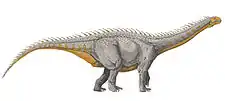
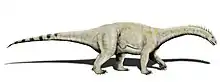
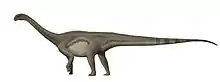
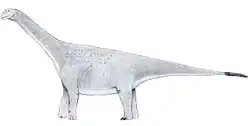
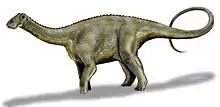
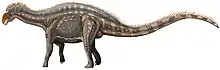
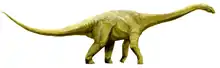
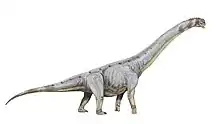
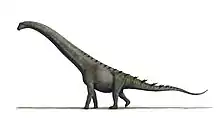
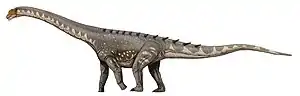
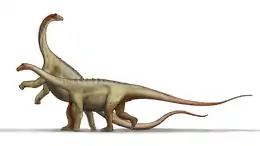
Malawisaurus (meaning "Malawi lizard") was a genus of titanosaurian sauropod dinosaur. It lived in what is now Africa, specifically Malawi, and South America, specifically Brazil during the Aptian-Cenomanian ages of the Early-Late Cretaceous Periods. It is one of the few titanosaurs for which skull material has been found.
| Malawisaurus | |
|---|---|
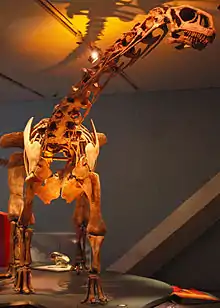 | |
| Display at the Royal Ontario Museum | |
Scientific classification  | |
| Kingdom: | Animalia |
| Phylum: | Chordata |
| Clade: | Dinosauria |
| Clade: | Saurischia |
| Suborder: | †Sauropodomorpha |
| Clade: | †Sauropoda |
| Clade: | †Eusauropoda |
| Clade: | †Neosauropoda |
| Clade: | †Macronaria |
| Clade: | †Titanosauria |
| Clade: | †Eutitanosauria |
| Clade: | †Lithostrotia |
| Genus: | †Malawisaurus Jacobs et al., 1993 |
| Species: | †M. dixeyi |
| Binomial name | |
| †Malawisaurus dixeyi (Haughton, 1928) [originally Gigantosaurus, preoccupied] | |
| Synonyms | |
| |
Discovery

It was named by Louis L. Jacobs and colleagues, Maeve Mercredi Fourie and was originally described in 1928 by Sidney H. Haughton as a species of Gigantosaurus (an invalid name for the diplodocid currently known as Tornieria). Haughton considered it closely related to the species G. robustus (later the type species of Janenschia).
Description
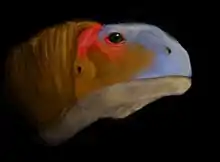
Relatively small by sauropod standards, Malawisaurus reached lengths of about 16 metres (52 ft), and weighed about 10 tonnes (11 short tons).[1] In 2020 it was given a smaller estimation of 11 meters (36 ft) and 2.8 tonnes (3.1 short tons).[2] Like some other titanosaurs, ossicles have been found which are believed to represent dermal scutes that covered the skin.
The vertebrae from the middle part of its tail had elongated centra.[3] Malawisaurus had vertebral lateral fossae that resembled shallow depressions.[4] Fossae that similarly resemble shallow depressions are known from Saltasaurus, Alamosaurus, Aeolosaurus, and Gondwanatitan.[4]
Classification
The cladogram below follows Franca et al. (2016), placing Malawisaurus as a basal lithostrotian.[5]
| Lithostrotia |
| |||||||||||||||||||||||||||||||||||||||||||||||||||||||||||||||||||||||||||||||||||||||||||||
See also
References
- Paul, G.S., 2010, The Princeton Field Guide to Dinosaurs, Princeton University Press p. 207
- Molina-Pérez & Larramendi (2020). Dinosaur Facts and Figures: The Sauropods and Other Sauropodomorphs. New Jersey: Princeton University Press. p. 264.
- "Caudal Vertebrae," Tidwell, Carpenter, and Meyer (2001). Page 145.
- "Caudal Vertebrae," Tidwell, Carpenter, and Meyer (2001). Page 147.
- França, M.A.G.; Marsola, J.C.d A.; Riff, D.; Hsiou, A.S.; Langer, M.C. (2016). "New lower jaw and teeth referred to Maxakalisaurus topai (Titanosauria: Aeolosaurini) and their implications for the phylogeny of titanosaurid sauropods". PeerJ. 4: e2054. doi:10.7717/peerj.2054. PMC 4906671. PMID 27330853.
Footnotes
- S. H. Haughton. 1928. On some reptilian remains from the Dinosaur Beds of Nyasaland. Transactions of the Royal Society of South Africa 16:67-75
- Paul, Gregory S. (2010) The Princeton Field Guide to Dinosaurs.
- Tidwell, V., Carpenter, K. & Meyer, S. 2001. New Titanosauriform (Sauropoda) from the Poison Strip Member of the Cedar Mountain Formation (Lower Cretaceous), Utah. In: Mesozoic Vertebrate Life. D. H. Tanke & K. Carpenter (eds.). Indiana University Press, Eds. D.H. Tanke & K. Carpenter. Indiana University Press. 139-165.
External links
 |
Wikimedia Commons has media related to Malawisaurus. |
- page on Malawisaurus from DinoDictionary.
- New material of an Early Cretaceous titanosaurid dinosaur of Malawi
- Palaeontologica-Electronica - Sauropod Dinosaurs from the Early Cretaceous of Malawi, Africa
- Research Casting International - Malawisaurus dixeyi