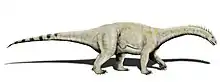
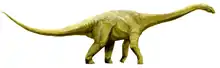
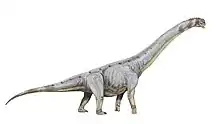
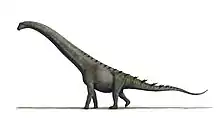
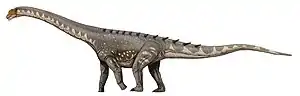
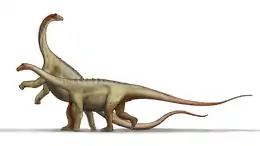
Bagualia
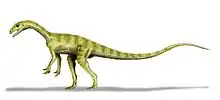
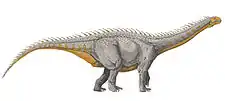
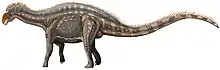
Bagualia (meaning "wild horse" in Spanish, after Bagual Canyon, the type locality), is an extinct genus of eusauropod sauropod dinosaur, from the Early Jurassic of Argentina. The type species, Bagualia alba was formally described in 2020.[1]
| Bagualia | |
|---|---|
 | |
Scientific classification  | |
| Kingdom: | Animalia |
| Phylum: | Chordata |
| Clade: | Dinosauria |
| Clade: | Saurischia |
| Suborder: | †Sauropodomorpha |
| Clade: | †Sauropoda |
| Clade: | †Eusauropoda |
| Genus: | †Bagualia Pol et al., 2020 |
| Type species | |
| †Bagualia alba Pol et al., 2020 | |
Description
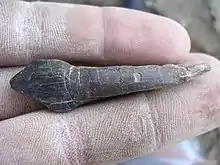
Remains of Bagualia consist of over 100 bones, such as vertebrae from the neck, limb bones and skull and teeth elements incased in plant fossils.[1] The size of Bagualia was likely brought on by a newly formed ecosystem and climate shifts, which were all caused by volcanic activity in the Southern hemisphere during the Early Jurassic. While the harsh climate and volcanic activity drove most sauropodomorphs to extinction, Bagualia was able to adapt to newly-sprouting conifers and plants, using its long neck to snip plant matter from them while staying in place, conserving energy. Its teeth are surrounded by a thick layer of enamel, roughly 7x thicker than other extinct herbivores, enabling the animal to better shear conifer leaves. The digestive system of Bagualia was also a likely reason why it grew to such a large size,[1] and another function of its long neck has been proposed: it may have dissipated heat in a similar fashion to how elephants use their ears to do the same.[1]
Classification
Bagualia was placed in a phylogenetic analysis and emerged as an early member of Eusauropoda. Due to its provenance from the Cañadon Asfalto Formation, which the describers date to the Toarcian, 179 Ma, they see it as evidence of a eusauropod dominance after an Early Jurassic global warming event, replacing more basal sauropodomorphs. Their cladogram is shown below, with clade names added by definition:
| Eusauropoda |
| |||||||||||||||||||||||||||||||||||||||||||||||||||||||||||||||||||||||||||
References
- D. Pol; J. Ramezani; K. Gomez; J. L. Carballido; A. Paulina Carabajal; O. W. M. Rauhut; I. H. Escapa; N. R. Cúneo (2020). "Extinction of herbivorous dinosaurs linked to Early Jurassic global warming event". Proceedings of the Royal Society B: Biological Sciences. 287 (1939): Article ID 20202310. doi:10.1098/rspb.2020.2310. PMID 33203331. S2CID 226982302.