Halszkaraptorinae
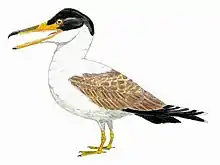
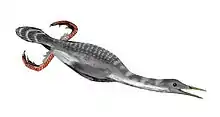
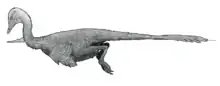
Halszkaraptorinae is a basal ("primitive") subfamily of Unenlagiidae that includes the enigmatic genera Halszkaraptor, Mahakala, and Hulsanpes. A comparison of the fossils of Halszkaraptor with the bones of extant crocodilians and aquatic birds revealed evidence of a semiaquatic lifestyle.[1] The group is named after Polish paleontologist Halszka Osmólska.[2]
| Halszkaraptorinae | |
|---|---|
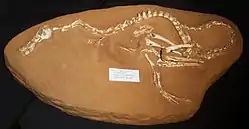 | |
| Holotype specimen of Halszkaraptor escuilliei | |
Scientific classification  | |
| Kingdom: | Animalia |
| Phylum: | Chordata |
| Clade: | Dinosauria |
| Clade: | Saurischia |
| Clade: | Theropoda |
| Family: | †Unenlagiidae |
| Subfamily: | †Halszkaraptorinae Cau et al., 2017 |
| Type genus | |
| †Halszkaraptor escuilliei Cau et al., 2017 | |
| Genera | |
Description
Halszkaraptorinae is defined as the most inclusive clade that contains Halszkaraptor escuilliei but not Dromaeosaurus albertensis, Unenlagia comahuensis, Saurornithoides mongoliensis or Vultur gryphus. The subfamily is diagnosed by their long necks, proximal caudal vertebrae with oriented articular processes (projections of the vertebra fits with an adjacent vertebra) and prominent zygodiapophyseal laminae (plates of bone that form the posterior walls of each vertebra), a flattened ulna with a sharp posterior margin, ilium with a shelf-like supratrochanteric (above the trochanter of the femur) process, metacarpal III shaft transversely as thick as that of metacarpal II, a posterodistal surface on the femoral shaft with an elongate fossa bound by a lateral crest and the proximal half of metatarsal III being unconstricted and markedly convex anteriorly.[1]
Classification
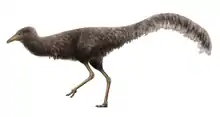
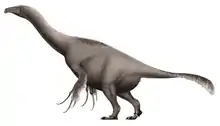
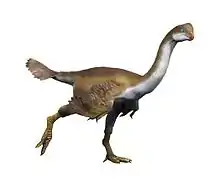
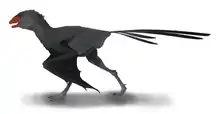
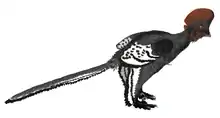
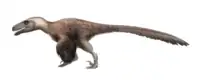
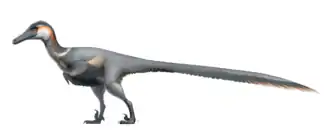
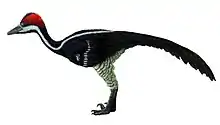
The cladogram below is based on the phylogenetic analysis conducted in 2017 by Cau et al. using updated data from the Theropod Working Group in their description of Halszkaraptor.[1]
| Dromaeosauridae |
| ||||||||||||||||||||||||||||||||||||||||||||||||||||||||||||
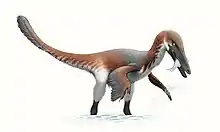
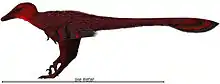
.jpg.webp)
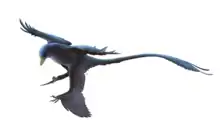
.png.webp)

References
- Cau, A.; Beyrand, V.; Voeten, D.; Fernandez, V.; Tafforeau, P.; Stein, K.; Barsbold, R.; Tsogtbaatar, K.; Currie, P.; Godrfroit, P. (6 December 2017). "Synchrotron scanning reveals amphibious ecomorphology in a new clade of bird-like dinosaurs". Nature. 552 (7685): 395–399. doi:10.1038/nature24679. PMID 29211712.
- Greshko, Michael (6 December 2017). "Duck-Like Dinosaur Is Among Oddest Fossils Yet Found". National Geographic Society. Retrieved 8 December 2017.
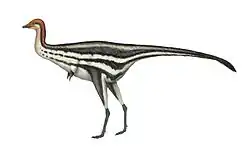
.png.webp)
.jpg.webp)