Eudromaeosauria
Eudromaeosauria ("true dromaeosaurs") is a subgroup of terrestrial dromaeosaurid theropod dinosaurs. They were relatively large-bodied, feathered hypercarnivores (with diets consisting almost entirely of other terrestrial vertebrates) that flourished in the Cretaceous Period.
| Eudromaeosaurians | |
|---|---|
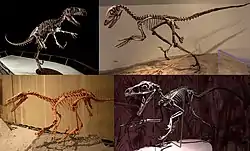 | |
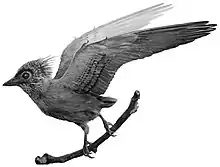
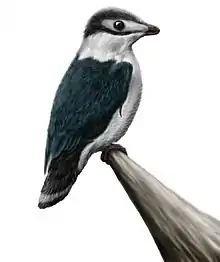
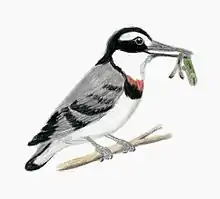
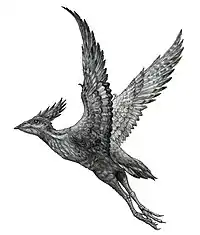
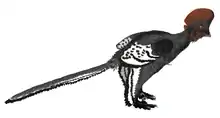
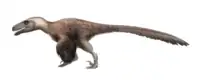
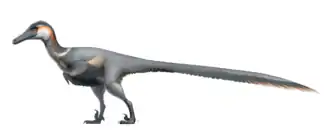
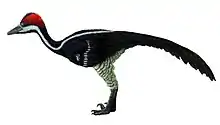
| Eudromaeosauria diversity, featuring from top left to lower right: Utahraptor, Deinonychus, Velociraptor and Bambiraptor | |
Scientific classification  | |
| Kingdom: | Animalia |
| Phylum: | Chordata |
| Clade: | Dinosauria |
| Clade: | Saurischia |
| Clade: | Theropoda |
| Family: | †Dromaeosauridae |
| Clade: | †Eudromaeosauria Longrich & Currie, 2009 |
| Subgroups | |
Eudromaeosaur fossils are known almost exclusively from the northern hemisphere. They first appeared in the early Cretaceous Period (early Aptian stage, about 124 million years ago) and survived until the end of the Cretaceous (Maastrichtian stage, 66 Ma). The earliest known definitive eudromaeosaur is the dromaeosaurine Utahraptor ostrommaysi, from the Cedar Mountain Formation, dated to 124 million years ago.[1] However, the earlier (143-million-year-old) fossils such as those of Nuthetes destructor and several indeterminate teeth dating to the Kimmeridgian stage may represent eudromaeosaurs.[2][3]
Description
While other dromaeosaurids filled a variety of specialized ecological niches, mainly those of small predators or larger fish-eating forms, eudromaeosaurs functioned as large-bodied predators of often medium to large-sized prey. Aside from their generally larger size, eudromaeosaurs are characterized by several features of the foot. First, there were differences in the positions of the grooves which anchored blood vessels and keratin sheathes of the toe claws. In primitive dromaeosaurids like Hesperonychus, these grooves ran parallel to each other on either side of the claw along its length. In eudromaeosaurs, the grooves were asymmetrical, with the inner one split into two distinct grooves and elevated toward the top of the claw, while the single outer groove remained positioned at the midline.[4]
The second distinguishing characteristic of eudromaeosaurs is an expanded and enlarged "heel" on the last bone in the second toe (phalange), which bore the enlarged, sickle-like toe claw. Finally, the first bone of the second toe also possessed an enlarged expansion at the joint, another adaptation relating to the unusually enlarged claw, and which helped the animal hold the claw high off the ground. Also unlike their more basal relatives, the sickle-claw of eudromaeosaurs was sharper and more blade-like. In unenlagiines and microraptorines, the claw is broader at its base.[4]
Classification
Eudromaeosauria was first defined as a node-based clade by Nick Longrich and Philip J. Currie in 2009, as the most inclusive natural group containing Dromaeosaurus, Velociraptor, Deinonychus, and Saurornitholestes, their most recent common ancestor and all of its other descendants. The various "subfamilies" have also been re-defined as clades, usually defined as all species closer to the groups namesake than to Dromaeosaurus or any namesakes of other sub-clades.[4]
The subgroups of Eudromaeosauria frequently shift in content based on new analysis, but typically consist of the following groups. For example, the subfamily Velociraptorinae has traditionally included Velociraptor, Deinonychus, and Saurornitholestes, and while the discovery of Tsaagan lent support to this grouping, the inclusion of Saurornitholestes is still uncertain. The Dromaeosaurinae is usually found to consist of medium to giant-sized species, with generally box-shaped skulls (the other subfamilies generally have narrower snouts). A number of eudromaeosaurs have not been assigned to any particular subfamily, because they are too poorly preserved to be placed confidently in phylogenetic analysis (see section Phylogeny below).[5]
The following classification of the various genera of eudromaeosaurs follows the table provided in Holtz, 2010 unless otherwise noted.[6]
- Eudromaeosauria
- Subfamily Saurornitholestinae
- Subfamily Dromaeosaurinae
- Subfamily Velociraptorinae
Relationships
The below cladogram follows an analysis by Evans et al. in 2013. Their analysis used an updated version of the dataset originally compiled by Nick Longrich and Phil Currie to study dromaeosaurid relationships, and found a relatively traditional arrangement of eudromaeosaurian relationships.[7]
| Eudromaeosauria |
| ||||||||||||||||||||||||||||||||||||||||||||||||||||||||||||||||||||||||
The cladogram below follows a 2015 analysis by paleontologists Robert DePalma, David Burnham, Larry Martin, Peter Larson, and Robert Bakker, using updated data from the Theropod Working Group. This analysis concluded that several members of traditional eudromaeosaurian subgroups are actually outside of that group, and that traditional groupings like Velociraptorinae are paraphyletic.[8]
| Dromaeosauridae |
| ||||||||||||||||||||||||||||||||||||||||||||||||||||||||||||||||||||||||||||||
See also
References
- McDonald AT, Kirkland JI, DeBlieux DD, Madsen SK, Cavin J, et al. (2010). "New Basal Iguanodonts from the Cedar Mountain Formation of Utah and the Evolution of Thumb-Spiked Dinosaurs". PLoS ONE. 5 (11): e14075. doi:10.1371/journal.pone.0014075. PMC 2989904. PMID 21124919.
- Sweetman S.C. (2004). "The first record of velociraptorine dinosaurs (Saurischia, Theropoda) from the Wealden (Early Cretaceous, Barremian) of southern England". Cretaceous Research. 25 (3): 353–364. doi:10.1016/j.cretres.2004.01.004.
- Van der Lubbe, T.; Richter, U.; Knotschke, N. (2009). "Velociraptorine dromaeosaurid teeth from the Kimmeridgian (Late Jurassic) of Germany" (PDF). Acta Palaeontologica Polonica. 54 (3): 401–408. doi:10.4202/app.2008.0007.
- Longrich, N.R.; Currie, P.J. (2009). "A microraptorine (Dinosauria–Dromaeosauridae) from the Late Cretaceous of North America". PNAS. 106 (13): 5002–7. doi:10.1073/pnas.0811664106. PMC 2664043. PMID 19289829.
- Turner, A.S.; Hwang, S.H.; Norell, M.A. (2007). "A small derived theropod from Öösh, Early Cretaceous, Baykhangor Mongolia" (PDF). American Museum Novitates. 3557: 1–27. doi:10.1206/0003-0082(2007)3557[1:ASDTFS]2.0.CO;2. hdl:2246/5845. Retrieved 2007-03-29.
- Holtz, Thomas R. Jr. (2010) Dinosaurs: The Most Complete, Up-to-Date Encyclopedia for Dinosaur Lovers of All Ages, Winter 2010 Appendix.
- Evans, D. C.; Larson, D. W.; Currie, P. J. (2013). "A new dromaeosaurid (Dinosauria: Theropoda) with Asian affinities from the latest Cretaceous of North America". Naturwissenschaften. 100 (11): 1041–9. doi:10.1007/s00114-013-1107-5. PMID 24248432.
- DePalma, Robert A.; Burnham, David A.; Martin, Larry D.; Larson, Peter L.; Bakker, Robert T. (2015). "The First Giant Raptor (Theropoda: Dromaeosauridae) from the Hell Creek Formation". Paleontological Contributions (14).
- Senter, P.; Kirkland, J. I.; Deblieux, D. D.; Madsen, S.; Toth, N. (2012). Dodson, Peter (ed.). "New Dromaeosaurids (Dinosauria: Theropoda) from the Lower Cretaceous of Utah, and the Evolution of the Dromaeosaurid Tail". PLoS ONE. 7 (5): e36790. doi:10.1371/journal.pone.0036790. PMC 3352940. PMID 22615813.
- Bell, P. R., and P. J. Currie. 2015. A high-latitude dromaeosaurid, Boreonykus certekorum, gen. et sp. nov. (Theropoda), from the upper Campanian Wapiti Formation, west-central Alberta. Journal of Vertebrate Paleontology. doi:10.1080/02724634.2015.1034359
.png.webp)
.jpg.webp)