Trochilini
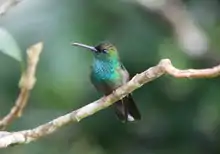
Trochilini is one of the three tribes that make up the subfamily Trochilinae in the hummingbird family Trochilidae. The other two tribes in the subfamily are Lampornithini (mountain gems) and Mellisugini (bees).
| Trochilini | |
|---|---|
_adult_male_2.jpg.webp) | |
| Red-billed streamertail (Trochilus polytmus) | |
Scientific classification  | |
| Kingdom: | Animalia |
| Phylum: | Chordata |
| Class: | Aves |
| Order: | Apodiformes |
| Family: | Trochilidae |
| Subfamily: | Trochilinae |
| Tribe: | Trochilini Vigors, 1825 |
| Genera | |
|
36, see text | |
The informal name "emeralds" has been proposed for this group. Several genera contain species with "emerald" in their common name including Chlorostilbon which contains ten.[1]
The tribe contains 114 species divided into 36 genera.[2][3]
Phylogeny
A molecular phylogenetic study of the hummingbirds published in 2007 found that the species formed nine major clades.[4] When Edward Dickinson and James Van Remsen, Jr. updated the Howard and Moore Complete Checklist of the Birds of the World for the 4th edition in 2013 they based their classification on these results and placed three of the nine clades in the subfamily Trochilinae. The clades were placed in separate tribes which they named Trochilini (emeralds), Lampornithini (mountain gems) and Mellisugini (bees).[5] The tribe Trochilini with the current circumscription was introduced in 2009.[6]
| Trochilidae |
| ||||||||||||||||||||||||||||||||||||||||||||||||
The above cladogram of the hummingbird family is based on molecular phylogenetic studies by Jimmy McGuire and collaborators published between 2007 and 2014.[2][4][6] The English names are those introduced in 1997.[1] The Latin names are those proposed by Dickinson and Remsen in 2013.[7]
| Trochilini |
| ||||||||||||||||||||||||||||||||||||||||||||||||||||||||||||||||||||||||||||||||||||||||||||||||||||||||||||||||||||||||||||||||||||||||||||||||||||||||||||||||||||||||||||||||||||||||||||||||||||||||||||||||||
The above cladogram shows the revised classification of the Trochilini based on the molecular genetic study by McGuire published in 2014.[2] Many of the traditional genera were found to be polyphyletic and as a result the classification was substantially revised. Only one new genus was introduced (Elliotomyia) but eleven genera were resurrected (Phaeoptila, Riccordia, Pampa, Thaumasius, Talaphorus, Leucolia, Saucerottia, Amazilis, Uranomitra, Chionomesa and Polyerata). At the same time six of the former genera were synonymized (Aphantochroa, Cyanophaia, Elvira, Goethalsia, Juliamyia and Lepidopyga).[3][8]
Taxonomic list
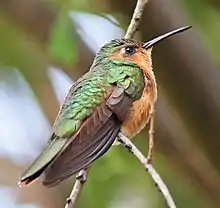
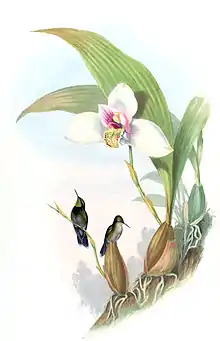
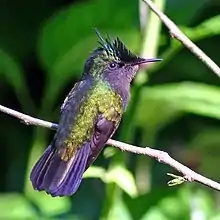
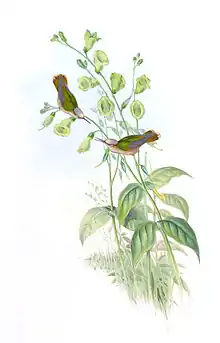
The tribe contains 36 genera.[3]
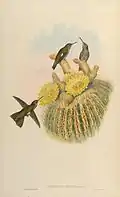
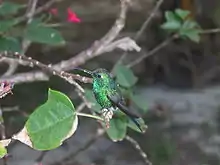
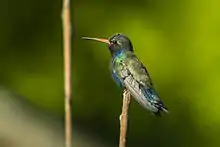
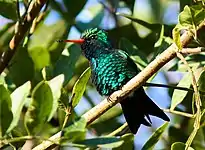
.jpg.webp)
_JCB.jpg.webp)
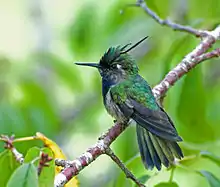
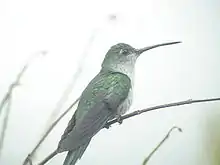
_crop.jpg.webp)
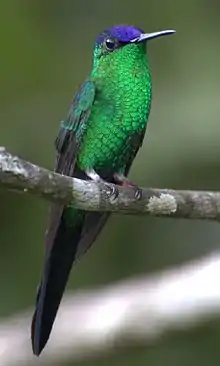
.jpg.webp)
.jpg.webp)
.jpg.webp)
.jpg.webp)
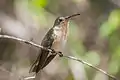
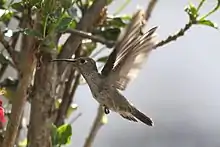
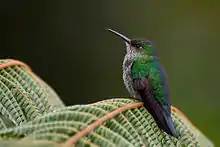
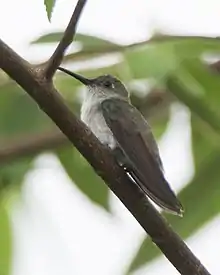
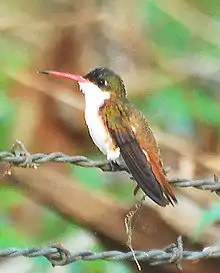
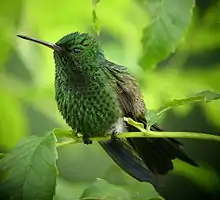
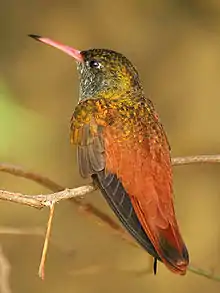
.jpg.webp)
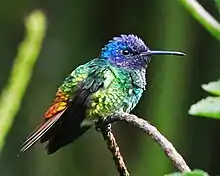
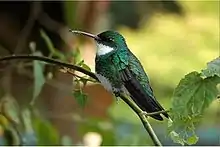
.jpg.webp)
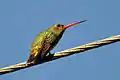
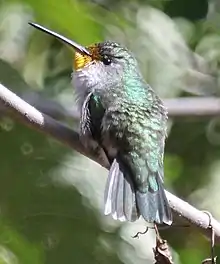
_male.jpg.webp)
References
- Bleiweiss, R.; Kirsch, J.A.; Matheus, J.C. (1997). "DNA hybridization evidence for the principal lineages of hummingbirds (Aves:Trochilidae)". Molecular Biology and Evolution. 14 (3): 325–343. doi:10.1093/oxfordjournals.molbev.a025767.
- McGuire, J.; Witt, C.; Remsen, J.V.; Corl, A.; Rabosky, D.; Altshuler, D.; Dudley, R. (2014). "Molecular phylogenetics and the diversification of hummingbirds". Current Biology. 24 (8): 910–916. doi:10.1016/j.cub.2014.03.016.
- Gill, Frank; Donsker, David; Rasmussen, Pamela, eds. (July 2020). "Hummingbirds". IOC World Bird List Version 10.2. International Ornithologists' Union. Retrieved 10 January 2020.
- McGuire, J.A.; Witt, C.C.; Altshuler, D.L.; Remsen, J.V. (2007). "Phylogenetic systematics and biogeography of hummingbirds: Bayesian and maximum likelihood analyses of partitioned data and selection of an appropriate partitioning strategy". Systematic Biology. 56 (5): 837–856. doi:10.1080/10635150701656360.
- Dickinson & Remsen 2013, p. 131.
- McGuire, J.A.; Witt, C.C.; Remsen, J.V.; Dudley, R.; Altshuler, D.L. (2009). "A higher-level taxonomy for hummingbirds". Journal of Ornithology. 150 (1): 155–165. doi:10.1007/s10336-008-0330-x.
- Dickinson & Remsen 2013, pp. 105–136.
- Stiles, F.G.; Remsen, J.V. Jr.; Mcguire, J.A. (2017). "The generic classification of the Trochilini (Aves: Trochilidae): Reconciling taxonomy with phylogeny". Zootaxa. 4353 (3): 401–424. doi:10.11646/zootaxa.4353.3.
Sources
- Dickinson, E.C.; Remsen, J.V., Jr., eds. (2013). The Howard & Moore Complete Checklist of the Birds of the World. Volume 1: Non-passerines (4th ed.). Eastbourne, UK: Aves Press. ISBN 978-0-9568611-0-8.