Spinops
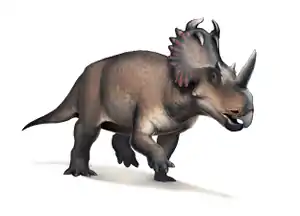
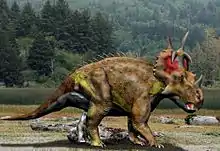
Spinops is an extinct genus of centrosaurine ceratopsian dinosaur from the Late Cretaceous of Alberta, southern Canada.[1]
| Spinops | |
|---|---|
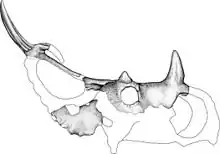 | |
| Skull reconstruction | |
Scientific classification  | |
| Kingdom: | Animalia |
| Phylum: | Chordata |
| Clade: | Dinosauria |
| Order: | †Ornithischia |
| Family: | †Ceratopsidae |
| Subfamily: | †Centrosaurinae |
| Tribe: | †Centrosaurini |
| Genus: | †Spinops Farke et al., 2011 |
| Species: | †S. sternbergorum |
| Binomial name | |
| †Spinops sternbergorum Farke et al., 2011 | |
Discovery and naming
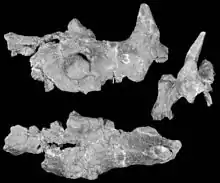
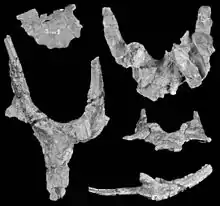
Spinops is known from the holotype NHMUK R16307, a partial parietal bone, preserving most of the midline bar. Referred material include NHMUK R16308, a partial parietal bone, partial dentary and unidentifiable limb fragments, NHMUK R16306, an incomplete skull, preserving only the dorsal portion of the skull, and NHMUK R16309, a partial right squamosal. None of this material was found in articulation, however it was all closely associated in the same bone bed, in the northwestern region ("Steveville Badlands") of the Dinosaur Provincial Park. Fossils of Spinops were first found in 1916, and were housed in the Natural History Museum in London. The material was not described until 2011, when the new species Spinops sternbergorum was erected. The material was probably collected from the upper part of the Oldman Formation or the lower part of the Dinosaur Park Formation, dating to the Campanian stage of the Late Cretaceous period.[1]
Two partials skulls of Spinops were found in 1916, in a large bone bed near the Red Deer River of southern Alberta, by American commercial fossil collector Charles Hazelius Sternberg and his son Levi Sternberg. The fossils were sent to the Natural History Museum in London (then called the British Museum (Natural History)), which had financed the expedition. The museum considered the fossils too fragmentary to display, leaving them unprepared in the collections. In a letter to Charles H. Sternberg, English paleontologist Arthur Smith Woodward of the British Museum called the Spinops material "nothing but rubbish".[2] The precise whereabouts of the bonebed that yielded the fossils is unknown due to poor field record keeping, but Darren Tanke of the Royal Tyrrell Museum is spearheading attempts at its relocation. The fossils were re-examined in 2011 by a team led by Dr Andrew A. Farke; which realized that the fossils represented an entirely new species of dinosaur.[3]
Spinops was first named by Andrew A. Farke, Michael J. Ryan, Paul M. Barrett, Darren H. Tanke, Dennis R. Braman, Mark A. Loewen, and Mark R. Graham in 2011; the type species is Spinops sternbergorum. The generic name is derived from Latin spina, "spine", and Greek ops, "face", in reference to the unique ornamentation on the face. The specific name honours Charles H. and Levi Sternberg.[1]
Classification
The cladogram presented below follows a recent phylogenetic analysis by Chiba et al. (2017):[4]
| Centrosaurinae |
| |||||||||||||||||||||||||||||||||||||||||||||||||||||||||||||||||||||||||||||||||||||||||||||||||||||||||||||||
See also
References
- Farke, Andrew A.; Michael J. Ryan; Paul M. Barrett; Darren H. Tanke; Dennis R. Braman; Mark A. Loewen; Mark R. Graham (2011). "A new centrosaurine from the Late Cretaceous of Alberta, Canada, and the evolution of parietal ornamentation in horned dinosaurs" (PDF). Acta Palaeontologica Polonica. 56 (4): 691–702. doi:10.4202/app.2010.0121.
- Bogar, Glenda (6 December 2011). "Scientists Discover New Species of Horned Dinosaur from Specimens Uncovered in London Museum Collections". Cleveland Museum of Natural History Press Room. Cleveland Museum of Natural History. Archived from the original on 3 October 2013. Retrieved 7 December 2011.
- Collins, Nick (6 Dec 2011). "New dinosaur species discovered in Natural History Museum after nearly a century". The Telegraph. Retrieved 13 Mar 2012.
- Kentaro Chiba; Michael J. Ryan; Federico Fanti; Mark A. Loewen; David C. Evans (2018). "New material and systematic re-evaluation of Medusaceratops lokii (Dinosauria, Ceratopsidae) from the Judith River Formation (Campanian, Montana)". Journal of Paleontology. in press. doi:10.1017/jpa.2017.62.
| ||||||||||||||||||||||||||||||||||||||||||||||||||||||
| ||||||||||||||||||||||||||||||||||||||||||||||||||||||
| ||||||||||||||||||||||||||||||||||||||||||||||||||||||