Rhinocerotoidea
Rhinocerotoidea is a superfamily consisting of three family groups of odd-toed ungulates, two of which, the Amynodontidae and Hyracodontidae, are extinct. The only extant family group is the Rhinocerotidae (true rhinoceroses), which survives as five living species. The extinct members of this superfamily are often called "rhinoceroses" alongside members of the family Rhinocerotidae, though they include genera, such as Paraceratherium, which do not closely resemble modern rhinoceroses.
| Rhinocerotoidea | |
|---|---|
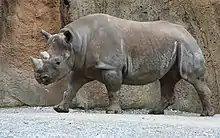 | |
| A Black rhinoceros (Diceros bicornis) at the Saint Louis Zoo | |
Scientific classification  | |
| Kingdom: | Animalia |
| Phylum: | Chordata |
| Class: | Mammalia |
| Order: | Perissodactyla |
| Suborder: | Ceratomorpha |
| Superfamily: | Rhinocerotoidea |
Taxonomy
The family tree below shows the relationship between Rhinocerotoidea and other groups.[1]
|
References
- Luke T. Holbrook and Joshua Lapergola (2011). "A New Genus of Perissodactyl (Mammalia) from the Bridgerian of Wyoming, with comments on basal Perissodactyl phylogeny". Journal of Vertebrate Paleontology. 31: 895–901. doi:10.1080/02724634.2011.579669.