Passerea
Passerea is a clade of neoavian birds that was proposed by Jarvis et al. (2014).[1] Their genomic analysis recovered two major clades within Neoaves, Passerea and Columbea, and concluded that both clades appear to have many ecologically driven convergent traits.
| Passerea | |
|---|---|
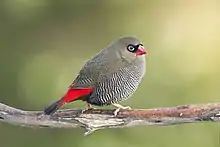 | |
| Beautiful firetail (Stagonopleura bella) | |
Scientific classification  | |
| Kingdom: | Animalia |
| Phylum: | Chordata |
| Class: | Aves |
| Infraclass: | Neognathae |
| Clade: | Neoaves |
| Clade: | Passerea Jarvis et al., 2014 |
| Clades | |
According to Jarvis (2014), these convergences include the footpropelled diving trait of grebes in Columbea with loons and cormorants in Passerea; the wading-feeding trait of flamingos in Columbea with ibises and egrets in Passerea; and pigeons and sandgrouse in Columbea with shorebirds (killdeer) in Passerea. For Jarvis (2014), these long-known trait and morphological alliances suggest that some of the traditional nongenomic trait classifications are based on polyphyletic assemblages.
Phylogeny
Cladogram of Passerea relationships based on Jarvis, E.D. et al. (2014)[1] with some clade names after Yuri, T. et al. (2013)[4] and Kimball et al. 2013.[5]
| Passerea |
| ||||||||||||||||||||||||||||||||||||||||||||||||||||||||||||
_white_background.jpg.webp)


_(6852440498)_white_background.jpg.webp)
_white_background.jpg.webp)

_white_background.jpg.webp)


| Telluraves |
| ||||||||||||||||||||||||||||||||||||||||||||||||||||||||||||||||||||||||


_white_background.jpg.webp)


_white_background.jpg.webp)


_white_background.jpg.webp)

_white_background.jpg.webp)
9_white_background.jpg.webp)

References
- Jarvis, E. D.; Mirarab, S.; Aberer, A. J.; et al. (2014). "Whole-genome analyses resolve early branches in the tree of life of modern birds". Science. 346 (6215): 1320–1331. Bibcode:2014Sci...346.1320J. doi:10.1126/science.1253451. PMC 4405904. PMID 25504713.
- Prum, R.O. et al. (2015) A comprehensive phylogeny of birds (Aves) using targeted next-generation DNA sequencing. Nature 526, 569–573.
- H Kuhl, C Frankl-Vilches, A Bakker, G Mayr, G Nikolaus, S T Boerno, S Klages, B Timmermann, M Gahr (2020) An unbiased molecular approach using 3’UTRs resolves the avian family-level tree of life. Molecular Biology and Evolution. https://doi.org/10.1093/molbev/msaa191
- Yuri, T.; et al. (2013). "Parsimony and Model-Based Analyses of Indels in Avian Nuclear Genes Reveal Congruent and Incongruent Phylogenetic Signals". Biology. 2 (1): 419–444. doi:10.3390/biology2010419. PMC 4009869. PMID 24832669.
- Kimball, R.T. et al. (2013) Identifying localized biases in large datasets: A case study using the Avian Tree of Life. Mol Phylogenet Evol. doi:10.1016/j.ympev.2013.05.029


