Oxyaenidae
Oxyaenidae ("sharp hyenas") is a family of extinct carnivorous eutherian mammals.[1] Traditionally classified in order Creodonta, this group is now classified in its own order Oxyaenodonta within clade Ferae. The group contains four subfamilies comprising fifteen genera. North American oxyaenids were the first to appear during the late Paleocene, while smaller radiations of oxyaenids in Europe and Asia occurred during the Eocene.[2]
| Oxyaenidae | |
|---|---|
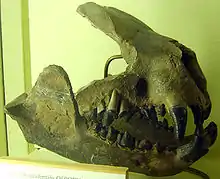 | |
| Part of a Palaeonictis occidentalis skull at the Museum für Naturkunde, Berlin | |
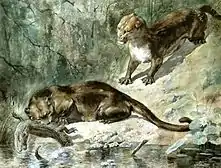 | |
| Restoration of Patriofelis ferox by Charles Knight | |
Scientific classification  | |
| Kingdom: | Animalia |
| Phylum: | Chordata |
| Class: | Mammalia |
| Clade: | Ferae |
| Order: | †Oxyaenodonta Van Valen, 1971 |
| Family: | †Oxyaenidae Cope, 1877 |
| Subfamilies | |
| |
| Synonyms | |
|
synonyms of order:
synonyms of family:
| |
General characteristics
They were superficially cat-like mammals that walked on flat feet, in contrast to modern cats, which walk and run on their toes. Anatomically, characteristic features include a short, broad skull, deep jaws, and teeth designed for crushing rather than shearing, as in the hyaenodonts or modern cats.
Oxyaenids were specialized carnivores that preyed on other terrestrial vertebrates, eggs and insects. They were capable of climbing trees, which is suggested by fossil evidence of their paws.
Classification and phylogeny
Taxonomy
- Order: †Oxyaenodonta (Van Valen, 1971)
- Family: †Oxyaenidae (Cope, 1877)
- Subfamily: †Machaeroidinae (Matthew, 1909)
- Genus: †Apataelurus (Scott, 1937)
- †Apataelurus kayi (Scott, 1937)
- †Apataelurus pishigouensis (Tong & Lei, 1986)
- Genus: †Isphanatherium (Lavrov & Averianov, 1998)
- Isphanatherium ferganensis (Lavrov & Averianov, 1998)
- Genus: †Machaeroides (Matthew, 1909)
- †Machaeroides eothen (Matthew, 1909)
- †Machaeroides simpsoni (Dawson, 1986)
- Genus: †Apataelurus (Scott, 1937)
- Subfamily: †Oxyaeninae (Cope, 1877)
- Genus: †Argillotherium (Cope, 1877)
- †Argillotherium toliapicum (Davies, 1884)
- Genus: †Dipsalidictides (Denison, 1938)
- †Dipsalidictides transiens (Matthew & Granger, 1915)
- Genus: †Dipsalidictis (Matthew & Granger, 1915) <−−−[paraphyletic genus]
- †Dipsalidictis aequidens (Matthew & Granger, 1915)
- †Dipsalidictis krausei (Gunnell & Gingerich, 1991)
- †Dipsalidictis platypus (Matthew & Granger, 1915)
- Genus: †Malfelis (Stucky & Hardy, 2007)[3]
- †Malfelis badwaterensis (Stucky & Hardy, 2007)
- Genus: †Oxyaena (Cope, 1874)
- †Oxyaena forcipata (Cope, 1874)
- †Oxyaena gulo (Matthew & Granger, 1915)
- †Oxyaena intermedia (Denison, 1938)
- †Oxyaena lupina (Cope, 1874)
- †Oxyaena pardalis (Matthew & Granger, 1915)
- †Oxyaena simpsoni (Van Valen, 1966)
- †Oxyaena woutersi (Lange-Badré & Godinot, 1982)
- Genus: †Patriofelis (Leidy, 1870)
- †Patriofelis ferox (Marsh, 1872)
- †Patriofelis ulta (Leidy, 1870)
- Genus: †Protopsalis (Cope, 1880)
- †Protopsalis tigrinus (Cope, 1880)
- Genus: †Sarkastodon (Granger, 1938)
- †Sarkastodon henanensis (Tong & Lei, 1986)
- †Sarkastodon mongoliensis (Granger, 1938)
- Genus: †Argillotherium (Cope, 1877)
- Subfamily: †Palaeonictinae (Denison, 1938) [synonym: Ambloctoninae (Cope, 1877)]
- Genus: †Ambloctonus (Cope, 1875)
- †Ambloctonus major (Denison, 1938)
- †Ambloctonus priscus (Matthew & Granger, 1915)
- †Ambloctonus sinosus (Cope, 1875)
- Genus: †Dipsalodon (Jepsen, 1930) <−−−[paraphyletic genus]
- †Dipsalodon churchillorum (Rose, 1981)
- †Dipsalodon matthewi (Jepsen, 1930)
- Genus: †Palaeonictis (de Blainville, 1842)
- †Palaeonictis gigantea (de Blainville, 1842)
- †Palaeonictis occidentalis (Osborn, 1892)
- †Palaeonictis peloria (Rose, 1981)
- †Palaeonictis wingi (Chester, 2010)
- Genus: †Ambloctonus (Cope, 1875)
- Subfamily: †Tytthaeninae (Gunnell & Gingerich, 1991)
- Genus: †Tytthaena (Gingerich, 1980)
- †Tytthaena lichna (Rose, 1981)
- †Tytthaena parrisi (Gingerich, 1980)
- Genus: †Tytthaena (Gingerich, 1980)
- Subfamily: †Machaeroidinae (Matthew, 1909)
- Family: †Oxyaenidae (Cope, 1877)
Phylogeny
The phylogenetic relationships of family Oxyaenidae are shown in the following cladogram:[4][5][6][7][8][9]
| Ferae |
| |||||||||||||||||||||||||||||||||||||||||||||||||||||||||||||||||||||||||||||||||||||||||||||||||||||||||||||||||||||||||||||||||||||||||||||||||||||||||||||||||||||||||||||||||||||||||||||||||||||||||||||||||||||||||||||||||||||||
.jpg.webp)
.jpg.webp)
.jpg.webp)
.jpg.webp)
.png.webp)
References
- Halliday, Thomas J. D.; Upchurch, Paul; Goswami, Anjali (2015). "Resolving the relationships of Paleocene placental mammals" (PDF). Biological Reviews. 92: n/a–n/a. doi:10.1111/brv.12242. ISSN 1464-7931. PMC 6849585. PMID 28075073.
- Gunnel, Gregg F.; Gingerich, Philip D. (30 Sep 1991). "Systematics and evolution of late Paleocene and early Eocene Oxyaenidae (Mammalia, Creodonta) in the Clarks Fork Basin, Wyoming" (PDF). Contributions From the Museum of Paleontology. The University of Michigan. 28 (7): 141–180. Retrieved 2010-01-03.
- Stucky, R. K.; Hardy, T. G. (2007). "A new large hypercarnivorous oxyaenid (Mammalia, Creodonta) from the Middle Eocene of the Wind River Formation, Natrona County, Wyoming". Bulletin of Carnegie Museum of Natural History. 39: 57–65. doi:10.2992/0145-9058(2007)39[57:anlhom]2.0.co;2.
- Gunnel, Gregg F.; Gingerich, Philip D. (1991). "Systematics and evolution of late Paleocene and early Eocene Oxyaenidae (Mammalia, Creodonta) in the Clarks Fork Basin, Wyoming" (PDF). Contributions From the Museum of Paleontology. The University of Michigan. 28 (7): 141–180.
- Stephen G. B. Chester; Jonathan I. Bloch; Ross Secord; Doug M. Boyer (2010). "A new small bodied species of Palaeonictis (Creodonta, Oxyaenidae) from the Paleocene-Eocene thermal maximum". Journal of Mammalian Evolution. 17 (4): 227–243. doi:10.1007/s10914-010-9141-y.
- F. Solé, E. Gheerbrant, and M. Godinot. (2011.) "New data on the Oxyaenidae from the Early Eocene of Europe; biostratigraphic, paleobiogeographic and paleoecologic implications." Palaeontologia Electronica 14(2):13A:1-41
- Solé, F. & Ladevèze, S. (2017). "Evolution of the hypercarnivorous dentition in mammals (Metatheria, Eutheria) and its bearing on the development of tribosphenic molars." Evolution & Development, 19(2), 56–68.
- Prevosti, F. J., & Forasiepi, A. M. (2018). "Introduction. Evolution of South American Mammalian Predators During the Cenozoic: Paleobiogeographic and Paleoenvironmental Contingencies"
- Shawn P. Zack (2019). "A skeleton of a Uintan machaeroidine 'creodont' and the phylogeny of carnivorous eutherian mammals". Journal of Systematic Palaeontology. 17 (8): 653–689. doi:10.1080/14772019.2018.1466374.
Further reading
- David Lambert and the Diagram Group. The Field Guide to Prehistoric Life. New York: Facts on File Publications, 1985. ISBN 0-8160-1125-7
| ||||||||||
| Family: †Oxyaenidae |
|   | ||||||||