Ooperipatellus nanus
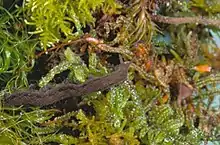
Ooperipatellus nanus is a species of velvet worm in the Peripatopsidae family. This species is endemic to New Zealand and is found in the South Island.
| Ooperipatellus nanus | |
|---|---|
 | |
| Scientific classification | |
| Kingdom: | |
| Phylum: | |
| Class: | |
| Order: | |
| Family: | |
| Genus: | |
| Species: | O. nanus |
| Binomial name | |
| Ooperipatellus nanus Ruhberg, 1985[1] | |
Taxonomy
This species was first described by Hilke Ruhberg in 1985.[2]
Description
O. nanus is a small species of velvet worm that grows to a length of approximately 10 mm.[3] It has 13 pairs of legs which is the lowest number of all the known species of velvet worms in New Zealand.[3]
Distribution
O. nanus has only been found in Southland, in the Takitimu Mountains.[2]
Life cycle
This species produce young by laying eggs from which the young subsequently hatch.[3]
Host species
O. nanus are found mainly in rotting beech logs.[4]
Conservation Status
This species has been classified as having the "At Risk, Naturally Uncommon" conservation status under the New Zealand Threat Classification System.[5]
References
- Oliveira, I.; Hering, L. & Mayer, G. "Updated Onychophora checklist". Onychophora Website. Retrieved 24 November 2016.
- Harris, A. C (1991). "A large aggregation of Peripatoides novaezealandiae (Hutton, 1876) (Onycophora: Peripatopsidae)". Journal of the Royal Society of New Zealand. 21 (4): 405–406. doi:10.1080/03036758.1991.10420836.
- Allwood, Julia; Gleeson, Dianne; Mayer, Georg; Daniels, Savel; Beggs, Jacqueline R.; Buckley, Thomas R. (April 2010). "Support for vicariant origins of the New Zealand Onychophora". Journal of Biogeography. 37 (4): 669–681. doi:10.1111/j.1365-2699.2009.02233.x.
- "Current Taxonomic Status: Onychophora". Manaaki Whenua - Landcare Research. Retrieved 2018-09-15.
- Trewick, Steve; Hitchmough, Rod; Rolfe, Jeremy; Stringer, Ian (2018). Conservation status of New Zealand Onychophora ('peripatus' or velvet worm), 2018 (PDF). New Zealand Threat Classification Series. 26. Department of Conservation. pp. 1–3. ISBN 9781988514703 – via Department of Conservation.
External links
 |
Wikimedia Commons has media related to Ooperipatellus nanus. |
