Mycenaceae
The Mycenaceae are a family of fungi in the order Agaricales. According to the Dictionary of the Fungi (10th edition, 2008), the family contains 10 genera and 705 species.[1] This is one of several families that were separated from the Tricholomataceae as a result of phylogenetic analyses. Taxa in the Mycenaceae are saprobic, have a cosmopolitan distribution, and are found in almost all ecological zones.[2] The family was circumscribed by Caspar van Overeem in 1926.
| Mycenaceae | |
|---|---|
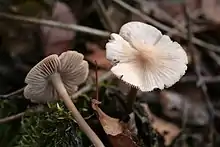 | |
| Mycena galericulata | |
Scientific classification  | |
| Kingdom: | Fungi |
| Division: | Basidiomycota |
| Class: | Agaricomycetes |
| Order: | Agaricales |
| Family: | Mycenaceae Overeem (1926) |
| Type genus | |
| Mycena | |
| Genera | |
The extinct genus Protomycena, described from Burdigalian age Dominican amber found on the island of Hispaniola[3] is one of four known agaric genera in the fossil record.[4]
Phylogeny
| |||||||||||||||||||||||||||||||||||||||||||||||||||||||||||||||||||||||||||||||||||||||||||||||||||||||||||||||||||||
| Phylogeny of the Mycenaceae based on nuclear large ribosomal subunit gene sequences.[5] |
A large-scale phylogenetic analysis study of the Agaricales published by a consortium of mycologists in 2002 adopted the name Mycenaceae for a strongly supported clade consisting of Dictyopanus, Favolaschia, Mycena, Mycenoporella, Prunulus, Panellus, Poromycena, and Resinomycena.[5] Dictyopanus has since been wrapped into Panellus,[6] and both Poromycena[7] and Prunulus into Mycena.[8]

References
- Kirk et al. (2008), p. 446.
- Cannon PF, Kirk PM (2007). Fungal Families of the World. Wallingford, UK: CAB International. pp. 225–26. ISBN 978-0-85199-827-5.
- Hibbett DS, Grimaldi DS, Donoghue MJ (1997). "Fossil mushrooms from Miocene and Cretaceous ambers and the evolution of Homobasidiomycetes". American Journal of Botany. 84 (8): 981–91. doi:10.2307/2446289. JSTOR 2446289.
- Hibbett DS, Binder M, Wang Z (2003). "Another fossil agaric from Dominican amber". Mycologia. 95 (4): 685–87. doi:10.2307/3761943. JSTOR 3761943. PMID 21148976.
- Moncalvo JM, Vilgalys R, Redhead SA, Johnson JE, James TY, Catherine Aime M, Hofstetter V, Verduin SJ, Larsson E, Baroni TJ, Greg Thorn R, Jacobsson S, Clémençon H, Miller OK Jr (2002). "One hundred and seventeen clades of euagarics". Molecular Phylogenetics and Evolution. 23 (3): 357–400. doi:10.1016/S1055-7903(02)00027-1. PMID 12099793.
- Kirk et al. (2008), p. 206.
- Kirk et al. (2008), p. 559.
- Kirk et al. (2008), p. 565.
Cited text
- Kirk PM, Cannon PF, Minter DW, Stalpers JA (2008). Dictionary of the Fungi (10th ed.). Wallingford, UK: CAB International. p. 446. ISBN 978-0-85199-826-8.