Muroidea
The Muroidea are a large superfamily of rodents, including mice, rats, voles, hamsters, gerbils, and many other relatives. They occupy a vast variety of habitats on every continent except Antarctica. Some authorities have placed all members of this group into a single family, Muridae, due to difficulties in determining how the subfamilies are related to one another. The following taxonomy is based on recent well-supported molecular phylogenies.[1]
| Muroidea | |
|---|---|
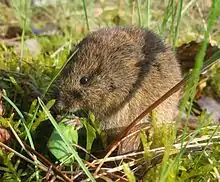 | |
| Common vole (Microtus arvalis) | |
Scientific classification  | |
| Kingdom: | Animalia |
| Phylum: | Chordata |
| Class: | Mammalia |
| Order: | Rodentia |
| Suborder: | Myomorpha |
| Superfamily: | Muroidea Illiger, 1811 |
| Families | |
|
Platacanthomyidae sister: Dipodoidea | |
The muroids are classified in six families, 19 subfamilies, around 280 genera, and at least 1750 species.
Taxonomy
- Family Platacanthomyidae (spiny dormouse and pygmy dormice)
- Family Spalacidae (fossorial muroids)
- Subfamily Myospalacinae (zokors)
- Subfamily Rhizomyinae (bamboo rats and root rats)
- Subfamily Spalacinae (blind mole rats)
- Clade Eumuroida – typical muroids
- Family Calomyscidae
- Subfamily Calomyscinae (mouse-like hamsters)
- Family Nesomyidae
- Subfamily Cricetomyinae (pouched rats and mice)
- Subfamily Dendromurinae (African climbing mice, gerbil mice, fat mice and forest mice)
- Subfamily Mystromyinae (white-tailed rat)
- Subfamily Nesomyinae (Malagasy rats and mice)
- Subfamily Petromyscinae (rock mice and the climbing swamp mouse)
- Family Cricetidae
- Subfamily Arvicolinae (voles, lemmings and muskrat)
- Subfamily Cricetinae (true hamsters)
- Subfamily Neotominae (North American rats and mice)
- Subfamily Sigmodontinae (New World rats and mice)
- Subfamily Tylomyinae (vesper rats and climbing rats)
- Family Muridae
- Subfamily Deomyinae (spiny mice, brush furred mice, link rat)
- Subfamily Gerbillinae (gerbils, jirds and sand rats)
- Subfamily Leimacomyinae (Togo Mouse)
- Subfamily Lophiomyinae (crested rat)
- Subfamily Murinae (Old World rats and mice including vlei rats)
- Family Calomyscidae
Phylogeny
5 main clades are recognized by Jansa & Weksler (2004).[2]
- Family Spalacidae: Spalacinae, Myospalacinae, and Rhizomyinae (fossorial species of the Old World)
- Family Calomyscidae: Calomyscinae (Asia)
- Family Nesomyidae: Petromyscinae, Mystromyinae, Cricetomyinae, Nesomyinae, and core dendromurines (Africa and Madagascar)
- Family Muridae: Murinae, Otomyinae, Gerbillinae, Acomyinae, and Lophiomyinae (Old World)
- Family Cricetidae: Sigmodontinae, Arvicolinae, and Cricetinae (New World)
Together, Muroidea and its sister group Dipodoidea form the suborder Myomorpha.
The following phylogeny of more than 70 Muroidea genera, based on molecular phylogenetic analysis of the Interphotoreceptor Retinoid Binding Protein (IRBP) gene, is from Jansa & Weksler (2004: 264).[2] Although Platacanthomyidae was not analyzed by Jansa & Weksler (2004), a study by Fabre et al. 2012[3] suggests that it is the most basal lineage of Muroidea.
| Muroidea | |
References
- Steppan, S.; Adkins, R.; Anderson, J. (2004). "Phylogeny and Divergence-Date Estimates of Rapid Radiations in Muroid Rodents Based on Multiple Nuclear Genes". Systematic Biology. 53 (4): 533–553. doi:10.1080/10635150490468701. PMID 15371245.
- Jansa, S.A.; Weksler, M. (2004). "Phylogeny of muroid rodents: relationships within and among major lineages as determined by IRBP gene sequences". Molecular Phylogenetics and Evolution. 31 (1): 256–276. doi:10.1016/j.ympev.2003.07.002. PMID 15019624.
- Fabre; et al. (2012). "A glimpse on the pattern of rodent diversification: a phylogenetic approach". BMC Evolutionary Biology. 12: 88. doi:10.1186/1471-2148-12-88. PMC 3532383. PMID 22697210.
- Jansa, S. A.; Giarla, T. C.; Lim, B. K. (2009). "The Phylogenetic Position of the Rodent Genus Typhlomys and the Geographic Origin of Muroidea". Journal of Mammalogy. 90 (5): 1083. doi:10.1644/08-MAMM-A-318.1.
- Jansa, S.A.; Weksler, M. (2004). "Phylogeny of muroid rodents: relationships within and among major lineages as determined by IRBP gene sequences". Molecular Phylogenetics and Evolution. 31 (1): 256–276. doi:10.1016/j.ympev.2003.07.002. PMID 15019624.
- Michaux, J.; Reyes, A.; Catzeflis, F. (2001). "Evolutionary history of the most speciose mammals: Molecular phylogeny of muroid rodents". Molecular Biology and Evolution. 18 (11): 2017–2031. doi:10.1093/oxfordjournals.molbev.a003743. PMID 11606698.
- Musser, G. G. and M. D. Carleton. 1993. Family Muridae. pp. 501–755 in Mammal Species of the World a Taxonomic and Geographic Reference. D. E. Wilson and D. M. Reeder eds. Smithsonian Institution Press, Washington D.C.
- Musser, G.G.; Carleton, M.D. (2005). "Superfamily Muroidea". In Wilson, D.E.; Reeder, D.M (eds.). Mammal Species of the World: A Taxonomic and Geographic Reference (3rd ed.). Johns Hopkins University Press. pp. 894–1531. ISBN 978-0-8018-8221-0. OCLC 62265494.
- Norris, R. W.; Zhou, K.; Zhou, C.; Yang, G.; William Kilpatrick, C.; Honeycutt, R. L. (2004). "The phylogenetic position of the zokors (Myospalacinae) and comments on the families of muroids (Rodentia)". Molecular Phylogenetics and Evolution. 31 (3): 972–978. doi:10.1016/j.ympev.2003.10.020. PMID 15120394.