Malawania
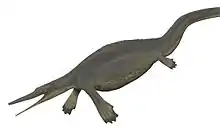
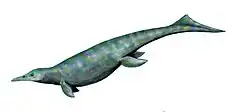
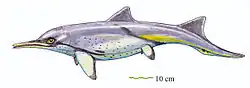
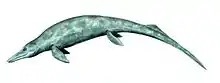
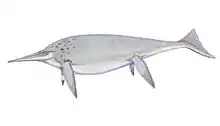
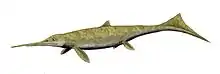
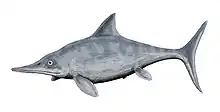
Malawania is an extinct genus of basal thunnosaur ichthyosaur known from the middle Early Cretaceous (Hauterivian or Barremian stage) of Iraq. Malawania was named by Valentin Fischer, Robert M. Appleby, Darren Naish, Jeff Liston, Riding, J. B., Brindley, S. and Pascal Godefroit in 2013 and the type species is Malawania anachronus.[1] It is unusual as it is much more primitive than other Cretaceous ichthyosaurs, being most closely related to Icthyosaurus itself from the Late Triassic and Early Jurassic, over 70 million years earlier, with all other known ichthyosaurs from the Late Jurassic onwards belonging to the family Ophthalmosauridae.
| Malawania | |
|---|---|
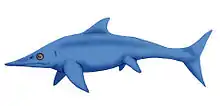 | |
| Restoration | |
Scientific classification  | |
| Kingdom: | Animalia |
| Phylum: | Chordata |
| Class: | Reptilia |
| Order: | †Ichthyosauria |
| Family: | †Ichthyosauridae |
| Genus: | †Malawania Fischer et al., 2013 |
| Type species | |
| †Malawania anachronus Fischer et al., 2013 | |
Discovery
The holotype and only known specimen was discovered in 1952 by British petroleum geologists D. M. Morton, F. R. S. Henson, R. J. Wetzel and L. C. F. Damesin while working in Chia Gara, Armadia in Iraqi Kurdistan. The slab was being used to dam a small river and was part of a mule track. It was then transported back to the UK and donated to the Natural History Museum in 1959. Robert M. Appleby would study the specimen for many years until his death in 2004, but never published a paper, one manuscript submitted to Paleontology in 1979 was rejected due to the uncertain provenance of the specimen.[2] The specimen was formally described in 2013 by Fischer and colleagues. Using palynology it was determined that the rocks surrounding the specimen were Hauterivian-Barremian in age, which was unexpected given the archaic nature of the specimen.[1]
Taxonomy
The name is derived from "Kurdish ‘Malawan’: swimmer and Latinized Greek noun in apposition ‘anachronus’ meaning ‘out of time’."[1]
Phylogeny
Below is a cladogram modified from Fischer et. al., 2013.[1]
| |||||||||||||||||||||||||||||||||||||||||||||||||||||||||||||||||||||||||||||||||||||||||||||||||||||||||||||||||||||||||||||||||||||||||||||||||||||||
References
- Fischer, V.; Appleby, R. M.; Naish, D.; Liston, J.; Riding, J. B.; Brindley, S.; Godefroit, P. (2013). "A basal thunnosaurian from Iraq reveals disparate phylogenetic origins for Cretaceous ichthyosaurs". Biology Letters. 9 (4): 20130021. doi:10.1098/rsbl.2013.0021. PMC 3730615. PMID 23676653.
- Naish, Darren. "Malawania from Iraq and the Cretaceous Ichthyosaur Revolution (part II)". Tetrapod Zoology. Scientific American. Retrieved 2020-07-27.
| |||||||||||||||||||||||||||||||||||||||||||||||||||
| |||||||||||||||||||||||||||||||||||||||||||||||||||
| |||||||||||||||||||||||||||||||||||||||||||||||||||
| |||||||||||||||||||||||||||||||||||||||||||||||||||
| |||||||||||||||||||||||||||||||||||||||||||||||||||