Loranthaceae
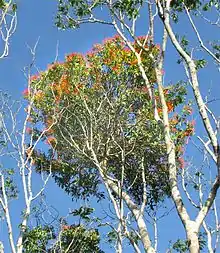
Loranthaceae, commonly known as the showy mistletoes, is a family of flowering plants.[2][3] It consists of about 75 genera and 1,000 species of woody plants, many of them hemiparasites. The three terrestrial species are Nuytsia floribunda (the Western Australian Christmas tree), Atkinsonia ligustrina (from the Blue Mountains of Australia), and Gaiadendron punctatum (from Central/South America.) Loranthaceae are primarily xylem parasites, but their haustoria may sometimes tap the phloem,[4] while Tristerix aphyllus is almost holoparasitic.[5] For a more complete description of the Australian Loranthaceae, see Flora of Australia online.,[2] for the Malesian Loranthaceae see Flora of Malesia.
| Loranthaceae | |
|---|---|
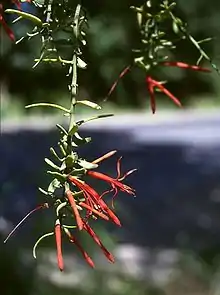 | |
| Ligaria cuneifolia | |
Scientific classification  | |
| Kingdom: | Plantae |
| Clade: | Tracheophytes |
| Clade: | Angiosperms |
| Clade: | Eudicots |
| Order: | Santalales |
| Family: | Loranthaceae Juss.[1] |
| Genera | |
|
See text | |
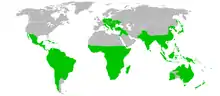 | |
| Distribution of the Loranthaceae. | |
Originally, Loranthaceae contained all mistletoe species, but the mistletoes of Europe and North America (Viscum, Arceuthobium, and Phoradendron) belong to the family Santalaceae. The APG II system 2003 assigns the family to the order Santalales in the clade core eudicots.
Phylogeny
Molecular phylogenetics suggests the following relationships of tribes, subtribes and genera:[6][7][8][9] Nuytsia is sister to the rest the Loranthaceae,[10] with many characters, including its pollen, its fruit (dry and three winged), and the number of its cotyledons, differing substantially from all other Loranthaceae genera.[5] The root parasitic habit is thought to be the basal condition of the family.,[5] with the stem/branch parasitic habit evolving ca. 28-40 million years ago.[5][11] However, Grimsson et al. (2017)[12] estimate this as occurring somewhat earlier (ca. 40-52 million years ago).
| ||||||||||||||||||||||||||||||||||||||||||||||||||||||||||||||||||||||||||||||||||||||||||||||||||||||||||||||||||||||||||||||||||||||||||||||||||||||||||||||||||||||||||||||||||||||||||||||||||||||||||||||||||||||||||||||||||||||||||||||||||||||||||||||||||||||||||||||||||||||||||||||
Genera
- Actinanthella
- Aetanthus
- Agelanthus
- Alepis
- Amyema
- Amylotheca
- Atkinsonia
- Bakerella
- Baratranthus
- Benthamina
- Berhautia
- Cecarria
- Cladocolea
- Cyne (plant)
- Dactyliophora
- Decaisnina
- Dendropemon
- Dendrophthoe
- Desmaria
- Diplatia
- Distrianthes
- Elytranthe
- Emelianthe
- Englerina
- Erianthemum
- Gaiadendron
- Globimetula
- Helicanthes
- Helixanthera
- Ileostylus
- Ixocactus
- Kingella
- Lampas
- Lepeostegeres
- Lepidaria
- Ligaria
- Loranthus
- Loxanthera
- Lysiana
- Macrosolen[13]
- Moquiniella
- Muellerina
- Notanthera
- Nuytsia
- Oliverella
- Oncella
- Oncocalyx
- Oryctanthus
- Oryctina
- Panamanthus
- Papuanthes
- Pedistylis
- Peraxilla
- Phragmanthera
- Phthirusa
- Plicosepalus
- Psittacanthus
- Pusillanthus
- Scurrula
- Septulina
- Socratina
- Sogerianthe
- Spragueanella
- Struthanthus
- Tapinanthus
- Taxillus
- Tetradyas
- Thaumasianthes
- Tolypanthus
- Trilepidea
- Tripodanthus
- Tristerix
- Trithecanthera
- Tupeia
- Vanwykia
See also
References
- Angiosperm Phylogeny Group (2009). "An update of the Angiosperm Phylogeny Group classification for the orders and families of flowering plants: APG III". Botanical Journal of the Linnean Society. 161 (2): 105–121. doi:10.1111/j.1095-8339.2009.00996.x.
- Barlow, B.A. "Flora of Australia online: Loranthaceae". Data derived from Flora of Australia Volume 1984 Vol 22, ABRS, ©Commonwealth of AustraliaAccessed 1 April 2018
- Kuijt, Job; Hansen, Bertel (2015). Flowering Plants. Eudicots. Santalales, Balanophorales. Cham: Springer International Publishing. doi:10.1007/978-3-319-09296-6. ISBN 978-3-319-09295-9.
- Barlow, B.A. 1997. "Loranthaceae. Pp. 209-401 (pdf)"., in Kalkman C., et al. (eds.), Flora malesiana. Ser. 1, vol. 13. Rijksherbarium/Hortus Botanicus, Leiden.
- Stevens, P.F. (2001 onwards). "Angiosperm Phylogeny Website. Version 14, July 2017 [and more or less continuously updated since]". Accessed 12 February 2018.
- Der, J.P., Nickrent, D.L. 2008. A molecular phylogeny of Santalaceae (Santalales). Systematic Botany 33: 107-116."(pdf)". doi:10.1600/036364408783887438
- Vidal-Russell, R., Nickrent, D.L. 2008. Evolutionary relationships in the showy mistletoe family (Loranthaceae). American Journal of Botany 95: 1015-1029."(pdf)" (PDF).doi:10.3732/ajb.0800085
- Malecot, V, Nickrent, D.L. 2008. Molecular Phylogenetic Relationships of Olacaceae and Related Santalales. Systematic Botany 33, 97-106."(pdf)" (PDF).doi:10.1600/036364408783887384
- Amico, G.C., Vidal-Russell, R., Garcia, M.A., Nickrent, D.L. 2012. "Evolutionary History of the South American Mistletoe Tripodanthus (Loranthaceae) Using Nuclear and Plastid Markers". January 2012.. Systematic Botany 37: 218-225
- Vidal-Russell, R., & Nickrent, D.L. 2005. "A molecular phylogeny of the mistletoe family Loranthaceae." Pp. 131-132, in Botany 2005. Learning from Plants.
- Vidal-Russell, R., & Nickrent, D.L. 2008. The first mistletoes: Origin of aerial parasitism in Santalales. Mol. Phyl. Evol. 47: 523-537."(pdf)" (PDF).doi:10.1016/j.ympev.2008.01.016
- Grímsson, F., Kapli, P., Hofmann, C.-C., Zetter, R., & Grimm, G.W. 2017. Eocene Loranthaceae pollen pushes back divergence ages for major splits in the family.// PeerJ 5:e3373. doi:10.7717/peerj.3373
- Macrosolen at The Plant List
External links
 Media related to Loranthaceae at Wikimedia Commons
- Loranthaceae on the Parasitic Plant Connection web site
- Notanthera heterophylla illustrations
- Chilean Loranthaceae at Chileflora