Later Liang (Sixteen Kingdoms)
The Later Liang (simplified Chinese: 后凉; traditional Chinese: 後凉; pinyin: Hòu Liáng; 386-403) was a state of the Sixteen Kingdoms during the Jin Dynasty (265-420) in China.[1] It was founded by the Lü family of the Di ethnicity.
Later Liang (後涼) 酒泉 (387-389), 三河 (389-396), 涼 (396-403) | |||||||||||||
|---|---|---|---|---|---|---|---|---|---|---|---|---|---|
| 386–403 | |||||||||||||
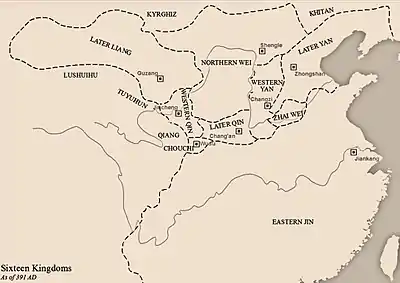 Later Liang in the northwest | |||||||||||||
| Capital | Guzang | ||||||||||||
| Government | Monarchy | ||||||||||||
| Tian Wang | |||||||||||||
• 386-400 | Lü Guang | ||||||||||||
• 400 | Lü Shao | ||||||||||||
• 401-403 | Lü Zuan | ||||||||||||
• 403-406 | Lü Long | ||||||||||||
| History | |||||||||||||
• Established | 386 | ||||||||||||
• Lü Guang's claiming of imperial title | 396 | ||||||||||||
| 397 | |||||||||||||
• Disestablished | 403 | ||||||||||||
• Lü Long's death | 416 | ||||||||||||
| |||||||||||||
| Today part of | China Kyrgyzstan | ||||||||||||

All rulers of the Later Liang proclaimed themselves "Heavenly Prince" (Tian Wang).
Rulers of the Later Liang
| Temple name | Posthumous name | Personal name | Duration of reign | Era names |
|---|---|---|---|---|
| Taizu | Yiwu | Lü Guang | 386-400 | Tai'an (太安) 386-389 Linjia (麟嘉) 389-396 Longfei (龍飛) 396-400 |
| – | Lü Shao | 400 | – | |
| – | Ling | Lü Zuan | 400-401 | Xianning (咸寧) 400-401 |
| – | Lü Long | 401-403 | Shending (神鼎) 401-403 | |
Rulers family tree
| Later Liang | |||||||||||||||||||||||||||||||||||||||||||||||||||||||||||||||||||||||||||||||||||||||||||||||||||||||||||||||||||||||||||||
|---|---|---|---|---|---|---|---|---|---|---|---|---|---|---|---|---|---|---|---|---|---|---|---|---|---|---|---|---|---|---|---|---|---|---|---|---|---|---|---|---|---|---|---|---|---|---|---|---|---|---|---|---|---|---|---|---|---|---|---|---|---|---|---|---|---|---|---|---|---|---|---|---|---|---|---|---|---|---|---|---|---|---|---|---|---|---|---|---|---|---|---|---|---|---|---|---|---|---|---|---|---|---|---|---|---|---|---|---|---|---|---|---|---|---|---|---|---|---|---|---|---|---|---|---|---|
| |||||||||||||||||||||||||||||||||||||||||||||||||||||||||||||||||||||||||||||||||||||||||||||||||||||||||||||||||||||||||||||
See also
References
- Grousset, Rene (1970). The Empire of the Steppes. Rutgers University Press. pp. 59–60. ISBN 0-8135-1304-9.
This article is issued from Wikipedia. The text is licensed under Creative Commons - Attribution - Sharealike. Additional terms may apply for the media files.