Lamiaceae
The Lamiaceae (/ˌleɪmiˈeɪsiaɪ, -iː/ LAY-mee-AY-see-e(y)e[3]) or Labiatae are a family of flowering plants commonly known as the mint or deadnettle or sage family. Many of the plants are aromatic in all parts and include widely used culinary herbs like basil, mentha, rosemary, sage, savory, marjoram, oregano, hyssop, thyme, lavender, and perilla, as well as other medicinal herbs such as catnip, salvia, bee balm, wild dagga, and oriental motherwort. Some species are shrubs, trees (such as teak), or, rarely, vines. Many members of the family are widely cultivated, not only for their aromatic qualities, but also their ease of cultivation, since they are readily propagated by stem cuttings. Besides those grown for their edible leaves, some are grown for decorative foliage. Others are grown for seed, such as Salvia hispanica (chia), or for their edible tubers, such as Plectranthus edulis, Plectranthus esculentus, Plectranthus rotundifolius, and Stachys affinis (Chinese artichoke). Many are also grown ornamentally, notably coleus, Plectranthus, and many Salvia species and hybrids.
| Mint family | |
|---|---|
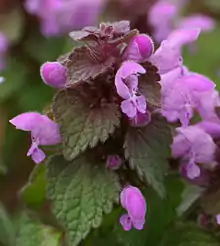 | |
| Lamium purpureum L. | |
Scientific classification  | |
| Kingdom: | Plantae |
| Clade: | Tracheophytes |
| Clade: | Angiosperms |
| Clade: | Eudicots |
| Clade: | Asterids |
| Order: | Lamiales |
| Family: | Lamiaceae Martinov[1][2] |
| Type genus | |
| Lamium | |
| Genera | |
|
See text | |
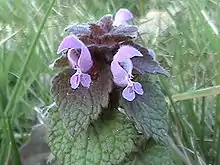
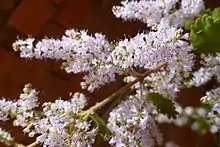
The family has a cosmopolitan distribution.[4] The enlarged Lamiaceae contain about 236 genera[5] and have been stated to contain 6,900[4] to 7,200[5] species, but the World Checklist lists 7,534.[6] The largest genera are Salvia (900), Scutellaria (360), Stachys (300), Plectranthus (300), Hyptis (280), Teucrium (250), Vitex (250), Thymus (220), and Nepeta (200).[5] Clerodendrum was once a genus of over 400 species,[5] but by 2010, it had been narrowed to about 150.[7]
The family has traditionally been considered closely related to the Verbenaceae;[5] in the 1990s, phylogenetic studies suggested that many genera classified in the Verbenaceae should be classified in the Lamiaceae [8][9] or to other families in the order Lamiales.[1]
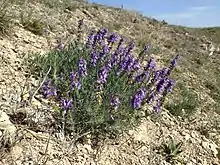
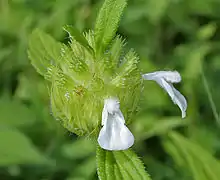
The alternative family name Labiatae refers to the fact that the flowers typically have petals fused into an upper lip and a lower lip (labia in Latin). The flowers are bilaterally symmetrical with five united petals and five united sepals. They are usually bisexual and verticillastrate (a flower cluster that looks like a whorl of flowers, but actually consists of two crowded clusters). Although this is still considered an acceptable alternative name, most botanists now use the name Lamiaceae in referring to this family. The leaves emerge oppositely, each pair at right angles to the previous one (decussate) or whorled. The stems are frequently square in cross section,[10] but this is not found in all members of the family, and is sometimes found in other plant families.
Genera
_in_Talakona_forest%252C_AP_W_IMG_8284.jpg.webp)
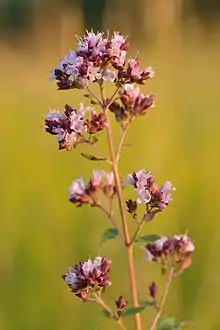
The last revision of the entire family was published in 2004.[5] It described and provided keys to 236 genera. These are marked with an asterisk (*) in the list below. A few genera have been established or resurrected since 2004. These are marked with a plus sign (+). Other genera have been synonymised. These are marked with a minus sign (-). The remaining genera in the list are mostly of historical interest only and are from a source that includes such genera without explanation.[11] Few of these are recognized in modern treatments of the family.
Kew Gardens provides a list of genera that includes additional information.[12] A list at the Angiosperm Phylogeny Website is frequently updated.[13]
- *Acanthomintha
- *Achyrospermum
- Acinos
- Acrocephalus
- *Acrotome
- *Acrymia
- Adelosa
- *Aegiphila
- *Aeollanthus
- *Agastache
- *Ajuga
- *Ajugoides
- *Alajja
- *Alvesia
- *Amasonia
- *Amethystea
- *Anisochilus
- *Anisomeles
- *Asterohyptis
- *Ballota
- *Basilicum
- Becium
- *Benguellia
- *Blephilia
- *Bostrychanthera
- Bovonia
- *Brachysola
- *Brazoria
- *Bystropogon
- Calamintha
- *Callicarpa
- *Capitanopsis
- Capitanya
- *Caryopteris
- *Catoferia
- *Cedronella
- Ceratanthus
- *Chaiturus
- *Chamaesphacos
- *Chaunostoma
- *Chelonopsis
- *Chloanthes
- *Cleonia
- *Clerodendrum
- *Clinopodium
- *Colebrookea
- *Collinsonia
- *Colquhounia
- *Comanthosphace
- *Congea
- *Conradina
- Coridothymus
- *Cornutia
- *Craniotome
- *Cryphia
- *Cuminia
- *Cunila
- *Cyanostegia
- *Cyclotrichium
- *Cymaria
- *Dauphinea
- *Dicerandra
- *Dicrastylis
- Discretitheca
- Dorystoechas
- *Dracocephalum
- *Drepanocaryum
- *Elsholtzia
- *Endostemon
- Englerastrum
- *Eremostachys
- *Eriope
- *Eriophyton
- Eriopidion
- *Eriothymus
- Erythrochlamys
- Euhesperida
- *Eurysolen
- *Faradaya
- *Fuerstia
- *Galeopsis
- *Garrettia
- Geniosporum
- *Glechoma
- *Glechon
- *Glossocarya
- *Gmelina
- *Gomphostemma
- *Gontscharovia
- *Hanceola
- *Haplostachys
- *Haumaniastrum
- *Hedeoma
- *Hemiandra
- *Hemigenia
- *Hemiphora
- *Hemizygia
- *Hesperozygis
- *Heterolamium
- *Hoehnea
- *Holmskioldia
- *Holocheila
- Holostylon
- *Horminum
- *Hosea
- *Hoslundia
- *Huxleya
- *Hymenocrater
- *Hymenopyramis
- *Hypenia
- *Hypogomphia
- *Hyptidendron
- *Hyptis
- *Hyssopus
- Isodictyophorus
- *Isodon
- *Isoleucas
- +Kalaharia
- *Karomia
- Keiskea
- Killickia
- Kudrjaschevia
- *Kurzamra
- *Lachnostachys
- *Lagochilus
- *Lagopsis
- *Lallemantia
- *Lamiophlomis
- *Lamium
- *Lavandula
- *Leocus
- *Leonotis
- *Leonurus
- *Lepechinia
- *Leucas
- Leucophae
- *Leucosceptrum
- Limniboza
- *Lophanthus
- *Loxocalyx
- *Lycopus
- *Macbridea
- *Madlabium
- *Marmoritis
- *Marrubium
- *Marsypianthes
- *Matsumurella
- *Meehania
- *Melissa
- *Melittis
- *Mentha
- *Meriandra
- Mesona
- *Metastachydium
- *Microcorys
- *Micromeria
- *Microtoena
- *Minthostachys
- *Moluccella
- *Monarda
- *Monardella
- *Monochilus
- *Mosla
- *Neoeplingia
- Neohyptis
- Neorapinia
- *Nepeta
- *Newcastelia
- Nosema
- *Notochaete
- *Obtegomeria
- *Ocimum
- Octomeron
- *Ombrocharis
- *Oncinocalyx
- *Origanum
- *Orthosiphon
- *Otostegia
- +Ovieda
- *Oxera
- *Panzerina
- *Paralamium
- *Paraphlomis
- *Paravitex
- *Peltodon
- *Pentapleura
- *Perilla
- *Perillula
- *Peronema
- -Perovskia
- Perrierastrum
- Petitia
- *Petraeovitex
- *Phlomidoschema
- *Phlomis
- *Phlomoides
- *Phyllostegia
- *Physopsis
- *Physostegia
- *Piloblephis
- Pitardia
- *Pityrodia
- *Platostoma
- *Plectranthus
- *Pogogyne
- *Pogostemon
- *Poliomintha
- *Prasium
- *Premna
- *Prostanthera
- *Prunella
- *Pseuderemostachys
- *Pseudocarpidium
- *Pseudocaryopteris
- *Pseudomarrubium
- Puntia
- *Pycnanthemum
- *Pycnostachys
- Rabdosiella
- *Renschia
- *Rhabdocaulon
- *Rhaphiodon
- *Rhododon
- -Rosmarinus
- *Rostrinucula
- *Rotheca
- *Roylea
- *Rubiteucris
- +Rydingia
- Sabaudia
- *Saccocalyx
- Salazaria
- *Salvia
- *Satureja
- *Schizonepeta
- *Schnabelia
- *Scutellaria
- *Sideritis
- *Siphocranion
- Solenostemon
- *Spartothamnella
- *Sphenodesme
- *Stachydeoma
- *Stachyopsis
- *Stachys
- *Stenogyne
- *Sulaimania
- *Suzukia
- *Symphorema
- Symphostemon
- *Synandra
- *Syncolostemon
- *Tectona
- *Teijsmanniodendron
- +Tetraclea
- *Tetradenia
- *Teucridium
- *Teucrium
- *Thorncroftia
- *Thuspeinanta
- *Thymbra
- *Thymus
- *Tinnea
- *Trichostema
- *Tripora
- *Tsoongia
- *Vitex
- *Viticipremna
- +Volkameria
- *Warnockia
- *Wenchengia
- *Westringia
- Wiedemannia
- *Wrixonia
- Xenopoma
- *Zataria
- *Zhumeria
- *Ziziphora
Recent changes
The circumscription of several genera has changed since 2004. Tsoongia, Paravitex, and Viticipremna have been sunk into synonymy with Vitex.[14] Huxleya has been sunk into Volkameria.[7] Kalaharia, Volkameria, Ovieda, and Tetraclea have been segregated from a formerly polyphyletic Clerodendrum.[7] Rydingia has been separated from Leucas.[15] The remaining Leucas is paraphyletic over four other genera.[16]
Subfamilies and tribes
In 2004, the Lamiaceae were divided into seven subfamilies with 10 genera not placed in any of the subfamilies.[5] The unplaced genera are: Tectona, Callicarpa, Hymenopyramis, Petraeovitex, Peronema, Garrettia, Cymaria, Acrymia, Holocheila, and Ombrocharis. The subfamilies are the Symphorematoideae, Viticoideae, Ajugoideae, Prostantheroideae, Nepetoideae, Scutellarioideae, and Lamioideae. The subfamily Viticoideae is probably not monophyletic.[14] The Prostantheroideae and Nepetoideae are divided into tribes. These are shown in the phylogenetic tree below.
Phylogeny
Most of the genera of Lamiaceae have never been sampled for DNA for molecular phylogenetic studies. Most of those that have been are included in the following phylogenetic tree. The phylogeny depicted below is based on seven different sources.[5][9][7][14][17][18][19]
| Lamiaceae |
| |||||||||||||||||||||||||||||||||||||||||||||||||||||||||||||||||||||||||||||||||||||||||||||||||||||||||||||||||||||||||||||||||||||||||||||||||||||||||||||||||||||||||||||||||||||||||||||||||||||||||||||||||||||||||||||||||||||||||||||||||||||||||||||||||||||||||||||||||||||||||||||||||||||||||||||||||||||||||||||||||
References
- Stevens, P. F. (July 2012). "Lamiales (Lamiaceae Family)". Angiosperm Phylogeny Website. Retrieved 25 March 2015.
- Angiosperm Phylogeny Group (2009). "An update of the Angiosperm Phylogeny Group classification for the orders and families of flowering plants: APG III". Botanical Journal of the Linnean Society. 161 (2): 105–121. doi:10.1111/j.1095-8339.2009.00996.x.
- "Pronunciation of lamiaceae". Retrieved 2014-11-25.
- Heywood, Vernon H.; Brummitt, Richard K.; Seberg, Ole; Culham, Alastair (2007). Flowering Plant Families of the World. Ontario, Canada: Firefly Books. ISBN 978-1-55407-206-4.
- Raymond M. Harley, Sandy Atkins, Andrey L. Budantsev, Philip D. Cantino, Barry J. Conn, Renée J. Grayer, Madeline M. Harley, Rogier P.J. de Kok, Tatyana V. Krestovskaja, Ramón Morales, Alan J. Paton, and P. Olof Ryding. 2004. "Labiatae" pages 167-275. In: Klaus Kubitzki (editor) and Joachim W. Kadereit (volume editor). The Families and Genera of Vascular Plants volume VII. Springer-Verlag: Berlin; Heidelberg, Germany. ISBN 978-3-540-40593-1
- World Checklist of Selected Plant Families
- Yuan, Yao-Wu; Mabberley, David J.; Steane, Dorothy A.; Olmstead, Richard G. (2010). "Further disintegration and redefinition of Clerodendrum (Lamiaceae): Implications for the understanding of the evolution of an intriguing breeding strategy". Taxon. 59 (1): 125–133. doi:10.1002/tax.591013.
- Cantino, P.D., Harley, R.M. & Wagstaff, S.J. 1992. Genera of Labiatae: status and classification. Pp. 511-522. In: Raymond M. Harley and Tom Reynolds (editors). Advances in Labiate Science. Richmond, Royal Botanic Gardens, Kew.
- Wagstaff, Steven J.; Hickerson, Laura; Spangler, Russ; Reeves, Patrick A.; Olmstead, Richard G. (1998). "Phylogeny in Labiatae s.l., inferred from cpDNA sequences". Plant Systematics and Evolution. 209 (3–4): 265–274. doi:10.1007/bf00985232. S2CID 601658.
- Parnell, J. and Curtis, T. 2012. Webb's An Irish Flora. Cork University Press ISBN 978-185918-4783
- "List of genera in Lamiaceae". In: "Lamiaceae". In: "List of families". In: "Families and genera in GRIN. (see External links below)
- List of Genera in Lamiaceae. At: Vascular Plant Families and Genera. At: World Checklist of Selected Plant Families. At: Electronic Plant Information Center. At: Website of Royal Botanic Gardens, Kew. (see External Links below).
- APG list of Lamiaceae genera
- Bramley, Gemma L.C.; Forest, Félix; Rogier (2009). "Troublesome tropical mints: re-examining generic limits of Vitex and relations (Lamiaceae) in South East Asia". Taxon. 58 (2): 500–510. doi:10.1002/tax.582014.
- Scheen, Anne-Cathrine; Albert, Victor A. (2007). "Nomenclatural and taxonomic changes within the Leucas clade (Lamioideae; Lamiaceae)"". Systematics and Geography of Plants. 77 (2): 229–238.
- Scheen, Anne-Cathrine; Albert, Victor A. (2009). "Molecular Phylogenetics of the Leucas Group (Lamioideae; Lamiaceae)"". Systematic Botany. 34 (1): 173–181. doi:10.1600/036364409787602366. S2CID 85894904.
- Zhong, Jin-Shun; Li, Jie; Li, Lang; Conran, John G.; Hsi-wen, Li (2010). "Phylogeny of Isodon (Schrad. ex Benth.) Spach (Lamiaceae) and Related Genera Inferred from Nuclear Ribosomal ITS, trnL-trnF Region, and rps16 Intron Sequences and Morphology". Systematic Botany. 35 (1): 207–219. doi:10.1600/036364410790862614. S2CID 54808462.
- Walker, Jay B.; Sytsma, Kenneth J. (2007). "Staminal Evolution in the Genus Salvia (Lamiaceae): Molecular Phylogenetic Evidence for Multiple Origins of the Staminal Lever". Annals of Botany. 100 (2): 375–391. doi:10.1093/aob/mcl176. PMC 2735309. PMID 16926227.
- Ryding, P. Olof (2010). "Pericarp structure and phylogeny of tribe Mentheae (Lamiaceae)"". Plant Systematics and Evolution. 285 (3–4): 165–175. doi:10.1007/s00606-010-0270-9. S2CID 24076224.
External links
 |
Wikimedia Commons has media related to Lamiaceae. |
 |
Wikispecies has information related to Lamiaceae. |
