Kuehneosauridae
Kuehneosauridae is an extinct family of small, lizard-like gliding diapsids known from the Triassic period of Europe and North America. They are often, but not always, placed in the group Lepidosauromorpha.[1]
| Kuehneosauridae | |
|---|---|
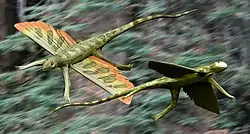 | |
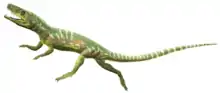
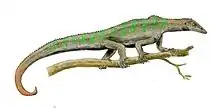
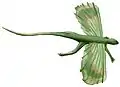
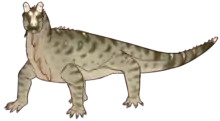
| Life restoration of Kuehneosuchus and Kuehneosaurus | |
Scientific classification  | |
| Kingdom: | Animalia |
| Phylum: | Chordata |
| Class: | Reptilia |
| Clade: | Lepidosauromorpha |
| Family: | †Kuehneosauridae Robinson, 1962 |
| Genera | |
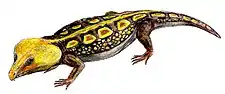
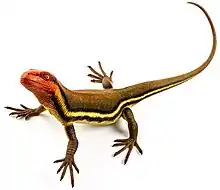
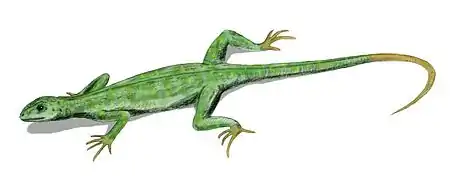
They were distinguished from other diapsids by their 'wings', which were really sails of skin held up by ribs. These sails would have served as gliding tools, but the kuehneosaurids were incapable of powered flight. They were most likely insectivorous, judging from their pin-like teeth. The oldest and most primitive known member is Pamelina from the Early Triassic (Olenekian stage) of Poland. Icarosaurus, which is known from a single specimen from Carnian-aged Lockatong Formation of New Jersey, is basal to more advanced kuehneosaurids. The Late Triassic (Norian stage) kuehneosaurids from England, Kuehneosaurus and Kuehneosuchus, are very similar and can be distinguished from one another primarily on the length of their "wing" ribs, relatively short and massive in Kuehneosaurus but longer and more gracile in Kuehneosuchus.[1] Rhabdopelix may have been a kuehneosaurid; however, the fossils were lost, and the characteristics described are not entirely consistent with the other family members.
The cladogram below follows a 2009 analysis by paleontologists Susan E. Evans and Magdalena Borsuk−Białynicka.[2]
| Diapsida |
| ||||||||||||||||||||||||||||||||||||||||||||||||||||||
The 2017 description of Avicranium, a toothless drepanosaur, involved a phylogenetic analysis which places kuehneosaurids inside Archosauromorpha rather than Lepidosauromorpha. Specifically, they were primarily found to be close relatives of Boreopricea and/or different allokotosaurs, depending on the constraints induced within the study.[3]
See also
References
- Susan E. Evans (2009). "An early kuehneosaurid reptile (Reptilia: Diapsida) from the Early Triassic of Poland" (PDF). Paleontologica Polonica. 65: 145–178.
- Susan E. Evans and Magdalena Borsuk−Białynicka (2009). "A small lepidosauromorph reptile from the Early Triassic of Poland" (PDF). Paleontologica Polonica. 65: 179–202.
- Pritchard, Adam C.; Nesbitt, Sterling J. (2017-10-01). "A bird-like skull in a Triassic diapsid reptile increases heterogeneity of the morphological and phylogenetic radiation of Diapsida". Royal Society Open Science. 4 (10): 170499. Bibcode:2017RSOS....470499P. doi:10.1098/rsos.170499. ISSN 2054-5703. PMC 5666248. PMID 29134065.
- Steins, K., Palmer, C., Gill, P.G., and Benton, M.J. (2008). "The aerodynamics of the British Late Triassic Kuehneosauridae." Palaeontology 51(4): 967–981. doi:10.1111/j.1475-4983.2008.00783.x
| |||||||||||||||||||||||||||||||||||||||||||
| |||||||||||||||||||||||||||||||||||||||||||
| |||||||||||||||||||||||||||||||||||||||||||
| |||||||||||||||||||||||||||||||||||||||||||
| |||||||||||||||||||||||||||||||||||||||||||
| |||||||||||||||||||||||||||||||||||||||||||
.jpg.webp)