Kaiwhekea
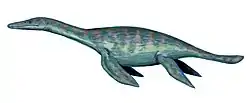
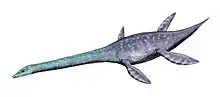
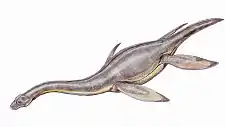
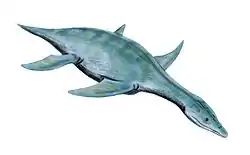
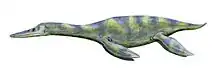
Kaiwhekea is an extinct genus of plesiosaur from the Late Cretaceous (Maastrichtian age) of what is now New Zealand.
| Kaiwhekea | |
|---|---|
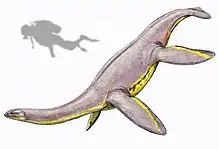 | |
| Restoration with size comparison | |
Scientific classification  | |
| Kingdom: | Animalia |
| Phylum: | Chordata |
| Class: | Reptilia |
| Superorder: | †Sauropterygia |
| Order: | †Plesiosauria |
| Family: | †Elasmosauridae |
| Clade: | †Aristonectinae |
| Genus: | †Kaiwhekea Cruickshank & Fordyce, 2002 |
| Species | |
| |
History of discovery
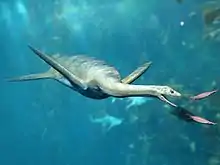
The type species, Kaiwhekea katiki, was first described by Arthur Cruickshank and Ewan Fordyce in 2002. Kaiwhekea was approximately 7 metres (23 ft) long and lived around 70-69 million years ago. The single known specimen, found in the Katiki Formation near Shag Point on the coast of Otago, is nearly complete, and is on display at the Otago Museum in Dunedin, New Zealand.[1]
Classification
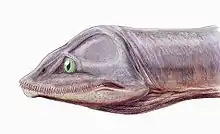
Kaiwhekea has been placed as an aristonectine plesiosaur close to Aristonectes (O'Keefe and Street, 2009). In 2010, Kaiwhekea was transferred to Leptocleididae,[2] but more recent analyses do not find the same result.[3]
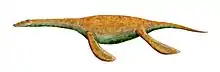
The following cladogram shows the placement of Kaiwhekea within Elasmosauridae following an analysis by Rodrigo A. Otero, 2016:[4]
| Elasmosauridae |
| |||||||||||||||||||||||||||||||||||||||||||||||||||||||||||||||||||||||||||||||||||||||||||||||||||||||||
References
- Cruickshank, Arthur R.I.; Fordyce, R. Ewan (2002). "A new marine reptile (Sauropterygia) from New Zealand: further evidence for a Late Cretaceous austral radiation of cryptoclidid plesiosaurs". Palaeontology. 45 (3): 557–575. doi:10.1111/1475-4983.00249.
- Ketchum, H. F.; Benson, R. B. J. (2010). "Global interrelationships of Plesiosauria (Reptilia, Sauropterygia) and the pivotal role of taxon sampling in determining the outcome of phylogenetic analyses". Biological Reviews. 85 (2): 361–392. doi:10.1111/j.1469-185X.2009.00107.x. PMID 20002391.
- O'Gorman, J.P.; Otero, R.A.; Hiller, N.; Simes, J.; Terezow, M. (2016). "Redescription of Tuarangisaurus keyesi (Sauropterygia; Elasmosauridae), a key species from the uppermost Cretaceous of the Weddellian Province: Internal skull anatomy and phylogenetic position". Cretaceous Research. 71: 118–136. doi:10.1016/j.cretres.2016.11.014.
- Otero, R. A. (2016). "Taxonomic reassessment of Hydralmosaurus as Styxosaurus: new insights on the elasmosaurid neck evolution throughout the Cretaceous". PeerJ. 4: e1777. doi:10.7717/peerj.1777. PMC 4806632. PMID 27019781.
External links
- Kaiwhekea, University of Otago, New Zealand
.png.webp)