Iguanomorpha
Iguania is an infraorder of squamate reptiles that includes iguanas, chameleons, agamids, and New World lizards like anoles and phrynosomatids. Using morphological features as a guide to evolutionary relationships, the Iguania are believed to form the sister group to the remainder of the Squamata, and comprise nearly 13,000 named species . However, molecular information has placed Iguania well within the Squamata as sister taxa to the Anguimorpha and closely related to snakes.[1] The order has been under debate and revisions after being classified by Charles Lewis Camp in 1923 due to difficulties finding adequate synapomorphic morphological characteristics.[2] The majority of Iguanias are arboreal but there are several terrestrial groups. They usually have primitive fleshy, non-prehensile tongues, although the tongue is highly modified in chameleons. The group has a fossil record that extends back to the Early Jurassic (the oldest known member is Bharatagama, which lived about 190 million years ago in what is now India).[3] Today they are scattered occurring in Madagascar, the Fiji and Friendly Islands and Western Hemisphere [4]
| Iguanomorpha | |
|---|---|
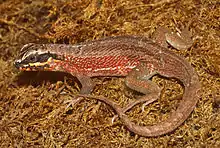 | |
| Leiocephalus personatus, a species of iguanian | |
Scientific classification  | |
| Kingdom: | Animalia |
| Phylum: | Chordata |
| Class: | Reptilia |
| Order: | Squamata |
| Clade: | Toxicofera |
| Clade: | Iguanomorpha |
| Suborder: | Iguania |
| Families | |
Classification
The Iguania currently include these extant families:[5][6]
- Clade Acrodonta
- Family Agamidae – agamid lizards, Old World arboreal lizards
- Family Chamaeleonidae – chameleons
- Clade Pleurodonta – American arboreal lizards, chuckwallas, iguanas
- Family Leiocephalidae
- Genus Leiocephalus: curly-tailed lizards
- Family Corytophanidae – helmet lizards
- Family Crotaphytidae – collared lizards, leopard lizards
- Family Hoplocercidae – dwarf and spinytail iguanas
- Family Iguanidae – marine, Fijian, Galapagos land, spinytail, rock, desert, green, and chuckwalla iguanas
- Family Tropiduridae – tropidurine lizards
- subclade of Tropiduridae Tropidurini – neotropical ground lizards
- Family Dactyloidae – anoles
- Family Polychrotidae
- subclade of Polychrotidae Polychrus
- Family Phrynosomatidae – North American spiny lizards
- Family Liolaemidae – South American swifts
- Family Opluridae – Malagasy iguanas
- Family Leiosauridae – leiosaurs
- subclade of Leiosaurini Leiosaurae
- subclade of Leiosaurini Anisolepae
- Family Leiocephalidae
Phylogeny
Below is a cladogram from the phylogenetic analysis of Daza et al. (2012) (a morphological analysis), showing the interrelationships of extinct and living iguanians:[7]
| Iguanomorpha |
| |||||||||||||||||||||||||||||||||||||||||||||||||||||||||||||||||||||||||||||||||||||||||||||||||||||||||||||||||||||||||||||||||||||||||||||||||||||||||||||||||||||||||||||||||||||||||||||||||||||||||||||||||||||||||||||||||||||||||||||||||||||||||||||||||||||||||||||||||||||||||||||||||||||||||||||||||||||||||||||||||||||||||||||||||||
Conservation Status
As of 2020 The IUCN Red List of endangered species lists 63.3% of the species as Least concern, 6.7% Near Threatened, 8.2 vulnerable, 9.1% endangered, 3.1% critically endangered, 0.3 extinct and 9.2% data deficient. The major threats include agriculture , residential and commercial development {https://www.iucnredlist.org/}.
References
- Vidal, N.; Hedges, S. B. (2005). "The phylogeny of squamate reptiles (lizards, snakes, and amphisbaenians) inferred from nine nuclear protein-coding genes" (PDF). Comptes Rendus Biologies. 328 (10–11): 1000–1008. doi:10.1016/j.crvi.2005.10.001. PMID 16286089. Archived from the original (PDF) on 2011-07-26.
- Daza, J., Abdala, V., Arias, J., García-López, D., & Ortiz, P. (2012). Cladistic Analysis of Iguania and a Fossil Lizard from the Late Pliocene of Northwestern Argentina. Journal of Herpetology, 46(1), 104-119. Retrieved May 12, 2020, from www.jstor.org/stable/41515023
- Evans, Susan E.; Prasad, G. V. R.; Manhas, B. K. (2002). "Fossil lizards from the Jurassic Kota Formation of India". Journal of Vertebrate Paleontology. 22 (2): 299. doi:10.1671/0272-4634(2002)022[0299:FLFTJK]2.0.CO;2.
- Moody, S. (1985). Charles L. Camp and His 1923 Classification of Lizards: An Early Cladist? Systematic Zoology, 34(2), 216-222. doi:10.2307/2413329
- Wiens, J.J., C. R. Hutter, D. G. Mulcahy, B. P. Noonan, T. M. Townsend, J. W. Sites Jr., T. W. Reeder. (2012) Resolving the phylogeny of lizards and snakes (Squamata) with extensive sampling of genes and species. Archived 2018-08-05 at the Wayback Machine Biology Letters
- Schulte II, J. A., J. P. Valladares, and A. Larson. (2003) [Phylogenetic relationships within Iguanidae inferred using molecular and morphological data and a phylogenetic taxonomy of iguanian lizards.] Herpetologica 59: 399-419
- Daza, J. D.; Abdala, V.; Arias, J. S.; García-López, D.; Ortiz, P. (2012). "Cladistic Analysis of Iguania and a Fossil Lizard from the Late Pliocene of Northwestern Argentina". Journal of Herpetology. 46: 104–119. doi:10.1670/10-112. S2CID 85405843.
 |
Wikimedia Commons has media related to Iguania. |