Crocodylus palaeindicus
Crocodylus palaeindicus is an extinct species of crocodile from southern Asia. C. palaeindicus lived from the Miocene to the Pleistocene. It may be an ancestor of the living Mugger crocodile.
| Crocodylus palaeindicus | |
|---|---|
Scientific classification  | |
| Kingdom: | Animalia |
| Phylum: | Chordata |
| Class: | Reptilia |
| Order: | Crocodilia |
| Family: | Crocodylidae |
| Genus: | Crocodylus |
| Species: | †C. palaeindicus |
| Binomial name | |
| †Crocodylus palaeindicus Falconer, 1859 | |
| Synonyms | |
| |
History
C. palaeindicus was first named by Scottish paleontologist Hugh Falconer in 1859. Falconer found fossils of the species in the Siwalik Hills of India along with the remains of many other animals like turtles, ostriches, camels, saber-toothed cats, mastodons.[1] Richard Lydekker later named another crocodile from the Siwalik Hills which he called C. sivalensis. Although the two crocodiles are very similar, C. sivalensis was distinguished from C. palaeindicus because the margin of its skull was less convex. C. sivalensis has recently been synonymized with C. palaeindicus, as the slight differences in shape are thought to be from natural variation or from fossilization.[2] In later years, fossils were also found from Pakistan and Myanmar.
Classification
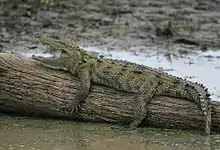
Historically, C. palaeindicus was considered a direct ancestor of the Mugger crocodile C. palustris. The two species are similar in appearance, and some fossils of C. palaeindicus were at first mistaken for C. palustris.[2] Most modern phylogenetic analyses of crocodiles place C. palaeindicus in a basal position among members of the genus Crocodylus; only the living Slender-snouted crocodile C. cataphractus is more basal, although it may belong to a distinct genus, Mecistops. Recent studies place it in a polytomy, or unresolved relationship, with two large groups: the neotropical and African crocodiles and the Indopacific crocodiles. The extinct African species Crocodylus anthropophagus is also part of this polytomy. Below is a cladogram modified from Brochu et al. (2010) showing the relation of C. palaeindicus with other crocodiles:[3]
| Crocodylidae |
| |||||||||||||||||||||||||||||||||||||||||||||||||||||||||||||||||||||||||||||||||
References
- Lydekker, R. (1885). Catalogue of the remains of Siwalik Vertebrata contained in the Geological Department of the Indian Museum, Calcutta. 1. Superintendent of Government Printing, India.
- Brochu, C. A. (2000). "Phylogenetic relationships and divergence timing of Crocodylus based on morphology and the fossil record". Copeia. 2000 (3): 657–673. doi:10.1643/0045-8511(2000)000[0657:pradto]2.0.co;2.
- Brochu, C. A.; Njau, J.; Blumenschine, R. J.; Densmore, L. D. (2010). "A new horned crocodile from the Plio-Pleistocene hominid sites at Olduvai Gorge, Tanzania". PLoS ONE. 5 (2): e9333. doi:10.1371/journal.pone.0009333. PMC 2827537. PMID 20195356.