Courtesy name
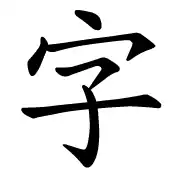
A courtesy name (Chinese: 字; pinyin: zì; lit. 'character'), also known as a style name,[1] is a name bestowed upon one at adulthood in addition to one's given name.[2] This practice is a tradition in the Sinosphere, including China, Japan, Korea, and Vietnam.[3]
| Courtesy name (Zi) | |
|---|---|
 | |
| Chinese name | |
| Traditional Chinese | (表) 字 |
| Hanyu Pinyin | (biǎo) zì |
| Wade–Giles | (piao)-tzu |
| Vietnamese name | |
| Vietnamese | tự |
| Korean name | |
| Hangul | 자 |
| Hanja | 字 |
| Revised Romanization | ja |
| McCune–Reischauer | cha |
| Japanese name | |
| Kanji | 字 |
| Hiragana | あざな |
| Revised Hepburn | azana |
The courtesy name would replace a man's given name as he entered adulthood.[4] It could be given either by the parents or by a private teacher on the first day of school. Women might adopt a zi in place of their given name upon marriage.[4] One also may adopt a self-chosen courtesy name.
A courtesy name is not to be confused with an art name (hào, Chinese: 號, Korean: 호), another frequently mentioned term for an alternative name in Asian culture-based context. An art name is usually associated with art and is more of a pen name or a pseudonym that is more spontaneous, compared to a courtesy name.
Usage
The zì, sometimes called the biǎozì (表字) or "courtesy name", is a name traditionally given to Chinese men at the age of 20, marking their coming of age. It was sometimes given to women upon marriage. The practice is no longer common in modern Chinese society. According to the Book of Rites, after a man reaches adulthood, it is disrespectful for others of the same generation to address him by his given name, or míng. Thus, the given name was reserved for oneself and one's elders, whereas the zì would be used by adults of the same generation to refer to one another on formal occasions or in writing; hence the term "courtesy name".
The zì is mostly disyllabic, consisting of two Chinese characters, and is often based on the meaning of the míng or given name. For example, Chiang Kai-shek's zì (介石, romanized as Kai-shek) and ming (中正, romanized as Chung-cheng) are both from the yù hexagram of I Ching.
Yan Zhitui of the Northern Qi dynasty asserted that whereas the purpose of the míng was to distinguish one person from another, the zì should express the bearer's moral integrity.
Another way to form a zì is to use the homophonic character zǐ (子) – a respectful title for a man – as the first character of the disyllabic zì. Thus, for example, Gongsun Qiao's zì was Zǐchǎn (子產), and Du Fu's: Zǐměi (子美).
It is also common to construct a zì by using as the first character one which expresses the bearer's birth order among male siblings in his family. Thus Confucius, whose name was Kǒng Qiū (孔丘), was given the zì Zhòngní (仲尼), where the first character zhòng indicates that he was the second son born into his family. The characters commonly used are bó (伯) for the first, zhòng (仲) for the second, shū (叔) for the third, and jì (季) typically for the youngest, if the family consists of more than three sons. General Sun Jian's four sons, for instance, were Sun Ce (伯符, Bófú), Sun Quan (仲謀, Zhòngmóu), Sun Yi (叔弼, Shūbì) and Sun Kuang (季佐, Jìzuǒ).
The use of zì began during the Shang dynasty, and slowly developed into a system which became most widespread during the succeeding Zhou dynasty. During this period, women were also given zì. The zì given to a woman was generally composed of a character indicating her birth order among female siblings and her surname. For example, Mèng Jiāng (孟姜) was the eldest daughter in the Jiāng family.
Prior to the twentieth century, sinicized Koreans, Vietnamese, and Japanese were also referred to by their zì. The practice was also adopted by some Mongols and Manchus after the Qing conquest of China.
Examples
| Chinese | Family name | Given name | Courtesy name |
|---|---|---|---|
| Lǎozǐ 老子 | Lǐ 李 | Ěr 耳 | Bóyáng 伯陽 |
| Kǒngzǐ (Confucius) 孔子 | Kǒng 孔 | Qiū 丘 | Zhòngní 仲尼 |
| Sūnzǐ (Sun Tzu) 孫子 | Sūn 孫 | Wǔ 武 | Chángqīng 長卿 |
| Cáo Cāo 曹操 | Cáo 曹 | Cāo 操 | Mèngdé 孟德 |
| Guān Yǔ 關羽 | Guān 關 | Yǔ 羽 | Yúncháng 雲長 |
| Liú Bèi 劉備 | Liú 劉 | Bèi 備 | Xuándé 玄德 |
| Zhūgé Liàng 諸葛亮 | Zhūgé 諸葛 | Liàng 亮 | Kǒngmíng 孔明 |
| Zhào Yún 趙雲 | Zhào 趙 | Yún 雲 | Zǐlóng 子龍 |
| Lǐ Bái 李白 | Lǐ 李 | Bái 白 | Tàibái 太白 |
| Sū Dōngpō 蘇東坡 | Sū 蘇 | Shì 軾 | Zǐzhān 子瞻 |
| Yuè Fēi 岳飛 | Yuè 岳 | Fēi 飛 | Péngjǔ 鵬舉 |
| Yuán Chónghuàn 袁崇煥 | Yuán 袁 | Chónghuàn 崇煥 | Yuánsù 元素 |
| Liú Jī 劉基 | Liú 劉 | Jī 基 | Bówēn 伯溫 |
| Táng Yín 唐寅 | Táng 唐 | Yín 寅 | Bóhǔ 伯虎 |
| Máo Zédōng 毛澤東 | Máo 毛 | Zédōng 澤東 | Rùnzhī 潤之 |
| Chiang Kai-shek 蔣介石 | Jiǎng 蔣 | Zhōngzhèng 中正 | Jièshí 介石 |
See also
- Cognomen, the third name of a citizen of ancient Rome
References
- Tianjun Liu, Xiao Mei Qiang (2013). Chinese Medical Qigong. p. 590. ISBN 978-1848190962.
Mencius (371—289 BCE), born in Zou county (Shandong province), first name Ke, style name Zi Yu, was a famous philosopher, educator, politician, and expert on the Qigong life nurturing of Confucius in the Zhanguo Period.
- Origins of Chinese Names. 2007. p. 142. ISBN 978-9812294623.
In ancient times, besides having a surname and a given name, one would have a courtesy name 'Zì' as well. The courtesy name was the proper form of address for an adult. On reaching 20 years of age, young men would 'put on the hat' as ...
- Names of Persons and Titles of Rulers
- "Qū lǐ shàng" 曲禮上 [Summary of the Rules of Propriety Part 1]. Lǐjì 禮記 [Book of Rites]. Line 44.
A son at twenty is capped, and receives his appellation....When a daughter is promised in marriage, she assumes the hair-pin, and receives her appellation.