Brachydiastematherium
Brachydiastematherium transylvanicum (literally "short Diastema Beast of Transylvania") is the westernmost species of brontothere, with the first fossils of it being found in Transylvania, Romania. In comparison with other brontothere fossils, it is suggested that B. transylvanicum would have had an elongated head, not unlike Dolichorhinus, and be about 2 meters at the withers (anatomically speaking, the highest part of the back at the base of the neck).[1][2]
| Brachydiastematherium Temporal range: Late Eocene | |
|---|---|
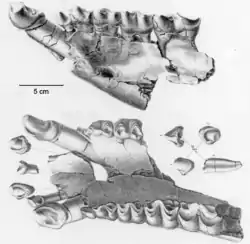 | |
| Holotype of B. transylvanicum. | |
| Scientific classification | |
| Kingdom: | |
| Phylum: | |
| Class: | |
| Order: | |
| Family: | |
| Genus: | Brachydiastematherium |
| Species: | B. transylvanicum Böckh & Matyasovski, 1876 |
Phylogeny
Cladogram after Mihlbachler (2008):[3]
| Embolotheriita |
| |||||||||||||||||||||||||||||||||||||||||||||||||||
References
- Spencer George Lucas und Robert M. Schoch: European Brontotheres. In: Donald R. Prothero und Robert M. Schoch (Hrsg.): The evolution of perissodactyls. New York und London, 1989, S. 485–489
- Cristina Fărcas: Study of the Upper Eocene-Lower Oligocene continental formations from northwestern side of Transylvanian Depression - Biostratigraphy, and palaeoenvironmental reconstructions based on land vertebrates. Babeș-Bolyai-Universität, Cluj-Napoca, 2011
- Matthew C. Mihlbachler: Species taxonomy, phylogeny, and biogeography of the Brontotheriidae (Mammalia: Perissodactyla). Bulletin of the American Museum of Natural History 311, 2008, ISSN 0003-0090, S. 1–475.
| |||||||||||
| Basal brontotheres |  | ||||||||||
| Brontotheriinae |
| ||||||||||
This article is issued from Wikipedia. The text is licensed under Creative Commons - Attribution - Sharealike. Additional terms may apply for the media files.