Begonia
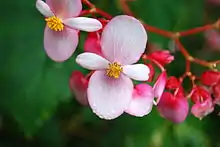
Begonia is a genus of perennial flowering plants in the family Begoniaceae. The genus contains more than 1,800 different plant species. The Begonias are native to moist subtropical and tropical climates. Some species are commonly grown indoors as ornamental houseplants in cooler climates. In cooler climates some species are cultivated outside in summertime for their bright colorful flowers, which have sepals but no petals.
| Begonia | |
|---|---|
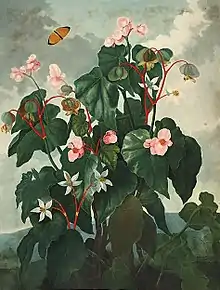 | |
| Begonia obliqua | |
Scientific classification  | |
| Kingdom: | Plantae |
| Clade: | Tracheophytes |
| Clade: | Angiosperms |
| Clade: | Eudicots |
| Clade: | Rosids |
| Order: | Cucurbitales |
| Family: | Begoniaceae |
| Genus: | Begonia L. |
| Type species | |
| Begonia obliqua L. | |
| Species | |
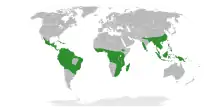 | |
| Range of the genus Begonia | |
| Synonyms | |
|
List
| |
Description
With 1,831 species, Begonia is one of the largest genera of flowering plants.[1][2] The species are terrestrial (sometimes epiphytic) herbs or undershrubs, and occur in subtropical and tropical moist climates, in South and Central America, Africa, and southern Asia. Terrestrial species in the wild are commonly upright-stemmed, rhizomatous, or tuberous. The plants are monoecious, with unisexual male and female flowers occurring separately on the same plant; the male contains numerous stamens, and the female has a large inferior ovary and two to four branched or twisted stigmas. In most species, the fruit is a winged capsule containing numerous minute seeds, although baccate fruits are also known. The leaves, which are often large and variously marked or variegated, are usually asymmetric (unequal-sided).
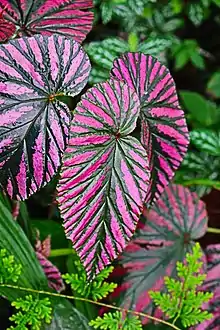 Begonia brevirimosa
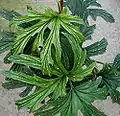 Begonia aconitifolia
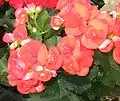 A flowering begonia
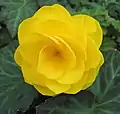 Begonia cultivars come in many different colors, such as yellow
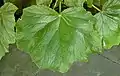 A begonia leaf
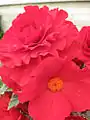 A pair of blossoms, male and female
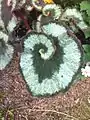 A nautilus-leaf form of begonia
 Begonia
 Begonia leaf
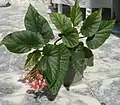 Cracklin Rosie begonia
 Cracklin Rosie begonia
Taxonomy
The genus name Begonia was coined by Charles Plumier, a French patron of botany, and adopted by Linnaeus in 1753, to honor Michel Bégon, a former governor of the French colony of Saint-Domingue (now Haiti).
Phylogeny
The following phylogenetic tree shows the relationships among sections of the genus Begonia.[3]
| |||||||||||||||||||||||||||||||||||||||||||||||||||||||||||||||||||||||||||||||||||||||||||||||||||||||||||||||||||||||||||||||||||||||||||||||||||||||||||||||||||||||||||||||||||||||||||||||||||||||||||||||||||||||||||||||||||||||||||||||||||||||||||||||||||||||||||||||||||||||||||||||||||||||||||||||||||||||||||||||||||||||||||||||||||||||||||||||||||||||||||||||||||||||||||||||||||||||||||||||||||||||||||||||||||||||||||||||||||||||||||||||||||||||||||||||||||||||||||||||||||||||||||||
Species
Selected species:[4]
Cultivation
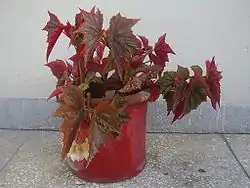
The different groups of begonias have different cultural requirements, but most species come from tropical regions, so they and their hybrids require warm temperatures. Most are forest understory plants and require bright shade; few will tolerate full sun, especially in warmer climates. In general, begonias require a well-drained growing medium that is neither constantly wet nor allowed to dry out completely. Many begonias will grow and flower year-round except for tuberous begonias, which usually have a dormant period. During this dormant period, the tubers can be stored in a cool, dry place. Begonias of the semperflorens group (or wax begonias) are frequently grown as bedding plants outdoors. A recent group of hybrids derived from this group is marketed as "Dragonwing" begonias; they are much larger both in leaf and in flower. Tuberous begonias are frequently used as container plants. Although most Begonia species are tropical or subtropical in origin, the Chinese species B. grandis is hardy to USDA hardiness zone 6 and is commonly known as the "hardy begonia". Most begonias can be grown outdoors year-round in subtropical or tropical climates, but in temperate climates, begonias are grown outdoors as annuals, or as house or greenhouse plants.
Most begonias are easily propagated by division or from stem cuttings. In addition, some can be propagated from leaf cuttings or even sections of leaves, particularly the members of the rhizomatous and rex groups.
Horticultural nomenclature
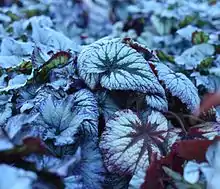
The nomenclature of begonias can be very complex and confusing. The term 'picotee' refers to edging on the petals that is in contrast to the color of the main petal if the colors blend. If they do not, then the term 'marginata' is used, but sometimes these terms are used simultaneously.[5] 'Non-Stop' refers to a camellia tuberous hybrid that under certain conditions will bloom 'non-stop' all year round.
Cultivar groups
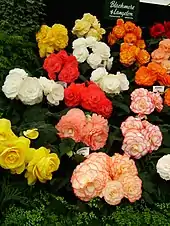
Because of their sometimes showy flowers of white, pink, scarlet, or yellow color and often attractively marked leaves, many species and innumerable hybrids and cultivars are cultivated. The genus is unusual in that species throughout the genus, even those coming from different continents, can frequently be hybridized with each other, and this has led to an enormous number of cultivars. The American Begonia Society classifies begonias into several major groups:
- Cane begonia – forms tough, bamboo-like canes
- shrub-like
- tuberous
- rhizomatous
- semperflorens (wax or fibrous rooted begonias)
- Rex
- trailing-scandent
- thick-stemmed
For the most part, these groups do not correspond to any formal taxonomic groupings or phylogeny, and many species and hybrids have characteristics of more than one group or do not fit well in any of them.
AGM plants
The following is a selection of about 70 species, varieties and cultivars which currently hold the Royal Horticultural Society's Award of Garden Merit:-[6]
- Begonia 'Benitochiba'[7]
- Begonia dregei[8]
- Begonia foliosa var. miniata[9]
- Begonia 'Glowing Embers'[10]
- Begonia grandis subsp. evansiana[11]
- Begonia grandis subsp. evansiana var. alba[12]
- Begonia 'Green Gold'[13]
- Begonia listada[14]
- Begonia luxurians[15]
- Begonia masoniana[16]
- Begonia metallica[17]
- Begonia solananthera[18]
- Begonia soli-mutata[19]
- Begonia sutherlandii[20]
Culture
The cultivar 'Kimjongilia' is a floral emblem of North Korea.
Most begonias are sour to the taste, and some people in some areas eat them. This is safe in small amounts but potentially toxic in large quantities due to the prevalence of oxalic acid in the tissues.[21]
References
- "Begonia - Welcome".
- David G. Frodin (2004). "History and concepts of big plant genera". Taxon. 53 (3): 753–776. doi:10.2307/4135449. JSTOR 4135449.
- Moonlight PW, Ardi WH, Padilla LA, Chung K-F, Fuller D, Girmansyah D, Hollands R, Jara-Muñoz A, Kiew R, Leong W-C, Liu Y, Mahardika A, Marasinghe LDK, O'Connor M, Peng C-I, Pérez ÁJ, Phutthai T, Pullan M, Rajbhandary S, Reynel C, Rubite RR, Sang J, Scherberich D, Shui Y-M, Tebbitt MC, Thomas DC, Wilson HP, Zaini NH, Hughes M. (2018). "Dividing and conquering the fastest-growing genus: Towards a natural sectional classification of the mega-diverse genus Begonia (Begoniaceae)". Taxon. 67 (2): 267–323. doi:10.12705/672.3.CS1 maint: uses authors parameter (link)
- The Plant List
- Perry, Leonard. "Begonia".
- "AGM Plants -Ornamental" (PDF). RHS. March 2020. p. 10. Retrieved 1 November 2020.
- "Begonia 'Benitochiba'". RHS. Retrieved 29 October 2020.
- "Begonia dregei". RHS. Retrieved 29 October 2020.
- "Begonia foliosa var. miniata". RHS. Retrieved 29 October 2020.
- "Begonia 'Glowing Embers'". RHS. Retrieved 29 October 2020.
- "Begonia grandis subsp. evansiana". RHS. Retrieved 29 October 2020.
- "Begonia grandis subsp. evansiana var. alba". RHS. Retrieved 29 October 2020.
- "Begonia 'Green Gold'". RHS. Retrieved 29 October 2020.
- "Begonia listada". RHS. Retrieved 29 October 2020.
- "Begonia luxurians". RHS. Retrieved 29 October 2020.
- "Begonia masoniana". RHS. Retrieved 29 October 2020.
- "Begonia metallica". RHS. Retrieved 29 October 2020.
- "Begonia solananthera". RHS. Retrieved 29 October 2020.
- "Begonia soli-mutata". RHS. Retrieved 29 October 2020.
- "Begonia sutherlandii". RHS. Retrieved 29 October 2020.
- Laferrière, Joseph E. 1990. On the edibility of begonias. Begonian 57:175.
External links
 |
Wikimedia Commons has media related to Begonia. |
 |
Wikispecies has information related to Begonia. |
 |
Look up begonia in Wiktionary, the free dictionary. |
- Chisholm, Hugh, ed. (1911). . Encyclopædia Britannica (11th ed.). Cambridge University Press.
- American Begonia Society
- W. S. Hoover et al. 2004, Notes on the geography of South-East Asian Begonia and species diversity in montane forests
- Phylogenetic Relationships of the Afro-Malagasy Members of the Large Genus Begonia Inferred from trnL Intron Sequences
- A Phylogeny of Begonia Using Nuclear Ribosomal Sequence Data and Morphological Characters
- Begonia L. Plants of the World Online
- Accepted species Plants of the World Online
- How to Grow, Care, Propagate Wax Begonia?
