Arachnomorpha
Arachnomorpha is a subdivision or clade of Arthropoda, comprising the monophyletic group formed by the trilobites, other great appendage arthropods and trilobite-like families (Helmetiidae, Xandarellidae, Naraoiidae, Liwiidae, and Tegopeltidae), and a diverse sister clade including the chelicerates.[1][2] Great debate is held on the position of the Pycnogonida, which are currently thought not to be placed in the immediate vicinity of the Chelicerata.[3] Arachnomorpha are considered the sister group to the crustaceans, which are increasingly being accepted as members of the mandibulate clade (including insects and myriapods).[2]
| Arachnomorpha | |
|---|---|
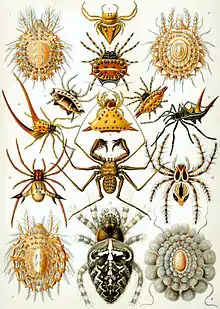 | |
| "Arachnida" from Ernst Haeckel's Kunstformen der Natur, 1904 | |
Scientific classification  | |
| Kingdom: | Animalia |
| Phylum: | Arthropoda |
| Clade: | Arachnomorpha Lameere, 1890 |
| Synonyms | |
| |
The arachnomorph concept has been challenged by suggestions that the trilobites fall in the mandibulata stem-group.[4]
There is no consensus as to assigning Arachnomorpha a formal Linnean rank.
A proposal contraposing many synapomorphies unites them to the Trilobita instead.[5] Consideration of the Olenellinae as sister group to the Chelicerata has been refuted.[6]
Classification
- ?Pycnogonida Latreille, 1806 (incl. Pantopoda Gerstaecker, 1863)
Arachnomorpha Lameere, 1890 [= Arachnata Paulus, 1979, = Palaeopoda Packard, 1903]
- †Trilobita Walch, 1771
- †Megacheira Hou & Bergstrom, 1997
- †Strabopida Hou & Bergström, 1997
- †Aglaspida Walcott, 1911
- †Cheloniellida Broili, 1932
- Chelicerata Heymons 1901
- Family †Sanctacarididae Legg & Pates, 2017
- Class Pycnogonida Latreille, 1810
- Clade Euchelicerata Weygoldt & Paulus, 1979
- Genus †Offacolidae Sutton et al., 2002
- Clade Prosomapoda Lamsdell, 2013
Phylogeny
Using fossil data, Bergström & Hou (2003) gave an outline of arthropod relationships emphasizing trilobitomorphs (a group that includes trilobites and trilobite-like animals).[7]
| |||||||||||||||||||||||||||||||||||||||||||||||||||||||||||||||||||||||||||||||||||||||||||||||||||||||||||||||||||
References
- Trevor J. Cotton & Simon J. Braddy (2003). "The phylogeny of arachnomorph arthropods and the origin of the Chelicerata". Transactions of the Royal Society of Edinburgh: Earth Sciences. 94 (3): 169–193. doi:10.1017/S0263593300000596.
- Jonathan R. Hendricks & Bruce S. Lieberman (2008). "New phylogenetic insights into the Cambrian radiation of arachnomorph arthropods". Journal of Paleontology. 82 (3): 585–594. doi:10.1666/07-017.1.
- J. A. Dunlop & C. P. Arango (2005). "Pycnogonid affinities: a review" (PDF). Journal of Zoological Systematics and Evolutionary Research. 43 (1): 8–21. doi:10.1111/j.1439-0469.2004.00284.x.
- Gerhard Scholtz & Gregory Edgecombe (2005). "Heads, Hox and the phylogenetic position of trilobites". Crustacea and Arthropod Relationships. CRC Press. pp. 139–165. CiteSeerX 10.1.1.130.2585.
- Karl-Ernst Lauterbach (1980). "Schlüsselereignisse in der Evolution des Grundplans der Arachnata (Arthropoda)" [Key events in the evolution of the ground plan of the Arachnata (Arthropoda)]. Abhandlungen des Naturwissenschaftlichen Vereins in Hamburg. NF (in German). 23: 163–327.
- R. A. Fortey & H. B. Whittington (1989). "The Trilobita as a natural group" (PDF). Historical Biology. 2 (2): 125–138. doi:10.1080/08912968909386496.
- Bergström, J. & Hou, X. G. (2003). "Arthropod origins" (PDF). Bulletin of Geosciences. 78 (4): 323–334. Archived from the original (PDF) on 2016-03-04. Retrieved 2014-03-03.