Amaryllideae
Amaryllideae are a tribe of subfamily Amaryllidoideae (family Amaryllidaceae). They are herbaceous monocot perennial flowering plants with a predominantly Southern African distribution, with the exception of the pantropical genus Crinum. They are generally treated as consisting of four subtribes. In addition to Crinum, other genera include Amaryllis, Boophone and Strumaria.[2]
| Amaryllideae | |
|---|---|
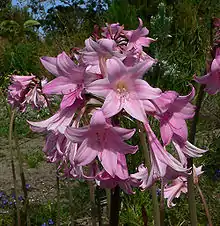 | |
| Amaryllis belladonna | |
Scientific classification  | |
| Kingdom: | Plantae |
| Clade: | Tracheophytes |
| Clade: | Angiosperms |
| Clade: | Monocots |
| Order: | Asparagales |
| Family: | Amaryllidaceae |
| Subfamily: | Amaryllidoideae |
| Tribe: | Amaryllideae Dumort.[1] |
| Type genus | |
| Amaryllis | |
| Subtribes | |
| Synonyms | |
|
Amarylleae | |
Taxonomy
Phylogeny
The placement of Amaryllideae within subfamily Amaryllidoideae is shown in the following cladogram:
| Cladogram: Tribes of subfamily Amaryllidoideae | |||||||||||||||||||||||||||||||||||||||||||||||||||||||||||||||||||||||||||||||||||||||
|
Subdivision
There are four subtribes:
- Amaryllidinae Pax[3]
- Boophoninae D.Müll.-Doblies & U.Müll.-Doblies[4]
- Crininae Baker[5]
- Strumariinae Traub ex D.Müll.-Doblies & U.Müll.-Doblies[6]
These are phylogenetically related as follows:
| Tribe Amaryllideae |
| ||||||||||||||||||
Amaryllidinae: Type. Monogeneric subtribe for genus Amaryllis.
Boophoninae: Monogeneric subtribe for genus Boophone.
Crininae: Three genera including Crinum.
Strumariinae: Six genera including Strumaria and Nerine.
References
- Du Mortier 1829, Anal. Fam. Pl.: 58. 1829..
- Meerow & Snijman 2001.
- Engler & Prantl Nat. Pflanzenfam.2, 5. 105. 1887 (emend. Meerow & Snijman 2001)
- Feddes Repertorium 107: S. c. 3. 1996
- J. Bot. 16: 164. ante 11 Jun 1878; Pax in Engler & Prantl, Nat. Pflanzenfam.2, 5. 108. 1887; D. & U. Muller-Doblies, Feddes Repertorium 107: S. c. 3. 1996.
- Bot. Jahrb. 107: 18. 1985 emend Meerow & Snijman, 2001.
Bibliography
- Du Mortier, Barthélemy-Charles (1829). Analyse des familles des plantes :avec l'indication des principaux genres qui s'y rattachent (in French). Tournay: Casterman. Retrieved 16 January 2016.CS1 maint: ref=harv (link)
- Meerow, Alan W.; Snijman, Deirdre A. (December 2001). "Phylogeny of Amaryllidaceae Tribe Amaryllideae Based on nrDNA ITS Sequences and Morphology". American Journal of Botany. 88 (12): 2321–2330. doi:10.2307/3558392. JSTOR 3558392. PMID 21669663.CS1 maint: ref=harv (link)
- Snijman, D. A.; Linder, H. P. (1996). "Phylogenetic Relationships, Seed Characters, and Dispersal System Evolution in Amaryllideae (Amaryllidaceae)". Annals of the Missouri Botanical Garden. 83 (3): 362–386. doi:10.2307/2399866. JSTOR 2399866.
- Vigneron, Pascal. "Amaryllidaceae". Amaryllidaceae.org (in French). Archived from the original on 4 January 2015. Retrieved 23 October 2014.
- "Amaryllidaceae: A taxonomic tool for the Amaryllidaceae of the world". eMonocot. Archived from the original on 2016-03-04. Retrieved 2016-02-25.
External links
 Data related to Amaryllideae at Wikispecies
 Media related to Amaryllideae at Wikimedia Commons