Afrophidia
Afrophidia is a clade of alethinophidian snakes comprising the groups Henophidia and Caenophidia, essentially making up the snakes people commonly associate with.[1][2][3][4] The name refers to the deep split between Afrophidia and their sister taxon, Amerophidia, which originated in South American origin, and the afrophidians was recently hypothesized to represent a vicariant event of the breakup of Gondwanan South America and Africa.[1]
| Afrophidia | |
|---|---|
.jpg.webp) | |
| Boa (Boa constrictor) | |
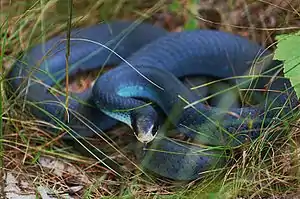 | |
| Eastern racer (Coluber constrictor) | |
Scientific classification  | |
| Kingdom: | Animalia |
| Phylum: | Chordata |
| Class: | Reptilia |
| Order: | Squamata |
| Suborder: | Serpentes |
| Infraorder: | Alethinophidia |
| Clade: | Afrophidia Vidal, Delmas & Hedges, 2007 |
| Subclades | |
Unlike the scolecophidians and amerophidians, which have evolved to be small, the afrophidians have evolved many larger species. This is also the group in which venom has been developed in several lines of snakes.[1]
Below is a phylogeny of Afrophidia recovered from numerous phylogenetic work on snakes:[1][5][2][3]
| Afrophidia |
| |||||||||||||||||||||||||||||||||||||||||||||||||||||||||||||||||||||||||||||||||||||||||||||||||||||||||||||||||||||||||||||||||||||||||||||||||||||||||||||||||||||||||||||||||||||||||||||||||||||||||||||||||||||||||||||||||||||||||||||||||||||||||||||||||||||||||||||||||||||||||||||||||||||||||||||||||||||||||||||||||||||||||||||||||||||||||||||||
References
- Hedges, SB; Marin, J; Suleski, M; Paymer, M; Kumar, S (2015). "Tree of Life Reveals Clock-Like Speciation and Diversification". Mol Biol Evol. 32 (4): 835–845. arXiv:1412.4312. doi:10.1093/molbev/msv037. PMC 4379413. PMID 25739733.
- Reynolds, R. G.; Niemiller, M. L.; Revell, L. J. (2014). "Toward a Tree-of-Life for the boas and pythons: Multilocus species-level phylogeny with unprecedented taxon sampling" (PDF). Molecular Phylogenetics & Evolution. 71: 201–213. doi:10.1016/j.ympev.2013.11.011. PMID 24315866. Archived from the original (PDF) on 2015-12-02. Retrieved 2019-03-05.
- Figueroa, A.; McKelvy, A. D.; Grismer, L. L.; Bell, C. D.; Lailvaux, S. P. (2016). "A species-level phylogeny of extant snakes with description of a new colubrid subfamily and genus". PLOS ONE. 11 (9): e0161070. Bibcode:2016PLoSO..1161070F. doi:10.1371/journal.pone.0161070. PMC 5014348. PMID 27603205.
- Zheng, Y; Wiens, JJ (2016). "Combining phylogenomic and supermatrix approaches, and a time-calibrated phylogeny for squamate reptiles (lizards and snakes) based on 52 genes and 4162 species". Molecular Phylogenetics & Evolution. 94 (Pt B): 537–547. doi:10.1016/j.ympev.2015.10.009. PMID 26475614.
- Pyron; Burbrink; Wiens (2013). "A phylogeny and revised classification of Squamata, including 4161 species of lizards and snakes". BMC Evolutionary Biology. 13: 93. doi:10.1186/1471-2148-13-93. PMC 3682911. PMID 23627680.