Unimog 401
The Unimog 401 is an all-wheel-drive vehicle of the Unimog-series by Mercedes-Benz, developed as a tractor and equipment carrier. It was produced by Daimler-Benz in the Unimog plant in Gaggenau from 1951 to 1956. A total of 16,250 Unimog 401 and 402 were made.[1]
| Unimog 401 | |
|---|---|
 401 | |
| Overview | |
| Type | Tractor |
| Manufacturer | Daimler-Benz AG |
| Also called | Unimog Unimog U25 |
| Production | 1951–1956 |
| Assembly | Mercedes-Benz-Werk Gaggenau |
| Body and chassis | |
| Related | Unimog 402 |
| Powertrain | |
| Engine | OM 636 (Diesel, 25 PS (18 kW; 25 hp)) |
| Transmission | 6-speed manual gearbox, two reverse gears |
| Chronology | |
| Predecessor | Unimog 2010 |
| Successor | Unimog 411 |
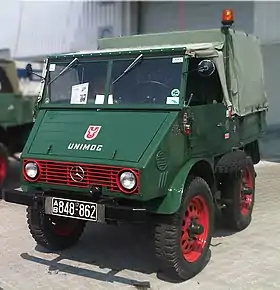
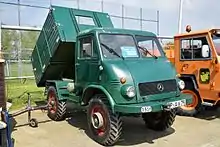
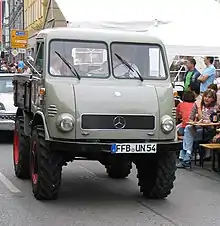
Initially, the Unimog 401 was made in the cabrio version only. The closed cab model Froschauge (German for frog-eye), with a cab made by Westfalia,[2] was introduced in September 1953.[3] An increased wheelbase model was developed, bearing model type 402. Both models were succeeded by the Unimog 411, available in both long and short wheelbases.[2]
History
After World War II, German engineer Albert Friedrich built the first Universalmotorgerät, however, Daimler-Benz declined to put it into series production. Manufacturer Boehringer in Göppingen on the other hand was interested and produced a prototype for the 1948 DLG-exhibition in Frankfurt. The Unimog attracted much interest, encouraging Boehringer to begin series production. Until 1950, approximately 600 Unimog 70.200 were made; their brand logo was an ox-head with U-shaped horns. In late 1950, Daimler-Benz purchased Boehringer moving Unimog production to Gaggenau, beginning series production in May 1951.[4] Initially, the Unimog's type number was 2010, changing to 401 in 1953, with the 401 becoming a new type. The Unimog 401 was the first Unimog to receive the Mercedes star on its grille.[5]
Technical description
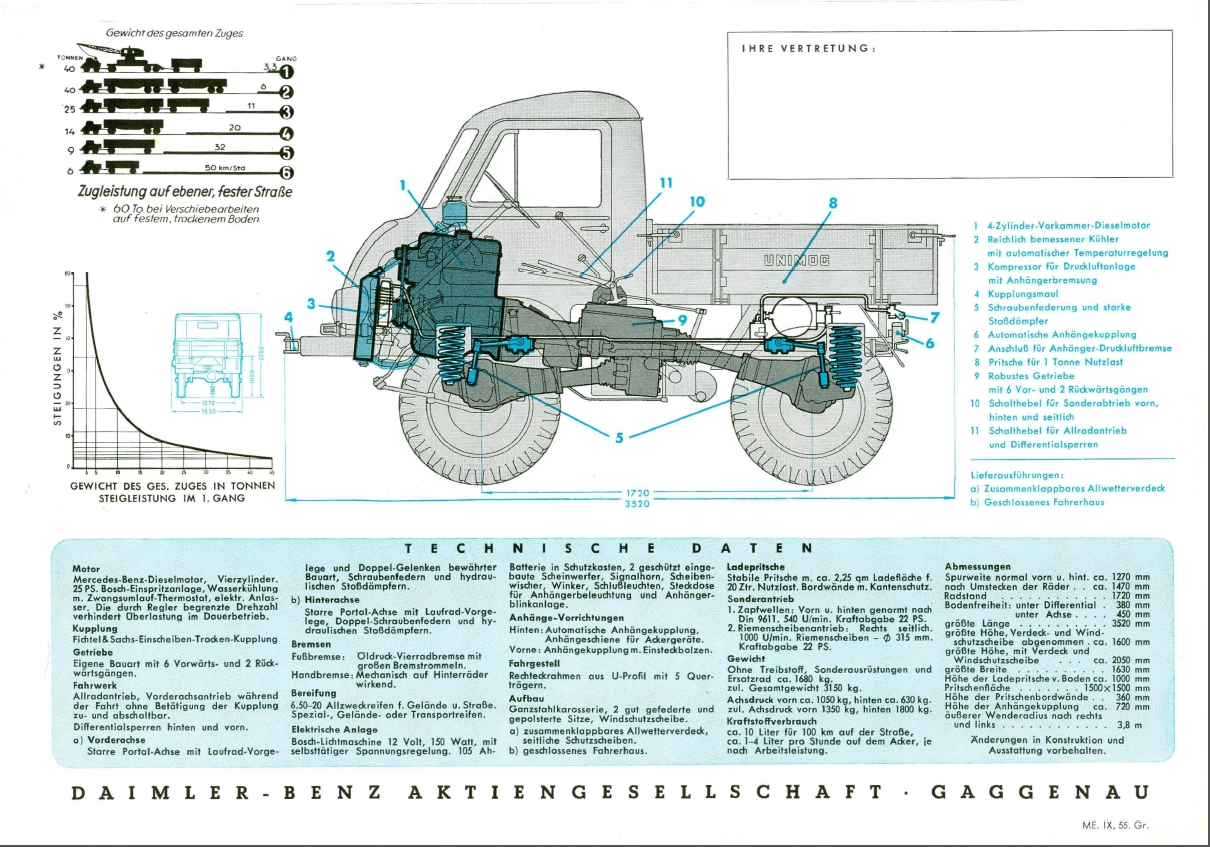
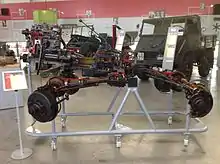
The Unimog 401 is a very compact vehicle with an approximate length of just 3.5 metres (11 ft 5 3⁄4 in). It has a U-shaped ladder frame, beam portal axles both in the rear and front, with four same-sized wheels. Each axle has additional reduction gears built in. Both front and rear axles are supported by a central joint and panhard rods. The 401 has coil springs and hydraulic shock absorbers. Daimler-Benz used 6.5–20" multi-purpose tyres, that are designed for both on and off-road applications. The brake system is hydraulic, the 401 having drum brakes for each wheel.[6] The 401 has a wheelbase of 1,720 mm (67 3⁄4 in); the 402, 2,120 mm (83 1⁄2 in).[2]
_(2).jpg.webp)
Engine and gearbox
The 401 uses a car engine, type OM 636 VI. It is a water-cooled naturally aspirated straight-four-diesel with precombustion chamber injection, OHV-valvetrain and a displacement of 1,767 cm3 (1.767 L; 107.8 cu in). Its standard power output is 40 PS (39 hp; 29 kW), reduced to 25 PS (25 hp; 18 kW) at 2350 rpm for the Unimog. The OM 636 is mounted slightly inclined towards the rear, in the front of the Unimog. It has an electric starter.[6]
The Unimog 401 uses a Daimler-Benz six-speed constant-mesh gearbox with two additional reverse gears. It has clutch-independent switchable all-wheel drive and differential locks for the front and rear axles. The clutch is a Fichtel & Sachs single-disc-dry-clutch.[6] Daimler-Benz offered an additional two-speed crawler-gearbox as a factory option.[7]
Features and accessories
The 401 uses a 150 W Bosch alternator, a 12 V / 105 Ah lead-acid battery, two headlights, two rear lamps, electric trafficators, windscreen wipers and a horn. A plug socket for a trailer was offered as a factory option.[6]
A flatbed is mounted on the rear, measuring 1,500 mm × 1,500 mm (59 1⁄16 in × 59 1⁄16 in), designed for a payload of 1,000 kg (2,200 lb). The 401 has a spring-mounted hitch in the rear and a standard hitch in the front. For additional equipment, it has an anchor rail.[6]
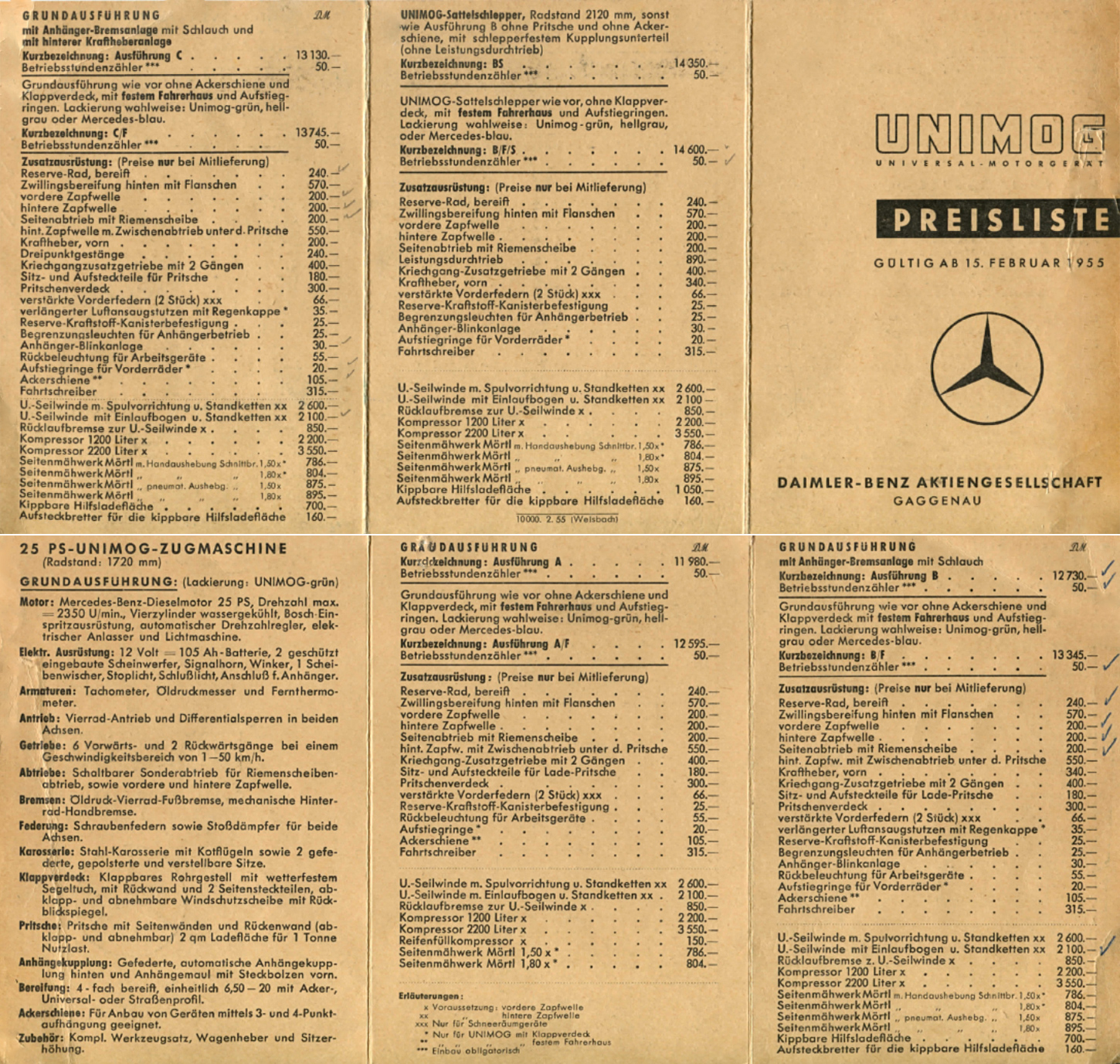
For power take-off, the Unimog was available with front and rear PTOs (DIN 9611, 540 rpm). The rated power is approximately 22 PS (22 hp; 16 kW). A 315 mm (12 3⁄8 in) belt pulley was also available, with an output power of 22 PS (22 hp; 16 kW). Daimler-Benz also offered a spare wheel, rear twin tyres, a trailer-brake-system, a winch, a mowing bar and air compressors for the 401.[7]
The previous Unimog 2010 was offered as a cabrio with a foldable top, a conceiling windscreen, removable side windows and a rigid rear panel. It was available in the colour Unimog-grün. After developing the 2010 into the 401, the closed cab was offered. The cabrio version then became Version A while the cab-version became Version A/F. Unimogs with a trailer-brake-system were called Version B and Version B/F. Unimogs with a closed cab were available in the paint colours Unimog-grün, hellgrau and Mercedes-blau.[7]
Technical specifications
| Unimog 401[6] | |
|---|---|
| Measurements and weights | |
| Track width | 1,270 mm (50 in) 1,470 mm (57 7⁄8 in) (after switching wheels) |
| Wheelbase | 1,720 mm (67 11⁄16 in) |
| Ground clearance | 380 mm (14 15⁄16 in) |
| Length | 3,520 mm (138 9⁄16 in) |
| Width | 1,630 mm (64 3⁄16 in) |
| Height | 2,050 mm (80 11⁄16 in) (with foldable top) |
| Turning clearance circle diameter | 7,600 mm (24 ft 11 3⁄16 in) |
| Bed | 1.5 m × 1.5 m (59 1⁄16 in × 59 1⁄16 in), 2.25 m2 (24.2 sq ft) |
| Mass | 1,680 kg (3,700 lb) |
| Payload | 1,000 kg (2,200 lb) |
| max. allowed mass | 3,150 kg (6,940 lb) |
| Drive train | |
| Torque transmission to | rear wheels, switchable all-wheel drive |
| Gearbox | Daimler-Benz six-speed constant-mesh gearbox, two reverse gears |
| Clutch | Single-disc-dry-clutch by Fichtel & Sachs |
| Top speed | 53 km/h (33 mph) |
| Fuel consumption | 10 L/100 km (28 mpg‑imp; 24 mpg‑US) |
| Engine | |
| Type | OM 636 VI |
| Layout | Straight-four diesel with precombustion chamber injection, OHV-Valvetrain |
| Cooling system | Water |
| Bore × Stroke | 75 mm × 100 mm (2.95 in × 3.94 in) |
| Displacement | 1,767 cm3 (107.8 in3) |
| Compression ratio | 19 : 1 |
| Rated power (DIN 70020) | 25 PS (18 kW; 25 hp) at 2350 rpm |
| Max. torque (DIN 70020) | 10.3 kp⋅m (101 N⋅m; 75 lbf⋅ft) at 2000 rpm |
Bibliography
- Werner Oswald: Mercedes-Benz Lastwagen und Omnibusse 1886–1986. Motorbuch Verlag Stuttgart, 2008, ISBN 978-3-613-02943-9.
References
- Werner Oswald, p. 320.
- Unimog-Community: Unimog U 401 (in German)
- Werner Oswald, p. 321.
- Werner Oswald, p. 321.
- Unimog U 2010 – Unimog-Community (in German)
- Daimler-Benz AG: Technische Daten Unimog 401 1955 (in German)
- Daimler-Benz AG: Preisliste für Unimog 401 1955 (in German)