Sisyrinchium angustifolium
Sisyrinchium angustifolium, commonly known as narrow-leaf blue-eyed-grass,[2] is a herbaceous perennial growing from rhizomes, native to moist meadow and open woodland. It is the most common blue-eyed grass of the eastern United States, and is also cultivated as an ornamental.
| Narrow-leaf blue-eyed-grass | |
|---|---|
 | |
Scientific classification  | |
| Kingdom: | Plantae |
| Clade: | Tracheophytes |
| Clade: | Angiosperms |
| Clade: | Monocots |
| Order: | Asparagales |
| Family: | Iridaceae |
| Genus: | Sisyrinchium |
| Species: | S. angustifolium |
| Binomial name | |
| Sisyrinchium angustifolium | |
| Synonyms[1] | |
|
List
| |
Range: Eastern Canada and US, west to Texas and Minnesota, in meadows, low woods, and shorelines.
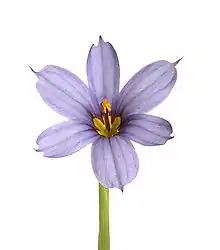
Height: 15–50 cm (6–20 in). Stem: broadly winged, 2–4 mm (1⁄16–3⁄16 in) wide, usually branched. Leaves: 2–6 mm (1⁄16–1⁄4 in) wide. Tepals: 6, blue, 7–10 mm (1⁄4–3⁄8 in), each tipped with a sharp point, veined, and darkening toward central yellow patch.
Gallery
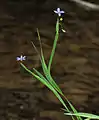 flowers, stem, and leaves
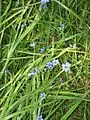 many, in grass
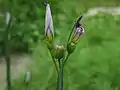 bud before flowering and immature fruits
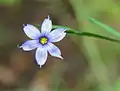 flower, close
References
- "Sisyrinchium angustifolium". World Checklist of Selected Plant Families (WCSP). Royal Botanic Gardens, Kew. Retrieved 8 July 2014 – via The Plant List.
- "Sisyrinchium angustifolium". Germplasm Resources Information Network (GRIN). Agricultural Research Service (ARS), United States Department of Agriculture (USDA). Retrieved 1 July 2014.
- Cholewa, Anita F.; Henderson, Douglass M. (2002). "Sisyrinchium angustifolium". In Flora of North America Editorial Committee (ed.). Flora of North America North of Mexico (FNA). 26. New York and Oxford – via eFloras.org, Missouri Botanical Garden, St. Louis, MO & Harvard University Herbaria, Cambridge, MA.
- Rhoads, Ann F.; Block, Timothy A. (2007). The Plants of Pennsylvania: An Illustrated Manual. Anna Anisko (Illustrator) (2nd ed.). University of Pennsylvania Press. ISBN 978-0-8122-4003-0.
- Gleason, Henry A.; Cronquist, Arthur (1991). Manual of Vascular Plants of Northeastern United States and Adjacent Canada (2nd ed.). The New York Botanical Garden Press. ISBN 0-89327-365-1.
- Thierer, John W.; Niering, William A.; Olmstead, Nancy C. (2001). National Audubon Society Field Guide to North American Wildflowers, Eastern Region (Revised ed.). Alfred A. Knopf. ISBN 0-375-40232-2.
This article is issued from Wikipedia. The text is licensed under Creative Commons - Attribution - Sharealike. Additional terms may apply for the media files.