Nesodon
Nesodon ("island tooth")[2] is a genus of Miocene mammal belonging to the extinct order Notoungulata which inhabited southern South America during the Late Oligocene to Miocene living from 29.0—16.3 Ma and existed for approximately 12.7 million years . [3] It had a relatively large size, weighing up to 554 kg (1221 lbs) and reaching 1.5 m in height.[4]
| Nesodon[1] | |
|---|---|
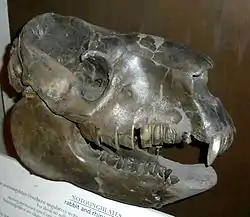 | |
| N. imbricatus skull | |
| Scientific classification | |
| Kingdom: | |
| Phylum: | |
| Class: | |
| Order: | |
| Family: | |
| Subfamily: | †Nesodontinae |
| Genus: | †Nesodon Owen 1846 |
| Type species | |
| †Nesodon imbricatus | |
| Species | |
| |
| Synonyms | |
Taxonomy
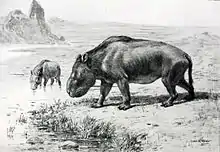
Nesodon was named by Owen (1846). It was assigned to Toxodontidae by Carroll (1988). It was an early member of the family Toxodontidae, which included the well-known Pleistocene genus Toxodon. Like almost all toxodontids, Nesodon was endemic to South America. In particular, fossils of Nesodon are known from late early Miocene (Santacrucian SALMA) deposits of Argentina and Chile.[5]
Three species of Nesodon are recognized including a larger species, N. imbricatus, and a smaller species, N. conspurcatus.[6] A poorly known and possibly invalid third species, N. cornutus, was similar to N. imbricatus but may have had a small horn on its head. All species of Nesodon were larger than species of the contemporary toxodontid Adinotherium.
The dentition of Nesodon shows features typical of living grazing (grass-eating) mammals, but a study of wear on the enamel of N. imbricatus suggests that it was a browser (leaf eater) that may have supplemented its diet with fruit or bark.[7]
Classification
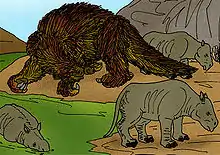
In 2014, a study identifying a new species of Nesodon, N. taweretus, resolved the families phylogenetic relations. The below cladogram was found by the study:[8]
| |||||||||||||||||||||||||||||||||||||||||||||||||||||||||||||||||||||||||||||||||||||||||||||||||||||||||||||||||||||||||||||||||||||||||||||||||
Distribution
Fossils of Nesodon have been found in:[9]
- Deseado and Santa Cruz Formation, Argentina
- Chucal and Río Frías Formations, Chile
References
- range and species from Croft et al. (2004) pp. 4–5; synonyms from McKenna and Bell (1997), p. 460
- Palmer (1904) p. 457.
- Paleobiology Database: Nesodon imbricatus, Basic info.
- D.Patterson, Bruce (2012) Bones, Clones, and Biomes: The History and Geography of Recent Neotropical Mammals p.92
- Croft et al. (2004), p. 5.
- Croft et al. (2004), pp. 7–8.
- Townsend & Croft (2008) p. 225.
- Forasiepi, A. A. M.; Cerdeño, E.; Bond, M.; Schmidt, G. I.; Naipauer, M.; Straehl, F. R.; Martinelli, A. N. G.; Garrido, A. C.; Schmitz, M. D.; Crowley, J. L. (2014). "New toxodontid (Notoungulata) from the Early Miocene of Mendoza, Argentina". Paläontologische Zeitschrift. 89 (3): 611–634. doi:10.1007/s12542-014-0233-5.
- Nesodon at Fossilworks.org
Bibliography
- Croft, D.A.; Flynn, J.J.; Wyss, A.R. (2004). "Notoungulata and Litopterna of the Early Miocene Chucal Fauna, Northern Chile". Fieldiana Geology. 50 (1): 1–52.
- McKenna, Malcolm C., and Bell, Susan K. 1997. Classification of Mammals Above the Species Level. Columbia University Press, New York, 631 pp. ISBN 0-231-11013-8
- Palmer, T.S. (1904). "Index Generum Mammalium: a List of the Genera and Families of Mammals". North American Fauna. 23: 1–984. doi:10.3996/nafa.23.0001.
- Townsend, K.E.B.; Croft, D.A. (2004). "Diets of notoungulates from the Santa Cruz Formation, Argentina: new evidence from enamel microwear". Journal of Vertebrate Paleontology. 28 (1): 217–230. doi:10.1671/0272-4634(2008)28[217:DONFTS]2.0.CO;2.