List of antbird genera
The antbirds are a large family, Thamnophilidae, of smallish passerine bird species of subtropical and tropical Central and South America. The family has more than 230 species divided into 62 genera and includes the antshrikes, antwrens, antvireos, fire-eyes, bare-eyes and bushbirds. The most closely related species to the antbirds are the gnateaters (family Conopophagidae) and the crescentchests (family Melanopareiidae).[1]
List and classification of genera
The list of genera below follows the World Bird List maintained by Frank Gill and David Donsker on behalf of the International Ornithologists' Union.[2] The division of the genera into subfamilies and tribes follows the phylogeny published by Jan Ohlson and colleagues in 2013 as well as the list maintained by Joseph del Hoyo on the Handbook of the Birds of the World Alive website.[1][3] For more detail, see list of antbird species.
Subfamily Euchrepomidinae
- Genus Euchrepomis – antwrens (4 species)
Subfamily Myrmornithinae
- Genus Myrmornis – wing-banded antbird
- Genus Pygiptila – spot-winged antshrike
- Genus Thamnistes – antshrikes (2 species)
Subfamily Thamnophilinae
Tribe Microrhopiini
- Genus Microrhopias – dot-winged antwren
- Genus Neoctantes – black bushbird
- Genus Clytoctantes – bushbirds (2 species) (Placement here is provisional)
- Genus Epinecrophylla – stipplethroats (8 species)
- Genus Myrmorchilus – stripe-backed antbird
- Genus Aprositornis – Yapacana antbird
- Genus Ammonastes – grey-bellied antbird
- Genus Myrmophylax – black-throated antbird
Tribe Formicivorini
- Genus Myrmotherula – antwrens (24 species)
- Genus Terenura – antwrens (2 species)
- Genus Myrmochanes – black-and-white antbird
- Genus Formicivora – antwrens (9 species)
Tribe Thamnophilini
- Genus Dichrozona – banded antbird
- Genus Rhopias – star-throated antwren
- Genus Isleria – antwrens (2 species)
- Genus Thamnomanes – antshrikes (4 species)
- Genus Megastictus – pearly antshrike
- Genus Herpsilochmus – wren-like antshrikes (17 species)
- Genus Dysithamnus – antvireos (8 species)
- Genus Thamnophilus – antshrikes (30 species)
.jpg.webp)
.jpg.webp)
- Genus Sakesphorus – antshrikes (3 species)
- Genus Biatas – white-bearded antshrike (Placement here is provisional)
- Genus Cymbilaimus – antshrikes (2 species)
- Genus Taraba – great antshrike
- Genus Mackenziaena – antshrikes (2 species)
- Genus Frederickena – antshrikes (3 species)
- Genus Hypoedaleus – spot-backed antshrike
- Genus Batara – giant antshrike
- Genus Xenornis – speckled antshrike (Placement here is provisional)
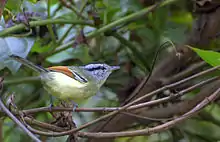
Tribe Pithyini
- Genus Pithys (2 species)
- Genus Phaenostictus – ocellated antbird
- Genus Gymnopithys (3 species)
- Genus Oneillornis (2 species)
- Genus Rhegmatorhina (5 species)
- Genus Phlegopsis – bare-eyes (3 species)
- Genus Willisornis (2 species)[4][5]
- Genus Drymophila (11 species)
- Genus Hypocnemis – warbling-antbirds (8 species)
- Genus Sciaphylax (2 species)
- Genus Cercomacroides (6 species)
- Genus Cercomacra (7 species)
Tribe Pyriglenini
- Genus Myrmoderus (5 species)
- Genus Hypocnemoides (2 species)
- Genus Hylophylax (3 species)
- Genus Sclateria – silvered antbird
- Genus Myrmelastes (8 species)
- Genus Poliocrania – chestnut-backed antbird
- Genus Ampelornis – grey-headed antbird
- Genus Sipia (4 species)
- Genus Myrmeciza – white-bellied antbird
- Genus Myrmoborus (5 species)
- Genus Gymnocichla – bare-crowned antbird
- Genus Pyriglena – fire-eyes (3 species)
- Genus Rhopornis – slender antbird (Placement here is provisional)
- Genus Percnostola (7 species)
Phylogeny
Phylogeny based on a study of the suboscines by Michael Harvey and colleagues published in 2020. Seven genera in the antbird family were found to be paraphyletic: Clytoctantes, Drymophila, Dysithamnus, Formicivora, Herpsilochmus, Myrmotherula and Sakesphorus.[6]
| ||||||||||||||||||||||||||||||||||||||||||||||||||||||||||||||||||||||||||||||||||||||||||||||||||||||||||||||||||||||||||||||||||||||||||||||||||||||||||||||||||||||||||||||||||||||||||||||||||||||||||||||||||||||||||||||||||||||||||||||||||||||||||||||||||||||||||||||||||||||||||||||||||||||||||||||||||||||||||||||||||||||||||||||||||||||||||||||||||||||||||||||||||||||||||||||||||||||||||||||||||||||||||||||||||
References
- Ohlson, J.I.; Irestedt, M.; Ericson, P.G.P.; Fjeldså, J (2013). "Phylogeny and classification of the New World suboscines (Aves, Passeriformes)". Zootaxa. 3613 (1): 1–35. doi:10.11646/zootaxa.3613.1.1.
- Gill, Frank; Donsker, David, eds. (2018). "Antbirds". World Bird List Version 8.1. International Ornithologists' Union. Retrieved 4 February 2018.
- del Hoyo, Joseph (ed.). "Taxonomic structure and notes". Handbook of the Birds of the World Alive. Lynx Edicions. Retrieved 28 January 2018.
- South American Classification Committee (2007) Revive the genus Dichropogon Archived 2008-05-08 at the Wayback Machine – Accessed 8 April 2008.
- Reassign Dichropogon to Willisornis Archived 2008-10-12 at the Wayback Machine – South American Classification Committee (2008)
- Harvey, M.G.; Bravo, G.A.; Claramunt, S.; Cuervo, A.M.; Derryberry, G.E.; Battilana, J.; Seeholzer, G.F.; McKay, J.S.; O’Meara, B.C.; Faircloth, B.C.; Edwards, S.V.; Pérez-Emán, J.; Moyle, R.G.; Sheldon, F.H.; Aleixo, A.; Smith, B.T.; Chesser, R.T.; Silveira, L.F.; Cracraft, J.; Brumfield, R.T.; Derryberry, E.P. (2020). "The evolution of a tropical biodiversity hotspot". Science. 370 (6522): 1343–1348. doi:10.1126/science.aaz6970.
Further reading
- Irestedt, Martin; Fjeldså, Jon; Nylander, Johan A. A. & Ericson, Per G. P. (2004): Phylogenetic relationships of typical antbirds (Thamnophilidae) and test of incongruence based on Bayes factors. BMC Evol. Biol. 4: 23. doi:10.1186/1471-2148-4-23 Supplementary information
- Isler, M., P. Isler, B. Whitney, and K. Zimmer (2007). Species limits in the "Schistocichla" complex of Percnostola Antbirds (Passeriformes: Thamnophilidae). Wilson Bull. 119(1): 53–70.
- Isler, M., P. Isler, and B. Whitney (2007). Species limits in Antbirds (Thamnophilidae): The Warbling Antbird (Hypocnemis cantator) complex. Auk 124(1): 11–28.
- Isler, M., D. Lacerda, P. Isler, S. Hackett, K. Rosenberg, and R. Brumfield (2006). Epinecrophylla, a new genus of antwrens (Aves: Passeriformes: Thamnophilidae). Proceedings of the Biological Society of Washington 119(4): 522-527