Heteronym (linguistics)
A heteronym (also known as a heterophone) is a word that has a different pronunciation and meaning from another word but the same spelling. These are homographs that are not homophones. Thus, lead (a metal element) and lead (a leash or halter to direct an animal) are heteronyms, but mean (intend) and mean (average) are not, since they are pronounced the same. Heteronym pronunciation may vary in vowel realisation, in stress pattern, or in other ways.
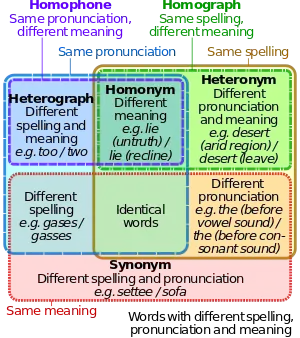
Description
A heteronym is a homograph that is not a homophone, a word that has a different pronunciation and meaning from another word with the same spelling. Heteronym pronunciation may vary in vowel realisation, in stress pattern, or in other ways.
"Heterophone" literally just means "different sound", and this term is sometimes applied to words that are just pronounced differently, irrespective of their spelling. Such a definition would include virtually every pair of words in the language, so "heterophone" in this sense is normally restricted to instances where there is some particular reason to highlight the different sound. For example, puns normally involve homophones, but in the case of heterophonic (or imperfect) puns, the two words sound different, and yet similar enough for one to suggest the other (for example, mouth and mouse).
Types
Most heteronyms are doubles. Triple heteronyms are extremely rare in English; three examples, sin, mobile and does, are listed below.
Proper nouns can sometimes be heteronyms. For example, the final syllable of Oregon is pronounced like the word in by residents of that state in the United States, while in the name of the village of Oregon in Wisconsin, the final syllable is pronounced like the word on. Other examples include local pronunciations of Cairo, Georgia; Versailles, Kentucky; and Milan, Tennessee—compared to the more well-known Cairo, Versailles, and Milan—or the difference between the pronunciation of Louisville, Kentucky (/ˈluːəvəl/) and the town of Louisville, New York (/ˈluːɪsvɪl/).
There are also pairs which ignore case and include both initialisms and regular words, e.g., US and us.
Heteronyms can also occur in non-alphabetic languages. For example, the Chinese character 行 can be pronounced háng, meaning "profession", or xíng, meaning "OK".
Examples
English
In some of these cases, American and British English pronunciations differ. One systematic case appears in the stress pattern of some deverbal nouns.
For a longer list, see wikt:Category:English heteronyms.
| Spelling | Pronun. | PoS | Meaning |
|---|---|---|---|
| abstract | /ˈæbstrækt/ | a. | existing in thought or as an idea but not having a physical or concrete existence |
| /æbˈstrækt/ | v. | consider (something) theoretically or separately from something else | |
| abuse | /əˈbjuːs/ | n. | improper treatment |
| /əˈbjuːz/ | v. | to use improperly | |
| address | AmE and BrE /əˈdrɛs/ | v. | to speak to (address) the crowd |
| AmE /ˈædrɛs/ BrE /əˈdrɛs/ | n. | a postal address | |
| advocate | /ˈædvəkeɪt/ | v. | to argue for someone else |
| /ˈædvəkɪt/ | n. | a person who speaks in support of something | |
| affect | /əˈfɛkt/ | v. | to have an effect on |
| /ˈæfɛkt/ | n. | mood, emotional state | |
| agape | /əˈɡeɪp/ | adv. | open wide |
| /ˈæɡəpiː/, /əˈɡɑːpeɪ/ | n. | altruistic, beneficial love | |
| allied | /əˈlaɪd/ | v. | They allied themselves with the French. |
| /ˈælaɪd/ | a. | The Treaty of Vienna had bound the Allied Powers to make war together upon Napoleon. | |
| alternate | /ˈɔːltərnət/ or /ɔːlˈtərnət/ | adj. | other |
| /ˈɔːltərneɪt/ | v. | to take turns | |
| alum | /ˈæləm/ | n. (or v.) | a type of astringent salt (or to chemically impregnate with that salt) |
| /əˈlʌm/ | n. | a past attendee or graduate (of either gender) of an educational institution | |
| analyses | /əˈnælɪsiːz/ | n. | plural of analysis |
| /ˈænəlaɪzəz/ | v. | third person singular present of analyse | |
| appropriate | /əˈproʊpriət/ | adj. | suitable |
| /əˈproʊprieɪt/ | v. | to set apart for | |
| attribute | /ˈætrɪbjuːt/ | n. | a characteristic |
| /əˈtrɪbjuːt/ | v. | to associate ownership | |
| articulate | /ɑːrˈtɪkjʊleɪt/ | v. | "The tourists are the ones who always try to articulate every syllable when they speak the language." |
| /ɑːrˈtɪkjʊlɪt/ | a. | "In one decade, the image of youth went from radicals uttering rage-filled rhetoric to the much less articulate valley girl or surfer wannabe." | |
| august/August | /ɔːˈɡʌst, ə-/ | adj. | awe-inspiring, majestic, noble, venerable |
| /ˈɔː.ɡəst/ | n. | the eighth month of the Roman, Julian, and Gregorian calendars | |
| axes | /ˈæksiːz/ | n. | pl. of axis |
| /ˈæksɪz/ | n. | pl. of axe | |
| bases | /ˈbeɪsɪz/ | n. | plural of base |
| /ˈbeɪsiːz/ | n. | plural of basis | |
| bass | /ˈbeɪs/ | n. | low in pitch |
| /ˈbæs/ | n. | a fish | |
| blessed | /ˈblɛsɪd/ | adj. | having divine aid |
| /ˈblɛst/ | v. | past tense of bless | |
| bow | /ˈboʊ/ | n. | a stringed weapon, or the initiator of sound in some stringed musical instruments. |
| n. | an object that you clip or tie on to your hair to keep it from falling into your face | ||
| /ˈbaʊ/ | v. | to bend in respect | |
| n. | the front of a boat or ship | ||
| buffet | /bəˈfeɪ/ ~ /ˈbʊfeɪ/ | n. | sideboard meal |
| /ˈbʌfɪt/ | v. | to strike | |
| close | /ˈkloʊz/ | v. | to shut |
| /ˈkloʊs/ | adj. | nearby | |
| combine | /ˈkɒmbaɪn/ | n. | A farm machine that harvests and threshes |
| /kəmˈbaɪn/ | v. | To bring two or more things together, mix | |
| compact | /kəmˈpækt/ | v. | to compress |
| /ˈkɒmpækt/ | adj. | small | |
| complex | /ˈkɒmplɛks/ | n. | A collection of buildings with a common purpose, such as a university or military base |
| /kəmˈplɛks/, /ˈkɒmplɛks/ | adj. | Made up of multiple parts | |
| compound | /ˈkɒmpaʊnd/ | n. | A substance having definite proportions of elements |
| /kəmˈpaʊnd/ | v. | To make a situation worse | |
| concert | /ˈkɒnsərt/ | n. | We saw the band in concert. |
| /kənˈsɜːrt/ | v. | We had to concert all our energy to stay awake. | |
| conduct | /ˈkɒndəkt/ | n. | action |
| /kənˈdʌkt/ | v. | to lead | |
| confines | /ˈkɒnfaɪnz/ | n. pl. | Work within the confines of the contract. |
| /kənˈfaɪnz/ | v. | But the contract confines my creativity! | |
| conflict | /ˈkɒnflɪkt/ | n. | The mother said to her belligerent son, "Violence is no way to resolve conflict!" |
| /kənˈflɪkt/ | v. | The two news reports seem to conflict with each other. | |
| console | /kənˈsoʊl/ | v. | provide comfort from grief |
| /ˈkɒnsoʊl/ | n. | control unit | |
| content | /ˈkɒntɪnt/ | n. | information |
| /kənˈtɛnt/ | adj., v. | satisfied, satisfy | |
| contract | /ˈkɒntrækt/ | n. | The contract was supposed to expire seven years after it was signed. |
| /kənˈtrækt/ | v. | Derek firmly stated that he would rather contract pneumonia and die than stand outside wearing that ridiculous pink and green poncho. | |
| convict | /kənˈvɪkt/ | v. | to find guilty |
| /ˈkɒnvɪkt/ | n. | one convicted | |
| crooked | /ˈkrʊkt/ | v. | I crooked my arm to show the sleeve. |
| /ˈkrʊkɪd/ | a. | Unfortunately, that just made the sleeve look crooked. | |
| decrease | /dɪˈkriːs/ | v. | To lessen |
| /ˈdiːkriːs/ | n. | A diminution | |
| defense | /dɪˈfɛns/ | n. | The attorney gave a strong defense. |
| /ˈdiːˈfɛns/ | n. | The coach put out his best defense. (dialectal, used in sports contexts) | |
| desert | /ˈdɛzərt/ | n. | an arid region |
| /dɪˈzɜːrt/ | v. | to abandon | |
| discard | /ˈdɪskɑːrd/ | n. | Toss it in the discard pile. |
| /dɪsˈkɑːrd/ | v. | But I don't want to discard it! | |
| do | /ˈduː/, /də/ | v. | What do you think you are doing? |
| /ˈdoʊ/ | n. | To warm-up, the singer sang the scale from do. | |
| does | /ˈdoʊz/ | n. | pl. of doe |
| /ˈdʌz/ | v. | form of do | |
| /ˈduːz/ | n. | one spelling of the plural of do as a noun - e.g. hair does | |
| dogged | /ˈdɒɡd/ | v. | At night proctors patrolled the street and dogged your steps if you tried to go into any haunt where the presence of vice was suspected. (Samuel Butler, The Way of All Flesh) |
| /ˈdɒɡɪd/ | a. | Still, the dogged obstinacy of his race held him to the pace he had set, and would hold him till he dropped in his tracks. (Jack London, The Son of the Wolf) | |
| dove | /ˈdʌv/ | n. | a bird |
| /ˈdoʊv/ | v. | Mainly American past tense of dive | |
| ellipses | /ɪˈlɪpsɪz/ | n. | Plural of ellipse |
| /ɪˈlɪpsiːz/ | n. | Plural of ellipsis | |
| entrance | /ˈɛntrəns/ | n. | doorway |
| /ɛnˈtræns/ | v. | to delight | |
| exploit | /ˈɛksplɔɪt/ | n. | a heroic or extraordinary deed |
| /ɛksˈplɔɪt/ | v. | to make use of or take advantage of | |
| house | /ˈhaʊs/ | n. | a residential building |
| /ˈhaʊz/ | v. | to place in residence | |
| incense | /ˈɪnsɛns/ | n. | Dad, I bought this incense at the temple. |
| /ɪnˈsɛns/ | v. | Big mistake. If you burn it here, you'll incense your mother. | |
| increase | /ɪn-ˈkriːs/ | v. | To get greater |
| /ˈɪn-kriːs/ | n. | An augmentation | |
| intimate | /ˈɪntɪmeɪt/ | v. | to suggest |
| /ˈɪntɪmət/ | adj. | very close | |
| invalid | /ɪnˈvælɪd/ | adj. | incorrect |
| /ˈɪnvəlɪd/ | n. | a disabled person | |
| laminate | /ˈlæmɪneɪt/ | v. | to assemble from thin sheets glued together |
| /ˈlæmɪnɪt/ | n. | material formed of thin sheets glued together | |
| lead | /ˈliːd/ | v. | to guide |
| /ˈlɛd/ | n. | a metal | |
| learned | /ˈlɜːrnɪd/ | adj. | having much learning |
| /ˈlɜːrnd/ | v. | past tense of learn | |
| lima/Lima | /ˈlaɪmə/ | n. or attributive | A vegetable |
| pn. | A city in Ohio, United States | ||
| /ˈliːmə/ | pn. | The capital city of Peru | |
| live | /ˈlɪv/ | v. | to be alive |
| /ˈlaɪv/ | adj. | having life | |
| merchandise | /ˈmɜːrtʃəndaɪs/ | n. | goods available for sale |
| /ˈmɜːrtʃəndaɪz/ | v. | to make (something) available for sale | |
| minute | /maɪˈnjuːt/ | adj. | small |
| /ˈmɪnət/ | n. | unit of time | |
| mobile/Mobile | AmE /ˈmoʊbiːl/, BrE /ˈmoʊbaɪl/ | n. | The baby sat in awe at the bright colors on the mobile. |
| AmE /ˈmoʊbəl/, BrE /ˈmoʊbaɪl/ | a. | Although most animals are mobile, the sponge is sessile. | |
| /moʊˈbiːl/ | pn. | A city in Alabama | |
| moped | /ˈmoʊpɛd/ | n. | a small motorcycle |
| /ˈmoʊpt/ | v. | past tense of mope | |
| mow | /ˈmaʊ/ | n. | a stack of hay, or the part of a barn where hay is stored |
| /ˈmoʊ/ | v. | To cut something (especially grass or crops) down or knock down | |
| multiply | /ˈmʌltɪplaɪ/ | v. | to increase |
| /ˈmʌltɪpli/ | adv. | in multiple ways | |
| number | /ˈnʌmbər/ | n. | a numeral |
| /ˈnʌmər/ | adj. | more numb | |
| object | /ˈɒbdʒɪkt/ | n. | a thing |
| /əbˈdʒɛkt/ | v. | to protest | |
| overall | /oʊvərˈɔːl/ | a. | Overall, we didn't do too badly. |
| /ˈoʊvərɔːl/ | n. | I need new overalls. | |
| periodic | /pɪəriˈɒdɪk/ | a. | Temperature shows periodic variation. |
| /pɜːrˈaɪɒdɪk/ | a. | Periodic acid is an oxoacid of iodine. | |
| polish/Polish | /ˈpɒlɪʃ/ | v. | to shine |
| /ˈpoʊlɪʃ/ | adj. | of, from, or native to Poland | |
| present | /prɪˈzɛnt/ | v. | to reveal |
| /ˈprɛzənt/ | n. | a gift | |
| n. | the current moment (e.g. At present) | ||
| adj. | existing in the immediate vicinity (e.g. Santa is present.) | ||
| primer | AmE /ˈprɪmər/, BrE /ˈpraɪmər/ | n. | Book that covers the basic elements of a subject |
| /ˈpraɪmər/ | n. | An undercoat of paint | |
| proceeds | /ˈproʊsiːdz/ | n. | Revenue |
| /prəˈsiːdz/ | v. | Third person singular of the verb "proceed" | |
| produce | /proʊˈdjuːs/ | v. | to make |
| /ˈproʊdjuːs/ | n. | fruit and vegetables | |
| progress | /prəˈɡrɛs/ | v. | I hope things will progress faster. |
| /ˈprɑɡrɛs/ | n. | I haven't made any progress. | |
| project | /ˈprɒdʒɪkt/ | n. | an undertaking |
| /proʊˈdʒɛkt/ | v. | to cast an image | |
| putting | /ˈpʊtɪŋ/ | v. | pr. part. of to put |
| /ˈpʌtɪŋ/ | v. | pr. part. of to putt | |
| ragged | /ˈræɡd/ | v. | She ragged on me about my ragged jeans. |
| /ˈræɡɪd/ | a. | But my ragged jeans are my trademark, I responded. | |
| read | /ˈriːd/ | v. | present tense |
| /ˈrɛd/ | v. | past tense | |
| rebel | /rɪˈbɛl/ | v. | to resist |
| /ˈrɛbəl/ | n. | one who rebels | |
| record | /ˈrɛkərd/ | n. | physical information |
| /rɪˈkɔːrd/ | v. | to make a record | |
| recreate | /ˈrɛkrieɪt/ | v. | to relax by leisure activity |
| /ˌriːkriˈeɪt/ | v. | to give new life or create again (some style guides specify a hyphen for this sense, to increase clarity: re-create) | |
| refuse | /ˈrɛfjuːs/ | n. | garbage |
| /rɪˈfjuːz/ | v. | to decline | |
| resign | /rɪˈzaɪn/ | v. | to quit |
| /riːˈsaɪn/ | v. | to sign again; re-sign | |
| resume | /rɪˈzjuːm/ | v. | to start again |
| /ˈrɛzjʊmeɪ/ | n. | curriculum vitae (sometimes distinguished with acute accents; résumé) | |
| retreat | /riˈtriːt/ | v. | to fall back from a battle front |
| /ˌriːˈtriːt/ | v. | to treat again (some style guides specify a hyphen for this sense, to increase clarity: re-treat) | |
| root | /ˈruːt/ or /ˈrʊt/) | n. | The tree's root was rotted. |
| /ˈruːt/ | v. | A pig can be trained to root for mushrooms. | |
| row | /ˈroʊ/ | n.; v. | a line; to paddle a boat |
| /ˈraʊ/ | n. | an argument | |
| sake | /ˈseɪk/ | n. | benefit |
| /ˈsɑːkiː/ | n. | rice wine | |
| second | /ˈsɛkənd/ | adj., n., v. | ordinal of "two", 1/60 of a minute, to endorse a motion |
| /səˈkɒnd/ | v. | to transfer temporarily to an alternative employment | |
| separate | /ˈsɛprɪt/ | a. | This should be divided into packets of ten cartridges each, which should be rolled up in flannel and hermetically sealed in separate tin canisters. (Samuel W. Baker, The Nile Tributaries of Abyssinia) |
| /ˈsɛpəreɪt/ | v. | To stalk these wary antelopes I was obliged to separate from my party, who continued on their direct route. (Samuel W. Baker, The Nile Tributaries of Abyssinia) | |
| sewer | /ˈsjuːər/ | n. | drainage pipes |
| /ˈsoʊ.ər/ | n. | one who sews | |
| shower | /ˈʃaʊ.ər/ | n. | precipitation |
| /ˈʃoʊ.ər/ | n. | one who shows | |
| sin/Sin | /ˈsɪn/ | n. | a moral error |
| /ˈsaɪn/ | n. | abbrev. for sine | |
| /ˈsiːn/ | n. | Sumerian god of the moon | |
| sow | /ˈsoʊ/ | v. | to plant seeds |
| /ˈsaʊ/ | n. | a mature female in the swine species | |
| subject | /ˈsʌbdʒɪkt/ | n. | a topic |
| /səbˈdʒɛkt/ | v. | to cause to undergo | |
| supposed | /səˈpoʊz(ɪ)d/ | adj. | being assumed to be |
| /səˈpoʊst/ | v. | obliged to do | |
| /səˈpoʊzd/ | v. | past sense of suppose | |
| tear | /ˈtɪər/ | n. | liquid produced by crying |
| /ˈtɛər/ | v. , n. | to separate | |
| tier | /ˈtɪər/ | n. | Our seats are in the third tier of the stadium. |
| /ˈtaɪ.ər/ | n. | Will the tier be around to make these knots? | |
| transfer | /ˈtrænsfər/ | n. | a movement of something from one place to another |
| /trænsˈfɜːr/ | v. | to move something from one place to another (the verb can be accented on either syllable) | |
| use | /ˈjuːs/ | n. | function, benefit |
| /ˈjuːz/ | v. | employ, utilize | |
| unionized | /ˈjuːniənaɪzd/ | adj. | formed into a union |
| /ʌnˈaɪənaɪzd/ | adj. | not ionized (some style guides specify a hyphen for this sense, to increase clarity: un-ionized) | |
| whoop | /ˈhwʊp/ | v. | Pa says he's gonna whoop you good if you don't learn some manners! |
| /ˈhwuːp/ | v. | When they scored a goal, he began to whoop and holler. | |
| wicked | /ˈwɪkɪd/ | adj. | bad, evil |
| /ˈwɪkt/ | v. | past tense of wick (e.g. to wick away some liquid) | |
| wind | /ˈwɪnd/ | n. | air movement |
| /ˈwaɪnd/ | v. | to tighten a spring | |
| wound | /ˈwaʊnd/ | v. | past tense of wind |
| /ˈwuːnd/ | n. , v. | an injury |
French
In French, most heteronyms result from certain endings being pronounced differently in verbs and nouns. In particular, -ent as a third person plural verb ending is silent while as an adjective ending, it is pronounced French pronunciation: [ɑ̃].
| Spelling | Pronun. | PoS | Meaning |
|---|---|---|---|
| affluent | [afly] | v. | they pour in |
| [aflyɑ̃] | n. | a tributary of a river | |
| as | [ɑ] | v. | you have |
| [ɑs] | n. | an ace | |
| bout | [bu] | n. | length |
| [but] | n. | rope (in nautical usage) | |
| content | [kɔ̃t] | v. | they recount |
| [kɔ̃tɑ̃] | adj. | happy | |
| convient | [kɔ̃vi] | v. | they invite |
| [kɔ̃vjɛ̃] | v. | it is suitable | |
| couvent | [cuv] | v. | they brood (eggs) |
| [cuvɑ̃] | n. | a convent | |
| éditions | [editjɔ̃] | v. | we edited |
| [edisjɔ̃] | n. | publications | |
| est | [ɛ] | v. | he/she is |
| [ɛst] | n. | the East | |
| excellent | [ɛksɛl] | v. | they excel |
| [ɛksɛlɑ̃] | adj. | excellent | |
| expédient | [ekspedi] | v. | they send |
| [ekspedjɑ̃] | n. | an expedient | |
| fier | [fje] | v. | to trust |
| [fjɛʁ] | adj. | proud | |
| fils | [fis] | n. | son, sons |
| [fil] | n. | wires | |
| négligent | [neɡliʒ] | v. | they neglect |
| [neɡliʒɑ̃] | adj. | negligent | |
| objections | [obʒektjɔ̃] | v. | we objected |
| [obʒeksjɔ̃] | n. | objections | |
| oignons | [wa.ɲɔ̃] | v. | we anoint |
| [ɔ.ɲɔ̃] | n. | onions | |
| parent | [pa.ʁ] | v. | they adorn |
| [pa.ʁɑ̃] | n. | parent | |
| portions | [portjɔ̃] | v. | we carried |
| [porsjɔ̃] | n. | portions | |
| relations | [ʁəlatjɔ̃] | v. | we recounted |
| [ʁəlasjɔ̃] | n. | relations | |
| résident | [ʁezid] | v. | they reside |
| [ʁe.zi.dɑ̃] | n. | resident | |
| violent | [vjɔl] | v. | they violate |
| [vjɔlɑ̃] | adj. | violent | |
| vis | [vi] | v. | I live, I saw (passé simple) |
| [vis] | n. | screw, screws |
Modern Greek
Modern Greek spelling is largely unambiguous, but there are a few cases where a word has distinct learned and vernacular meaning and pronunciation, despite having the same root, and where <ia> is pronounced /ja/ vs. /i.a/;[1][2] there are also a few cases where the different readings of <μπ> and <ντ> give different words.[3] Some of these distinctions are being neutralized in modern speech.[4]
| Spelling | Pronun. | PoS | Meaning |
|---|---|---|---|
| άδεια | [aðja] | adj. | empty |
| [aðji.a] | n. | leave, day off | |
| βεντέτα | [ven'deta] | n. | vendetta |
| [ve'deta] | n. | star (artist) | |
| βιάζω | [vjazo] | v. | I hasten |
| [vi.azo] | v. | I rape | |
| καμπάνα | [kam'bana] | n. | bell |
| [ka'bana] | n. | cabana | |
| λόγια | ['loʝa] | n. | words |
| ['loɣi.a] | adj. | learnèd |
Italian
Italian spelling is largely unambiguous, with a few exceptions:
- open and closed <e> and <o> are not distinguished;
- the voiced and unvoiced pronunciations of <z> are not distinguished;
- stress is not marked except when it is on the final syllable.
When stress is on the final, the vowel is written with an accent: mori 'mulberries' and morì 'he/she died'. Some monosyllabic words are also differentiated with an accent:e /e/ 'and' and è /ɛ/ 'he/she is'. These cases are not heteronyms.
Some common cases:[5]
- Pronunciations are shown using standard Italian orthography with the diacritic <´> for closed vowels <é> /e/ and <ó> /o/; and the diacritic <`> for open vowels <è> /ɛ/ and <ò> /ɔ/.
| Spelling | Pronun. | PoS | Meaning |
|---|---|---|---|
| affetto | affètto | n. | affection |
| affétto | v. | I slice | |
| arena | arèna | n. | arena |
| aréna | n. | sand | |
| botte | bòtte | n. | attacks, blows |
| bótte | n. | barrel | |
| collega | collèga | n. | colleague |
| colléga | v. | he/she connects | |
| corresse | corrèsse | v. | he/she corrected (correggere) |
| corrésse | v. | he/she ran (subj.) (correre) | |
| credo | crèdo | n. | creed |
| crédo | v. | I believe | |
| colto | còlto | ppl. | gathered |
| cólto | adj. | cultivated | |
| corso | còrso | n. | a Corsican |
| córso | n. | a course | |
| córso | ppl. | run | |
| esca | èsca | v. | he/she exits |
| ésca | n. | bait | |
| esse | èsse | n. | the letter S |
| ésse | pron. | they (f.) | |
| foro | fòro | n. | forum, court |
| fóro | n. | a hole | |
| fosse | fòsse | n. | pits |
| fósse | v. | were (imperfect subj.) | |
| indotto | indòtto | adj. | ignorant |
| indótto | ppl. | induced | |
| legge | lègge | v. | he/she reads |
| légge | n. | law | |
| mento | mènto | v. | I lie |
| ménto | n. | chin | |
| messe | mèsse | n. | harvest |
| mésse | n. | religious mass | |
| pesca | pèsca | n. | peach |
| pésca | n. | fishing | |
| pésca | v. | he/she fishes | |
| peste | pèste | n. | plague |
| péste | adj. | crushed (f.pl.) | |
| péste | n. | footprints | |
| re | rè | n. | re (music) |
| ré | n. | king | |
| scopo | scòpo | n. | goal |
| scópo | v. | I sweep | |
| sorta | sòrta | n. | kind |
| sórta | v. | I rose | |
| te | tè | n. | tea |
| té | pron. | you | |
| tema | tèma | n. | theme, subject |
| téma | n. | fear | |
| torta | tòrta | adj., ppl. | twisted (f. sing.) |
| tórta | n. | a torte | |
| venti | vènti | n. | winds |
| vénti | n. | twenty | |
| volgo | vòlgo | v. | I turn |
| vólgo | n. | the people | |
| volto | vòlto | ppl. | turned |
| vólto | n. | face |
| Spelling | Pronun. | PoS | Meaning |
|---|---|---|---|
| ancora | àncora | n. | anchor |
| ancòra | adv. | again | |
| ambito | àmbito | n. | ambit, scope |
| ambìto | ppl. | longed-for | |
| compito | cómpito | n. | task |
| compìto | ppl. | polite, completed | |
| cupido | cùpido | adj. | covetous |
| cupìdo | n. | Cupid | |
| nocciolo | nòcciolo | n. | kernel |
| nocciòlo | n. | hazelnut tree | |
| principi | prìncipi | n. | princes |
| princìpi | n. | principles | |
| retina | rètina | n. | retina |
| retìna | n. | small net | |
| seguito | sèguito | n. | sequel |
| seguìto | ppl. | followed | |
| Sofia | Sòfia | n. | Sofia (Bulgaria) |
| Sofìa | n. | Sofia (name) | |
| subito | subìto | v. | undergone |
| sùbito | adv. | immediately |
| Spelling | Pronun. | PoS | Meaning |
|---|---|---|---|
| razza | /'rattsa/ | n. | race, breed |
| /'raddzsa/ | n. | ray, skate |
Dutch
Dutch has heteronyms which vary in stress position, known as klemtoonhomogramen 'stress homograms', such as appel: /ˈɑpəl/ 'apple' vs. /ɑˈpɛl/ 'appeal' (formerly written appèl). Other examples include beamen, bedelen, hockeyster, kantelen, misdadiger, overweg, verspringen, verwerpen.
The word plant is generally pronounced /plɑnt/, but may be pronounced /plɛnt/ in the sense 'he/she plans'.
German
German has few heteronyms, for example:[6]
- Some vary in stress position: umfahren 'to knock down' vs. 'to bypass'; übersetzen 'to translate' vs. 'to traverse'; Spiegelei 'fried egg' vs. 'mirroring'.
- Some are compounded differently: Staubecken as Stau-becken vs. Staub-Ecken or Wachstube as 'Wach-stube' vs. 'Wachs-tube'; etc.
- Several are borrowings: modern 'to molder' (derived from Moder) vs. 'modern' (borrowed from French) or Montage 'Mondays' vs. 'mounting, installing, assembling' (the latter borrowed from French).
See also
Notes
- David Holton, Peter Mackridge, Irene Philippaki-Warburton, Vassilios Spyropoulos, Greek: A Comprehensive Grammar of the Modern Language, 2nd edition, 2012, ISBN 1136626387, p. 11
- Nick Nicholas, answer to "In modern Greek, are there any two words with different spellings but with exactly the same pronunciation? Also, is there any single spelling which has two different pronunciations?", Quora.com, May 23, 2019
- Demetrios E. Lekkas, comment to cited Nick Nicholas Quora answer
- Nick Nicholas, "The hiatus of διαζύγιο 'divorce'", Ἡλληνιστεύκοντος: Set Union of Greek and Linguistics (blog), January 5, 2011
- John J. Kinder, Vincenzo M. Savini, Using Italian: A Guide to Contemporary Usage, 2004, ISBN 0521485568, p. 83-87
- Tatjana Lackner, "Homographe", Die Schule des Sprechens, January 12, 2018,